Magnetic encoders uniquely outperform optical alternatives in harsh, contaminated, or high-vibration environments. They're immune to dust, oil, and moisture—making them indispensable in food processing, metalworking, and semiconductor manufacturing where optical encoders frequently fail. This guide covers the top 10 magnetic encoder manufacturers and distributors serving the US market, with a consistent evaluation framework to help you compare options quickly.
Key Takeaways
- Magnetic encoders sense position and speed without contact, making them reliable in harsh, high-vibration environments
- Domestic manufacturers offer shorter lead times; globally-backed distributors often provide broader rotary and linear configurations
- Select by encoder type (incremental vs. absolute), IP rating, resolution, certifications, and lead time
- Top suppliers include Dynapar, Sensata, EPC, US Digital, MTS Sensors, Renishaw, Celera Motion, CUI Devices, Nidec Avtron, and FIAMA US
- Prioritize ISO 9001-certified suppliers with application engineering support and short domestic lead times
What Is a Magnetic Encoder and Why Does It Matter for US Industries?
A magnetic encoder is a position/speed sensing device that uses a magnetized element and a Hall-effect or magnetoresistive sensor to detect motion without optical components. This makes it inherently resistant to dust, moisture, vibration, and temperature swings—critical advantages in real-world industrial environments.
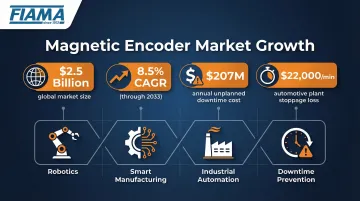
US industrial sectors increasingly prefer magnetic encoders over optical variants in applications like food and beverage processing, mining, packaging, and heavy machinery—industries where contamination and mechanical shock are constant concerns. The magnetic encoder market is projected to grow at a CAGR of 8.5% through 2033, reaching $2.5 billion globally, fueled by rapid adoption in robotics, smart manufacturing, and the high cost of unplanned downtime from component failure.
That growth has brought more suppliers into the market, which makes choosing the right one harder, not easier. When evaluating manufacturers, look beyond brand name and weigh:
- IP ratings — protection against dust and moisture ingress
- Lead times — availability from stock versus long factory lead times
- Application engineering support — whether the supplier's team can help spec the right unit for your environment
Top 10 Magnetic Encoder Manufacturers in the US
These 10 companies were selected based on product range, US market presence, application versatility, certifications, technical support quality, and customer trust across industrial sectors. The list is not ranked by preference — use the key differentiators and industry focus under each entry to identify the best fit for your application.
Dynapar Corporation
Dynapar, headquartered in Gurnee, Illinois, is a well-established US manufacturer offering both optical and magnetic incremental rotary encoders designed for rugged applications including material handling, packaging, and mining.
Key differentiators:
- AR62/AR63 series rated for 200g shock and 20g vibration
- Operating temperature range: -40°C to +100°C
- IP69K submersible sealing options for washdown environments
- Shafted, hollow-shaft, and hub-shaft configurations available across the magnetic encoder lineup
| Feature | Details |
|---|---|
| Encoder Types Offered | Magnetic and optical incremental rotary encoders, resolvers |
| Key Industries Served | Material handling, packaging, mining, heavy machinery, wind power |
| Certifications / Standards | CE, RoHS, ISO 9001:2015 |
Sensata Technologies
Sensata Technologies, headquartered in Massachusetts, is a global sensor manufacturer with strong US presence offering magnetic and optical position sensing solutions for industrial automation, transportation, and aerospace markets.
Key differentiators:
- LP35 series features ATEX, IECEx, and cULus certifications for hazardous locations
- SIL3/PLe functional safety ratings for safety-critical applications
- AHM/GHM absolute encoder series supports CANopen, SSI, and analog output interfaces
- High-volume OEM fulfillment supported by global production capacity
| Feature | Details |
|---|---|
| Encoder Types Offered | Magnetic and optical incremental encoders, absolute encoders (AHM/GHM series) |
| Key Industries Served | Automotive, aerospace, industrial automation, transportation, hazardous areas |
| Certifications / Standards | ISO, UL, ATEX, IECEx, SIL3/PLe |
Encoder Products Company (EPC)
EPC, based in Idaho, is a US manufacturer specializing in high-precision rotary encoders—including magnetic configurations—for industrial automation, motor control, and robotics, with most products designed and assembled domestically.
Key differentiators:
- In-house US manufacturing ensuring quality consistency and fast lead times
- Model 30M Accu-Coder® offers resolutions up to 1024 CPR with IP69K sealing
- Available in shafted, hollow-shaft, and bearingless designs
- Proven track record in harsh industrial environments
| Feature | Details |
|---|---|
| Encoder Types Offered | Magnetic and optical incremental/absolute rotary encoders (Accu-Coder® series) |
| Key Industries Served | Industrial automation, motor control, robotics, packaging |
| Certifications / Standards | ISO 9001:2015, CE, RoHS |
US Digital
US Digital, based in Vancouver, Washington, is a domestic encoder manufacturer known for broad optical and magnetic encoder portfolios, with a focus on OEM flexibility, modular design, and strong technical support for North American customers.
Key differentiators:
- M3K series operates -40°C to +100°C with resolutions up to 8,192 CPR
- MAE3 absolute magnetic encoder provides 10-bit or 12-bit PWM output
- Extensive configuration options (shaft sizes, resolutions, output signals)
- Two-year warranty and RoHS compliance
| Feature | Details |
|---|---|
| Encoder Types Offered | Magnetic and optical incremental rotary encoders, kit encoders, absolute encoders |
| Key Industries Served | CNC machinery, medical devices, robotics, automation, 3D printing |
| Certifications / Standards | RoHS, two-year warranty |
MTS Sensors (Temposonics)
MTS Sensors, headquartered in Cary, North Carolina, specializes in high-precision magnetostrictive linear position sensors and magnetic sensing solutions used in hydraulic, automation, and industrial process control applications across the US.
Key differentiators:
- Proprietary Temposonics® magnetostrictive technology provides absolute position feedback without homing cycles
- TH SSI Series offers resolution down to 0.5 µm with linearity better than ±0.01%
- Extensive hazardous area approvals: ATEX, IECEx, CEC, NEC, SIL
- Exceptional repeatability of < ±0.001% for critical applications
| Feature | Details |
|---|---|
| Encoder Types Offered | Magnetostrictive linear position sensors, magnetic absolute encoders |
| Key Industries Served | Hydraulics, industrial automation, process control, mobile machinery |
| Certifications / Standards | ATEX, IECEx, CEC, NEC, SIL, IP67/IP69K |
Renishaw (US Operations)
Renishaw, a UK-based global leader with significant US operations and distribution, manufactures ultra-precision magnetic and optical linear/rotary encoders used in high-accuracy applications from machine tools to scientific instrumentation.
Key differentiators:
- LM10 series features IP68 sealing with speeds up to 80 m/s
- Selectable resolutions from 0.244 µm to 250 µm
- Traceable calibration standards and sub-micron resolution magnetic scale technology
- Extensive application engineering support in the US
| Feature | Details |
|---|---|
| Encoder Types Offered | Magnetic and optical linear/rotary encoders (RESOLUTE™, TONiC™, LM10 series) |
| Key Industries Served | Machine tools, semiconductor, medical, scientific instrumentation |
| Certifications / Standards | ISO 9001:2015, CE, RoHS |
Celera Motion (Novanta Group)
Celera Motion, part of the US-headquartered Novanta Group based in Massachusetts, develops high-resolution encoder solutions—including inductive encoders often evaluated alongside magnetic types—for precision motion feedback in semiconductor equipment, medical imaging, and advanced robotics.
Key differentiators:
- IncOder series inductive encoders provide absolute position feedback in extreme environments
- Designed for thermal stability and low signal noise in high-cycle semiconductor and medical applications
- Custom engineering support available for tight-tolerance motion control integration
- Resolutions and form factors configurable for OEM-specific designs
| Feature | Details |
|---|---|
| Encoder Types Offered | High-resolution inductive and optical rotary/linear encoders |
| Key Industries Served | Semiconductor, medical imaging, robotics, advanced automation, Satcom |
| Certifications / Standards | CE, RoHS, medical and industrial standards compliance |
CUI Devices
CUI Devices, a US-based manufacturer operating as Same Sky, offers capacitive encoders (AMT Series) designed as rugged alternatives to magnetic encoders in industrial automation, instrumentation, and motion control—valued for competitive pricing and ease of integration.
Key differentiators:
- AMT series capacitive technology offers ruggedness comparable to magnetic encoders with higher accuracy
- Immunity to magnetic noise and contamination
- Multiple resolution and output type options
- Strong technical documentation and design resources
| Feature | Details |
|---|---|
| Encoder Types Offered | Capacitive incremental/absolute encoders (AMT Series), encoder accessories |
| Key Industries Served | Industrial automation, instrumentation, OEM motion control, renewable energy |
| Certifications / Standards | RoHS, CE |
Nidec Avtron (Nidec Group)
Nidec Avtron, part of the Japanese-owned Nidec Group with strong US operations in Cleveland, Ohio, manufactures heavy-duty, absolute, and hazardous-duty encoders—including magnetic variants—for demanding industrial plant environments across North America.
Key differentiators:
- M6C encoder features ATEX Zone 1 and IECEx certifications with IP66 rating
- SMARTSafe™ Series: world's first modular, bearingless explosion-proof encoders
- Purpose-built designs for steel mills, paper mills, oil & gas
- Strong US service network for heavy industry applications
| Feature | Details |
|---|---|
| Encoder Types Offered | Heavy-duty magnetic and optical incremental/absolute encoders, hazardous-duty encoders |
| Key Industries Served | Steel/paper mills, oil & gas, mining, industrial plants, drilling |
| Certifications / Standards | ATEX, IECEx, cULus, CSA, IP66 |
FIAMA US
FIAMA US, headquartered in Luling, Louisiana, is the North American distribution arm of Italy-based F.I.A.M.A. S.r.l., offering a focused lineup of Italian-engineered magnetic encoders and industrial measurement components—selected for superior build quality at competitive price points.
Key differentiators:
- All products are Italian-made to ISO 9001 quality standards (certified since January 24, 2001)
- Team composed entirely of degreed engineers (not commissioned sales staff)
- Extensive inventory for short lead times across North America
- Focused product line ensures deep expertise in every component supported
- EN series hollow shaft encoders available with IP67 weather-resistant ratings
- MAT absolute encoders support linear measurement up to 40 meters
| Feature | Details |
|---|---|
| Encoder Types Offered | Italian-made magnetic encoders (EN series rotary, MAT absolute linear), draw wire encoders, precision measurement components |
| Key Industries Served | Food & beverage, pharmaceutical, semiconductor, packaging, robotics, automotive |
| Certifications / Standards | ISO 9001 Quality Management System (certified since January 24, 2001), RoHS, EMC Directive 2014/30/UE |
How We Chose the Best Magnetic Encoder Manufacturers
Companies were assessed on US market accessibility (domestic manufacturing or established US distribution), product range covering both rotary and linear magnetic encoder types, quality certifications, application versatility, and evidence of engineering support—not marketing reputation alone.
Choosing based on brand name without checking lead times, support depth, or environmental ratings leads to mismatched specs and premature failures. Each company below was evaluated against five specific criteria:
- Encoder type coverage: Does the supplier offer incremental and absolute variants in both rotary and linear form factors? Gaps here force you into workarounds or secondary vendors.
- Environmental ratings: IP67 minimum for general industrial use, IP69K for washdown environments, operating range of -40°C to +100°C, and shock tolerance up to 200g for heavy-duty installations.
- Quality certifications: ISO 9001 confirms manufacturing consistency. ATEX/IECEx certification matters for hazardous locations. SIL ratings are required for safety-critical machine control.
- Availability and lead time: Domestic manufacturing or confirmed US inventory stock — not just catalog listings with 16-week import lead times.
- Application engineering support: Direct access to degreed engineers for specification and integration support, not a sales team routing questions to a generic tech line.
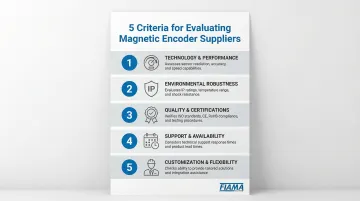
If a supplier can't clearly answer questions on items 2, 3, and 5, that's a signal to move on before spec'ing them into a project.
Conclusion
The right magnetic encoder partner should align with the specific demands of your application environment—not just offer the broadest catalog. Factors like IP rating, encoder type, lead time, and engineering expertise often matter more than brand prestige, particularly in high-uptime environments where unexpected failures carry serious cost consequences.
Shortlist two or three suppliers from this list, request datasheets or samples, and evaluate application fit before committing. Beyond initial specs, consider long-term factors: spare parts availability, technical support continuity, and production scalability as your operation grows.
For buyers across North America who need Italian-made, ISO 9001-certified magnetic encoders supported by a non-commissioned engineering team, FIAMA US is worth a direct conversation. Reach out at info@fiama-us.com or call 504-352-0986 to discuss your application requirements.
Frequently Asked Questions
What are the 4 types of encoders?
The four main encoder types are incremental, absolute, linear, and rotary. Incremental encoders count pulses from a reference point and require homing after power loss, while absolute encoders provide a unique position value at all times. Both designs come in linear (straight-line) or rotary (shaft-angle) form.
How accurate is a magnetic encoder?
Magnetic encoder accuracy typically ranges from ±0.1° to ±1° depending on the technology, calibration, and mounting configuration. High-end magnetic encoders with built-in correction can approach optical encoder precision (modern units achieve up to 20-bit resolution) while retaining superior environmental durability.
What is the difference between a magnetic encoder and an optical encoder?
Optical encoders use light and a code disc for higher baseline resolution but are sensitive to contamination. Magnetic encoders use magnetic fields and are inherently resistant to dust, moisture, and shock—making them the preferred choice in harsh industrial environments despite a generally lower resolution ceiling.
What industries use magnetic encoders most in the US?
Magnetic encoders are widely used in food and beverage processing, pharmaceutical manufacturing, packaging, material handling, mining, robotics, and automotive manufacturing—industries where contamination, moisture, or vibration would compromise optical encoder performance.
What IP rating should I look for in an industrial magnetic encoder?
IP67 (dust-tight, temporary immersion) is the minimum for most industrial environments; washdown or outdoor applications typically require IP69K, which handles high-pressure, high-temperature cleaning at close range. Always confirm the rating covers the full encoder assembly, not just the sensor element.
What is the difference between incremental and absolute magnetic encoders?
The key difference is what happens after a power loss: incremental encoders require a homing cycle to re-establish position, while absolute encoders retain their position value without re-referencing. Absolute types are the standard choice for safety-critical or restart-sensitive applications like robotics and medical equipment.