Rotary encoders play a critical role in modern automation and motion-control systems, serving as the eyes and ears for machines that need to track rotational movements. From robotics and CNC machines to medical equipment and satellite systems, these devices provide precise position feedback that ensures smooth, reliable, and safe operations across various industries.
At the heart of every rotary encoder is the ability to convert mechanical rotation into electrical signals, enabling machines to detect position, speed, direction, and even trends in movement. However, choosing the right encoder goes beyond just technical specifications; it is a decision that will impact your system's performance, durability, and efficiency over time.
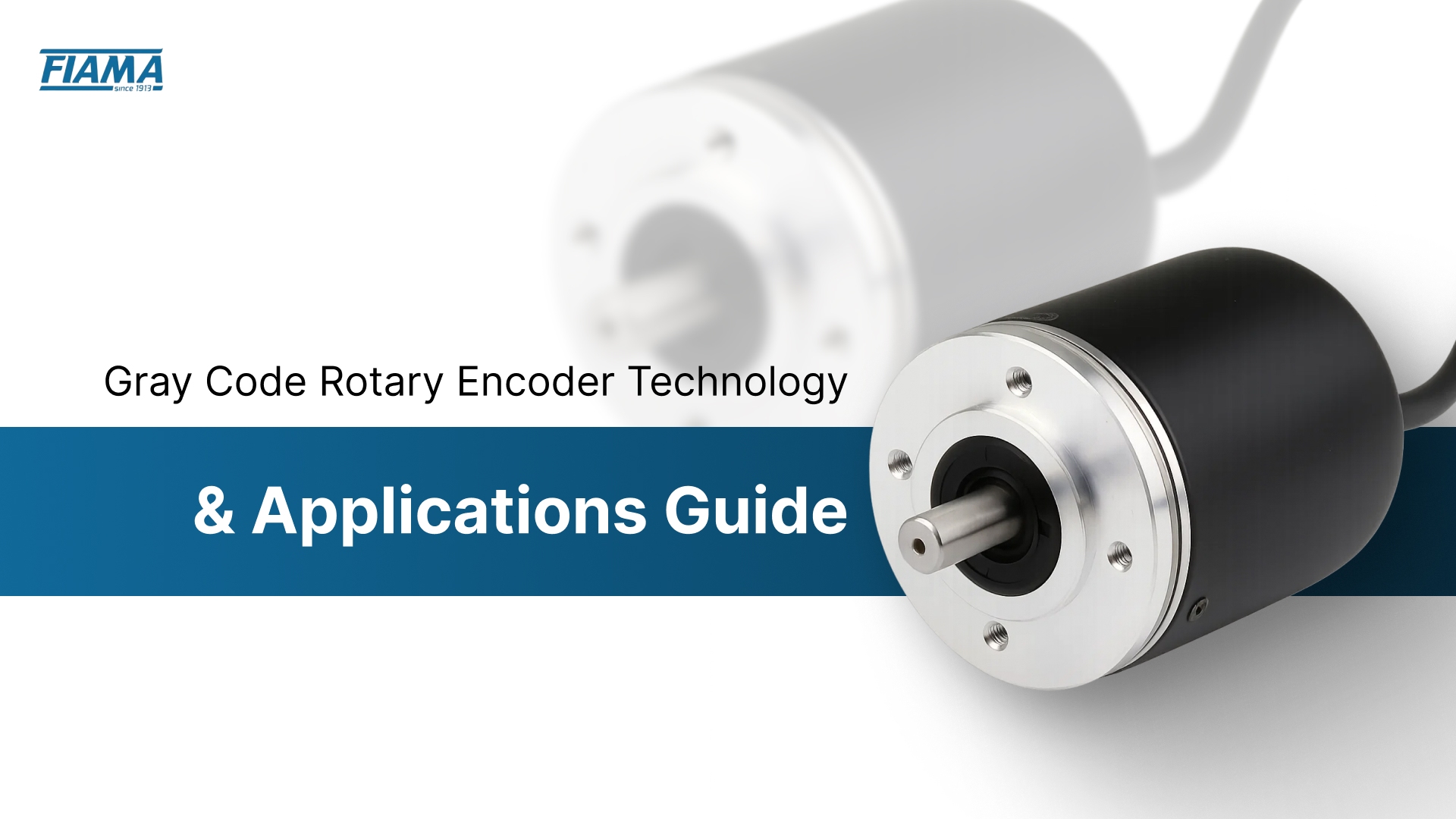
In this guide, we’ll walk you through the essential aspects of rotary encoders, from understanding the different types and sensing technologies to diving deep into Gray Code and its significance in ensuring accuracy.
At a Glance:
Rotary Encoders: Critical for precision in automation systems like robotics, CNC, and medical devices, converting rotational movement into accurate position feedback.
Encoder Types:
Incremental: Best for basic speed and direction control, requires homing after power-up.
Absolute: Provides unique position data, ideal for high-precision applications, even after power loss.
Sensing Technologies:
Optical: High precision, but sensitive to dust and moisture.
Magnetic: Durable, suitable for harsh environments.
Mechanical: Cost-effective, used in simple applications.
Gray Code: Ensures accurate position feedback by minimizing errors, crucial for high-speed, high-resolution systems.
Buyer Considerations: Choose based on precision needs, environment, and system compatibility.
Common Mistakes: Avoid using optical encoders in harsh environments and ensure proper encoder alignment.
Types by Output: Incremental vs. Absolute
Understanding the distinction between incremental and absolute output types is one of the most important steps when selecting a rotary encoder. These two encoder families operate differently, provide different kinds of information, and are suited for very different applications. Incremental encoders generate pulses based on relative movement, making them a strong fit for speed monitoring and basic motion control, while absolute encoders provide a unique digital value for every shaft position, ensuring precise and immediate position awareness even after power loss.
Choosing the right type impacts system accuracy, startup behavior, safety, and integration with controllers or PLCs. For buyers, this comparison helps determine whether the application requires simple motion tracking or exact, power-independent position feedback.
Incremental Encoders
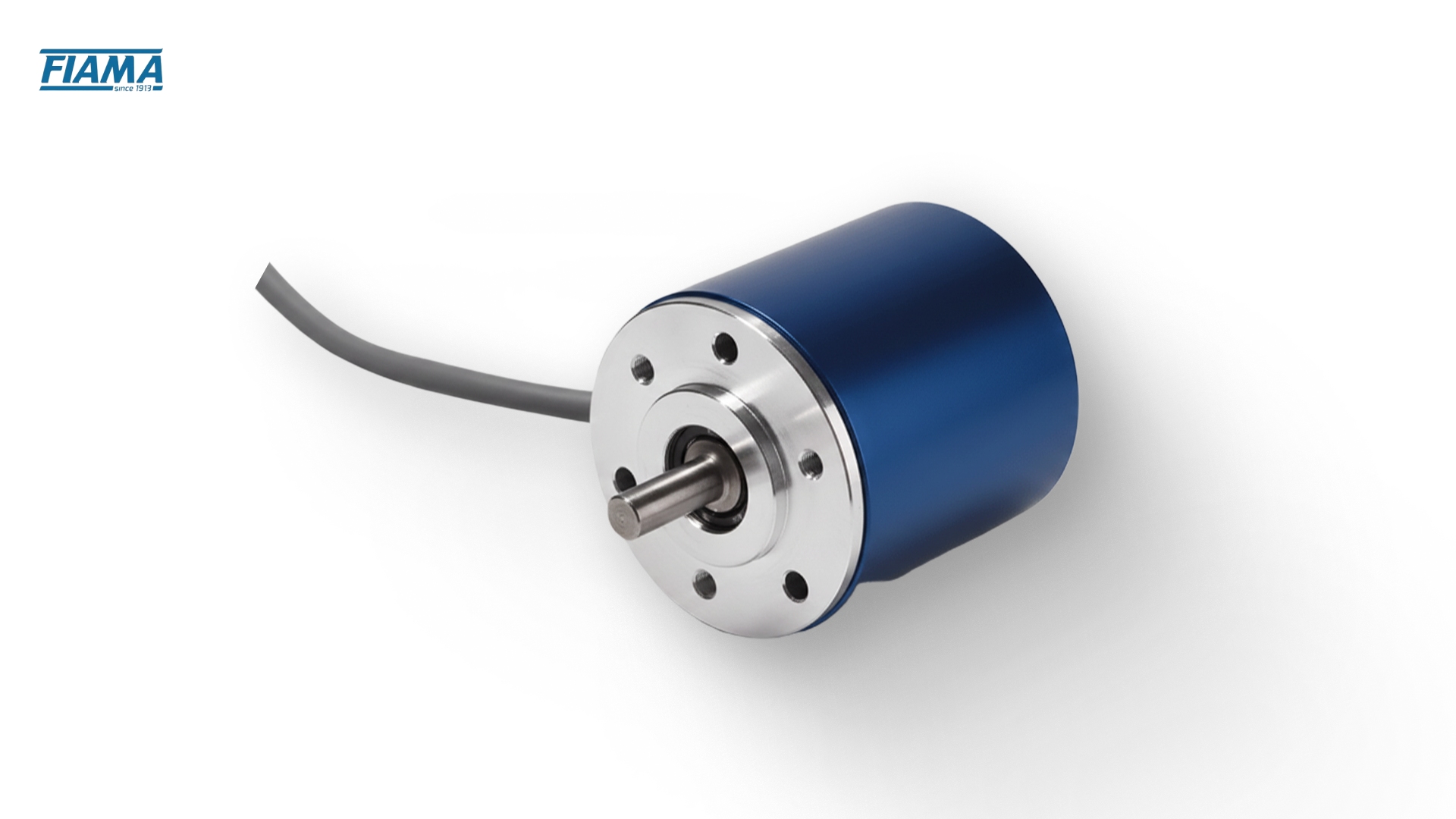
Incremental encoders are designed to track motion by generating pulses during shaft rotation. They are widely used in systems that need speed or directional feedback rather than absolute positioning.
Output pulses as the shaft moves
The encoder produces a series of equally spaced electrical pulses. Each pulse represents a small amount of rotation, allowing the controller to calculate speed and movement as long as the shaft is in motion.Provide the relative position only
They do not store or identify an exact angular position. Instead, they measure how far the shaft has moved from a reference point, which makes them suitable for simple motion tasks.Require homing after startup
Because the encoder does not know its position when powered on, the system must move to a predefined reference point (home) to establish a starting position.Ideal for cost-effective and simple motion-control systems
Their straightforward design, lower cost, and high-speed capability make them popular in conveyors, general automation, and basic motor-control applications.
Absolute Encoders
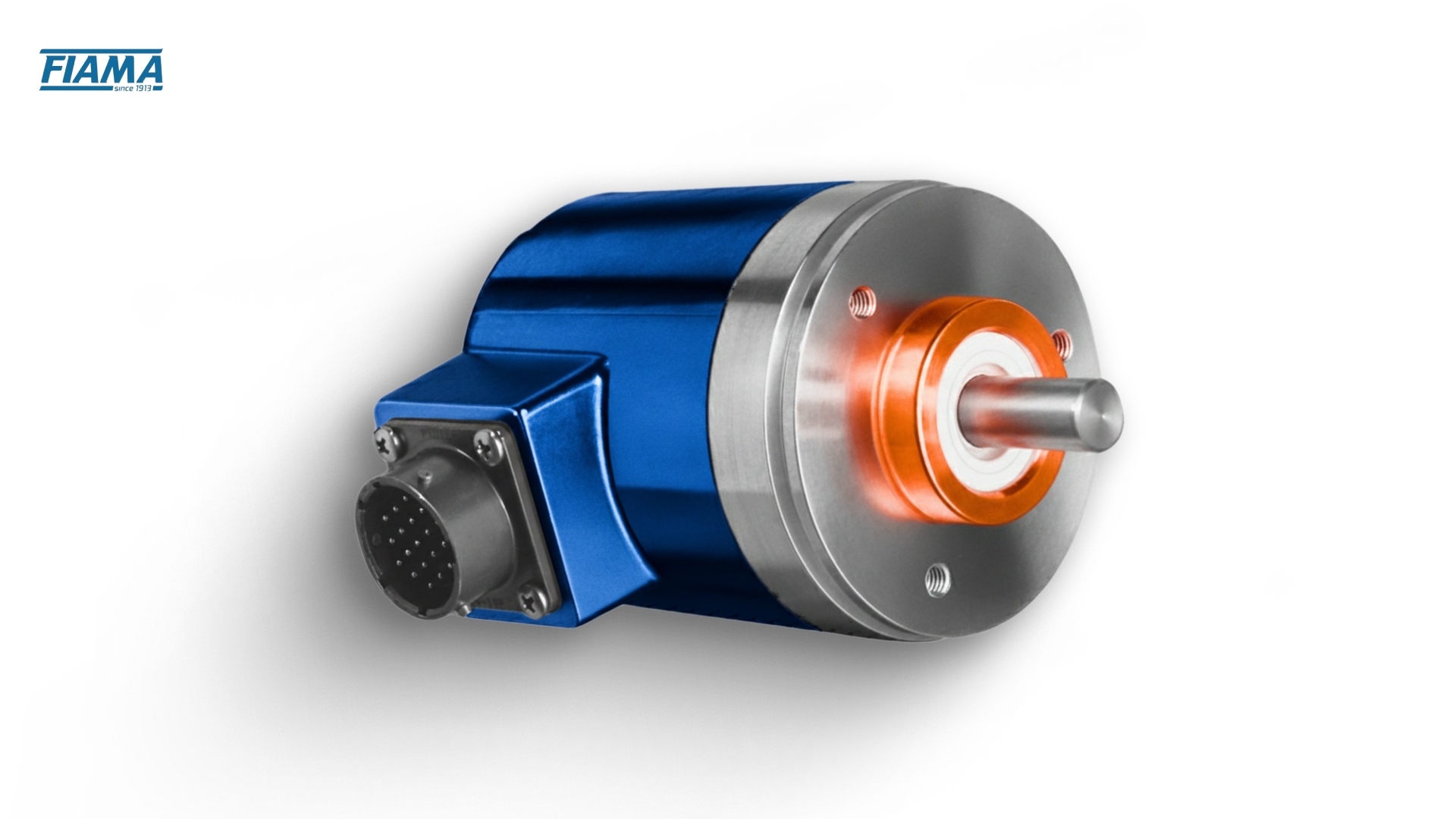
Absolute encoders deliver a unique digital value for each shaft position, ensuring precise, immediate position feedback at all times, even after power cycles.
Output a unique digital code for every shaft position
Each angle corresponds to a fixed digital value, allowing the controller to know the exact position at any moment without movement.Retain position after power loss
Because each position has its own digital pattern, the encoder does not lose track of where it is when power is removed and restored.Do not require homing
The system starts with correct position information immediately, reducing startup time and eliminating potential errors from missed homing steps.Ideal for robotics, CNC, medical devices, aerospace, and safety-critical systems
Any application requiring precise, reliable, and continuous feedback benefits from absolute encoders, especially those where safety, accuracy, or recovery after power loss is essential.
Sensing Technology: Optical, Magnetic, Mechanical Conductive
The sensing technology used inside an encoder determines its accuracy, durability, and environmental resistance. Each technology has strengths suited to specific industrial and commercial conditions.
Optical Encoders
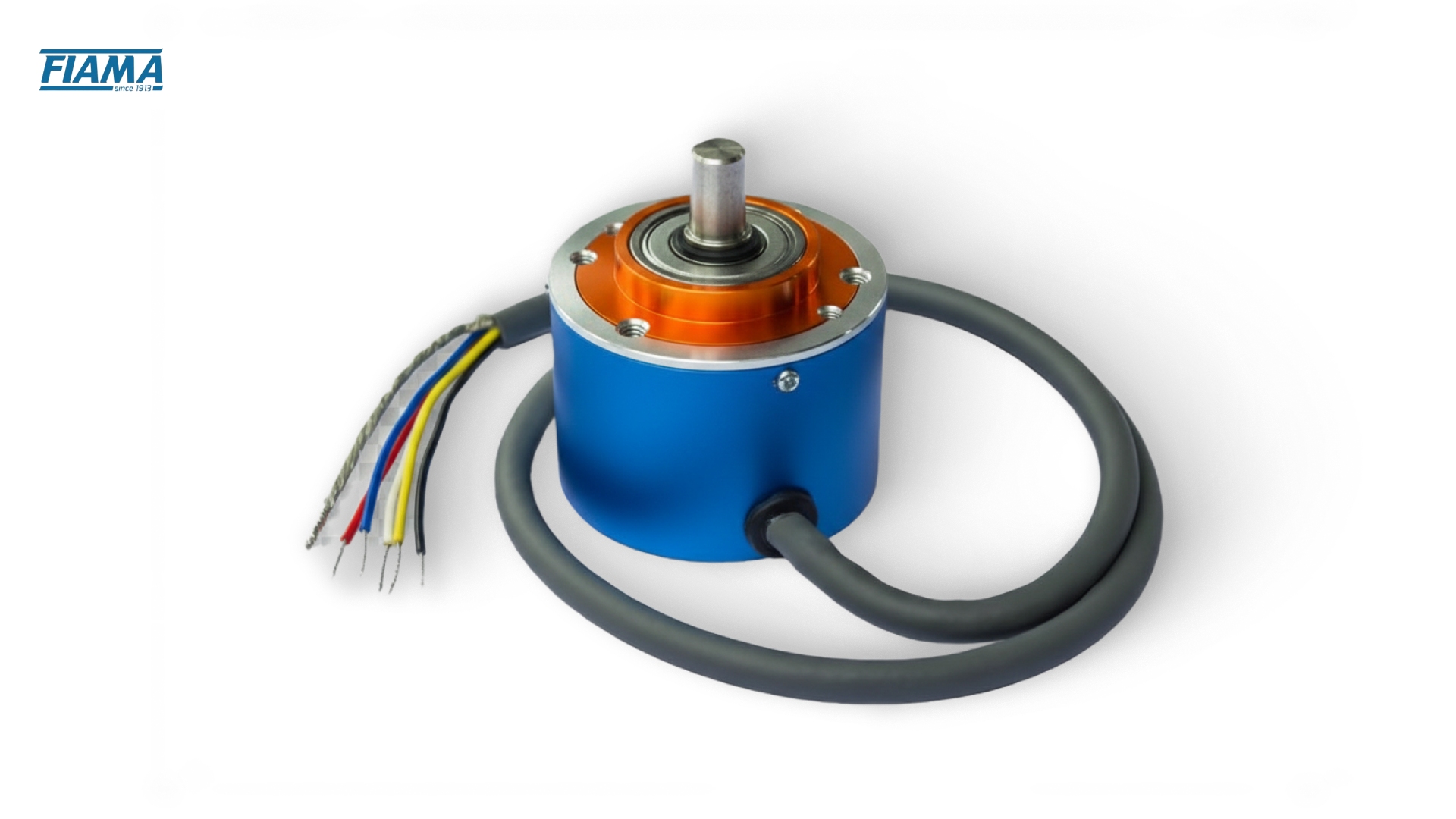
Optical encoders are known for delivering high resolution and accuracy, making them a top choice for precision equipment operating in clean environments.
Use an LED, a photodetector, and a patterned disc
A light beam passes through or reflects off a coded disc, and sensors interpret the interruptions as motion signals.Offer high precision and high resolution
Optical detection provides extremely fine detail, making it suitable for CNC machines, inspection systems, and robotic joints requiring exact positioning.Sensitive to dust, moisture, and oil
Contaminants can block or distort the light path, causing errors or failure, so they are best used in controlled or well-protected environments.
Magnetic Encoders
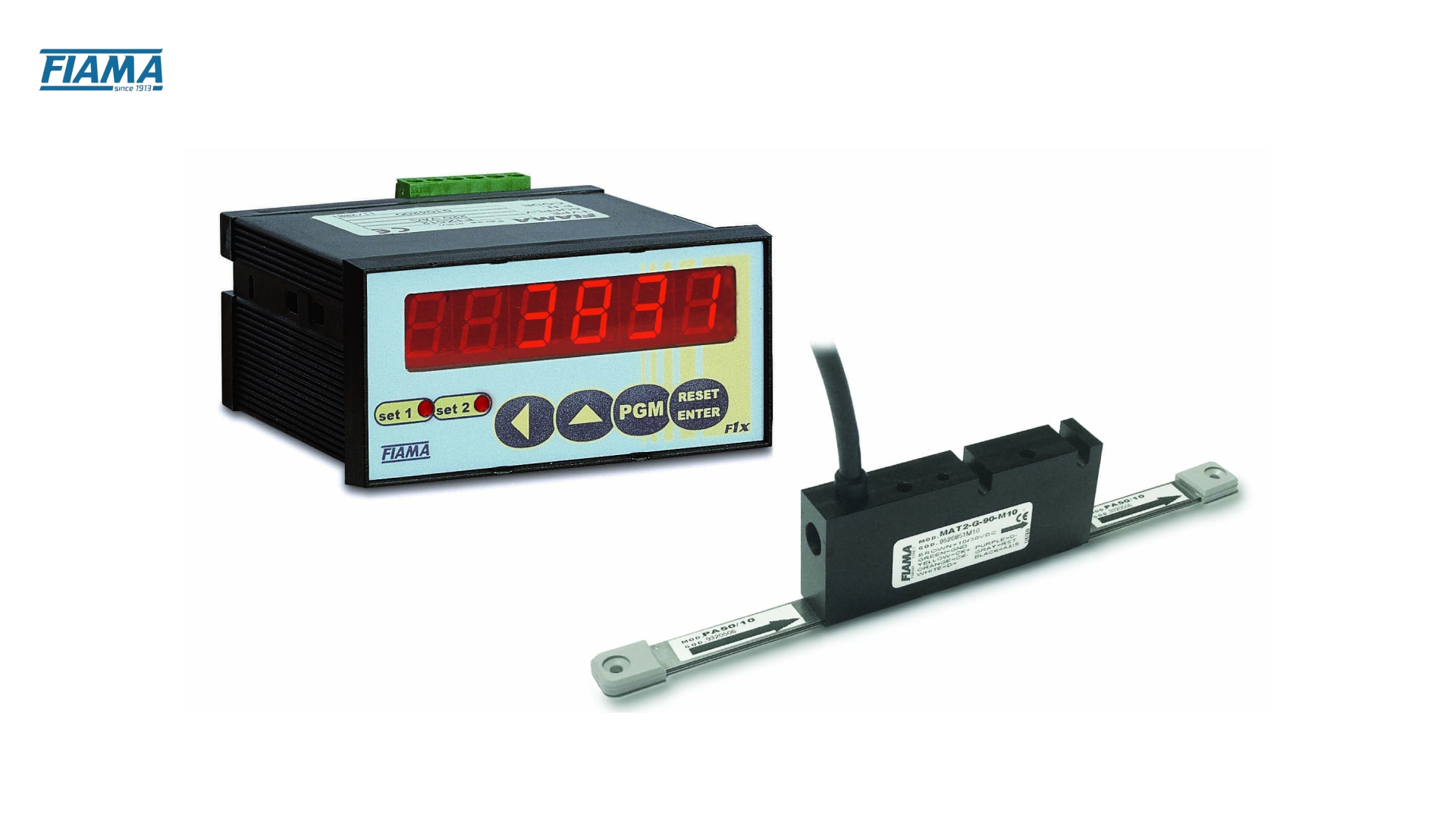
Magnetic encoders provide strong performance in harsh settings. They are less sensitive to dirt and physical stress, making them ideal for industrial and outdoor environments.
Use magnetic poles and Hall or AMR sensors
These sensors detect changes in magnetic fields as the shaft rotates, converting them into position or speed signals.Highly resistant to dirt, vibration, shock, and outdoor conditions
Magnetic sensing continues to operate reliably even under mechanical stress, dust, temperature changes, or moisture exposure.Strong choice for industrial, mobile, or harsh environments
They are often used in factory automation, heavy machinery, mobile equipment, and applications exposed to the elements.
Mechanical or Conductive Encoders
Mechanical or conductive encoders offer an economical solution for simple human-interface or low-speed applications where high precision is not required.
Cost-effective and simple
Their direct-contact design makes them inexpensive to produce and easy to integrate into basic control interfaces.Lower precision and shorter lifespan
Because they rely on physical contact, they wear out faster and cannot match the accuracy of optical or magnetic encoders.Common in consumer devices and low-speed interfaces
They are widely used in volume knobs, menu selectors, household equipment, and other low-duty applications
Why Choose Gray Code Rotary Encoders?
Gray Code is specifically designed to enhance accuracy and reliability in systems that measure position. Since only one bit changes between successive values, the risk of reading invalid or mixed bit states during transitions is dramatically reduced.
This is especially important for absolute encoders, which must report the correct position at all times, even during startup, rapid rotation, or in environments where precision and safety are critical.
By eliminating multi-bit switching errors, Gray Code ensures stable, predictable, and error-resistant performance across a wide range of demanding applications.
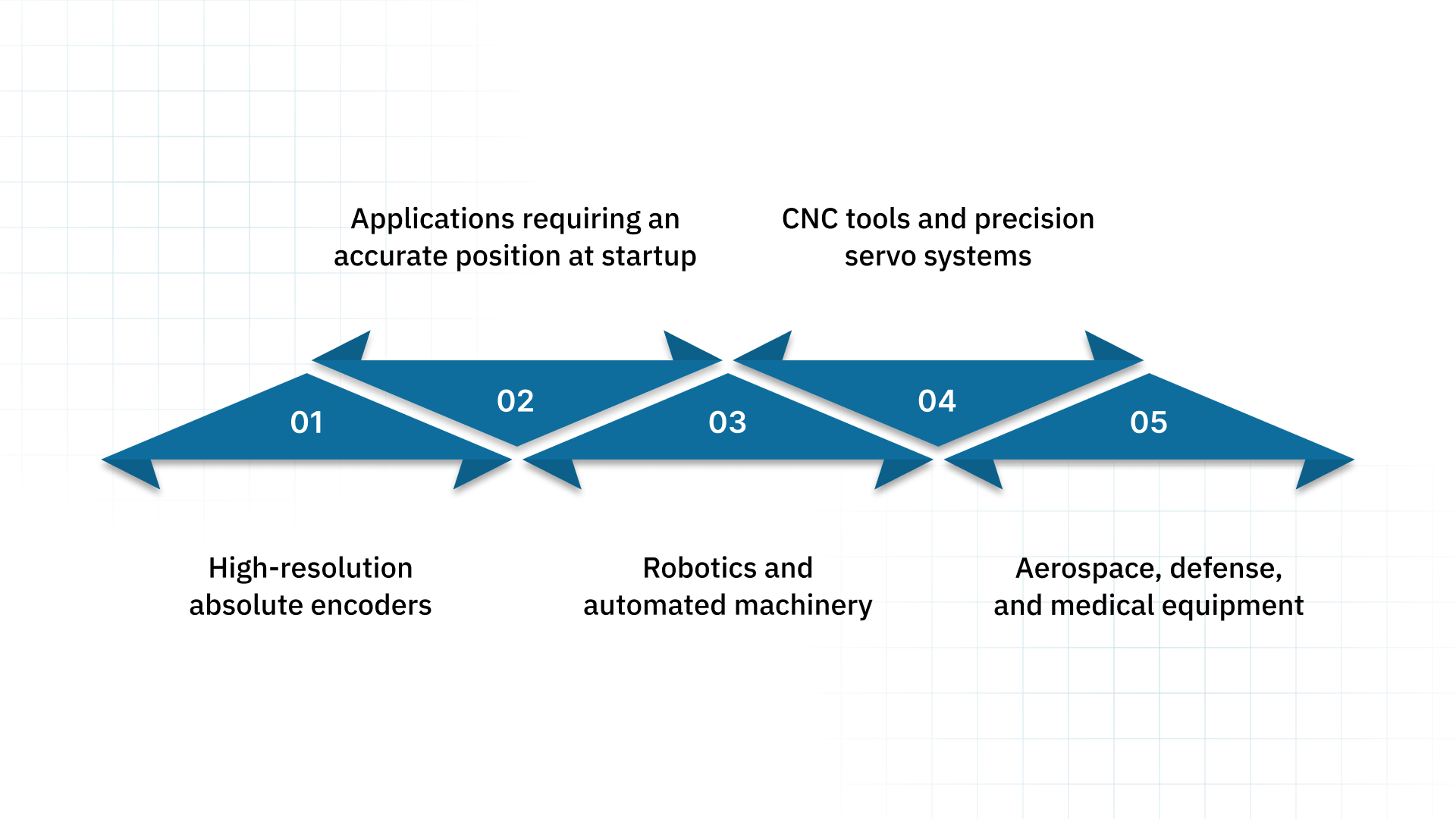
High-resolution absolute encoders
High-resolution encoders have many small steps per revolution, which increases the number of transitions between digital codes. In binary encoding, this raises the chance of reading errors because several bits may switch simultaneously. Gray Code prevents these multi-bit errors, ensuring cleaner transitions and more dependable output, even at extremely fine resolutions.
Applications requiring an accurate position at startup
Absolute encoders must provide the correct position immediately when powered on. If the encoding scheme produces ambiguous bit patterns, the system may misinterpret the initial position. Because Gray Code eliminates invalid intermediate states, the encoder always starts with a clean, accurate reading, critical for machines that must resume operation safely after shutdown or power loss.
Robotics and automated machinery
Robotic joints, actuators, and automated assembly systems rely on precise position data for smooth and coordinated motion. Any misread can cause jitter, misalignment, or even collisions. Gray Code helps maintain consistent and accurate position feedback, improving motion stability and overall system reliability.
CNC tools and precision servo systems
CNC machines and servo-driven equipment depend on exact, real-time position control. Small encoder errors can negatively affect surface finish, toolpaths, and dimensional accuracy. Gray Code keeps position readings stable even at high speeds or during rapid directional changes, enhancing machining precision and reducing the chance of defects.
Aerospace, defense, and medical equipment
These industries require the highest levels of safety and reliability. Incorrect position data can compromise mission-critical functions or patient safety. Gray Code’s one-bit-change property minimizes failure modes, ensuring consistent and predictable sensor output under vibration, high speed, and strict safety conditions, making it the preferred encoding standard for high-stakes environments.
If accuracy, reliability, or safety is a priority, Gray Code is the recommended choice for absolute encoders.
What to Evaluate When Buying a Rotary Encoder: Buyer’s Checklist?
Choosing the right rotary encoder requires more than just picking a resolution or shaft size. A well-informed buyer considers performance demands, environmental conditions, electrical compatibility, and long-term reliability. This checklist helps ensure that the encoder you select matches your application requirements, avoids common specification mistakes, and delivers consistent performance throughout its service life.
Use it as a step-by-step guide during evaluation, procurement, or engineering design.
Type (Absolute or Incremental)
Start by determining the level of positional information your system needs.
Absolute: Provides exact position immediately at power-up, eliminating homing. Best for robotics, CNC, automated machinery, and any safety-critical system.
Incremental: Provides pulses indicating relative movement. Suitable for cost-effective speed measurement, conveyor control, and simpler automation where homing is acceptable.
Sensing Technology
Choose the sensing method that aligns with your environment and accuracy expectations.
Optical: High accuracy and high resolution. Ideal for clean, indoor environments where contamination is minimal.
Magnetic: Highly resistant to dust, oil, moisture, shock, and vibration. A strong choice for harsh, industrial, outdoor, or mobile applications.
Mechanical/Conductive: Budget-friendly and simple. Works for low-speed consumer interfaces or basic adjustment knobs.
Resolution or CPR (Counts Per Revolution)
Ensure the encoder provides the precision your application demands.
Higher CPR/resolution yields finer motion control, better positioning accuracy, and smoother velocity feedback.
Avoid overspecifying, as extremely high resolution may increase cost and processing requirements without real benefit.
Mechanical Interface
Verify that the encoder physically fits and aligns with your system.
Choose between solid shaft and hollow shaft depending on your design.
Select a mounting style: flange, clamp, synchro, or servo mounts.
Confirm shaft diameter, coupling method, and allowable misalignment to avoid premature wear, vibration, or encoder failure.
Environmental Tolerance
Make sure the encoder can withstand the operating conditions.
Review IP ratings for dust/water sealing.
Check temperature limits to ensure stable operation.
Evaluate resistance to vibration, shock, moisture, chemicals, or oil if expected.
Selecting the correct environmental protection directly impacts reliability and service life.
Output Format
Select the electrical interface your controller or PLC supports.
Options include parallel, serial, analog, TTL/HTL signals, and communication standards like Gray Code, SSI, CANopen, BiSS-C, or others.
Ensure compatibility with cable lengths, signal levels, and data rates required by your system.
Electrical Requirements
Prevent electrical noise, misreadings, or component damage through proper matching.
Confirm supply voltage range, grounding method, and shielding quality.
Verify EMC/EMI compatibility to ensure stable signals in electrically noisy environments such as motors or inverters.
Maintenance and Durability
Evaluate long-term reliability based on usage intensity and environment.
Mechanical encoders may require periodic inspection or have shorter lifespans.
Optical encoders can fail if contamination builds up.
Magnetic encoders often require minimal maintenance and offer longer durability.
Understanding potential failure modes helps plan service schedules and avoid downtime.
Use-Case Examples: Matching Encoder Types to Applications
In industrial and automation systems, selecting the right encoder type is crucial for ensuring accurate motion feedback and system performance. Different applications demand specific encoder features to optimize precision, durability, and efficiency.
Let's look at the following:
Application | Recommended Encoder Type and Notes |
Industrial automation and conveyors | Incremental encoder, optical or magnetic, moderate resolution |
Robotics and joint actuators | Absolute encoder using Gray Code, optical or magnetic, depending on the environment |
CNC machines and precision manufacturing | High-resolution absolute encoder, sealed or rugged for contamination resistance |
Medical imaging and surgical robots | Absolute encoder with Gray Code and high reliability standards |
Aerospace and satellite positioning | Rugged absolute encoder, magnetic or sealed optical type |
Consumer electronics and control knobs | Incremental mechanical encoder for simple control inputs |
Common Mistakes Buyers Should Avoid
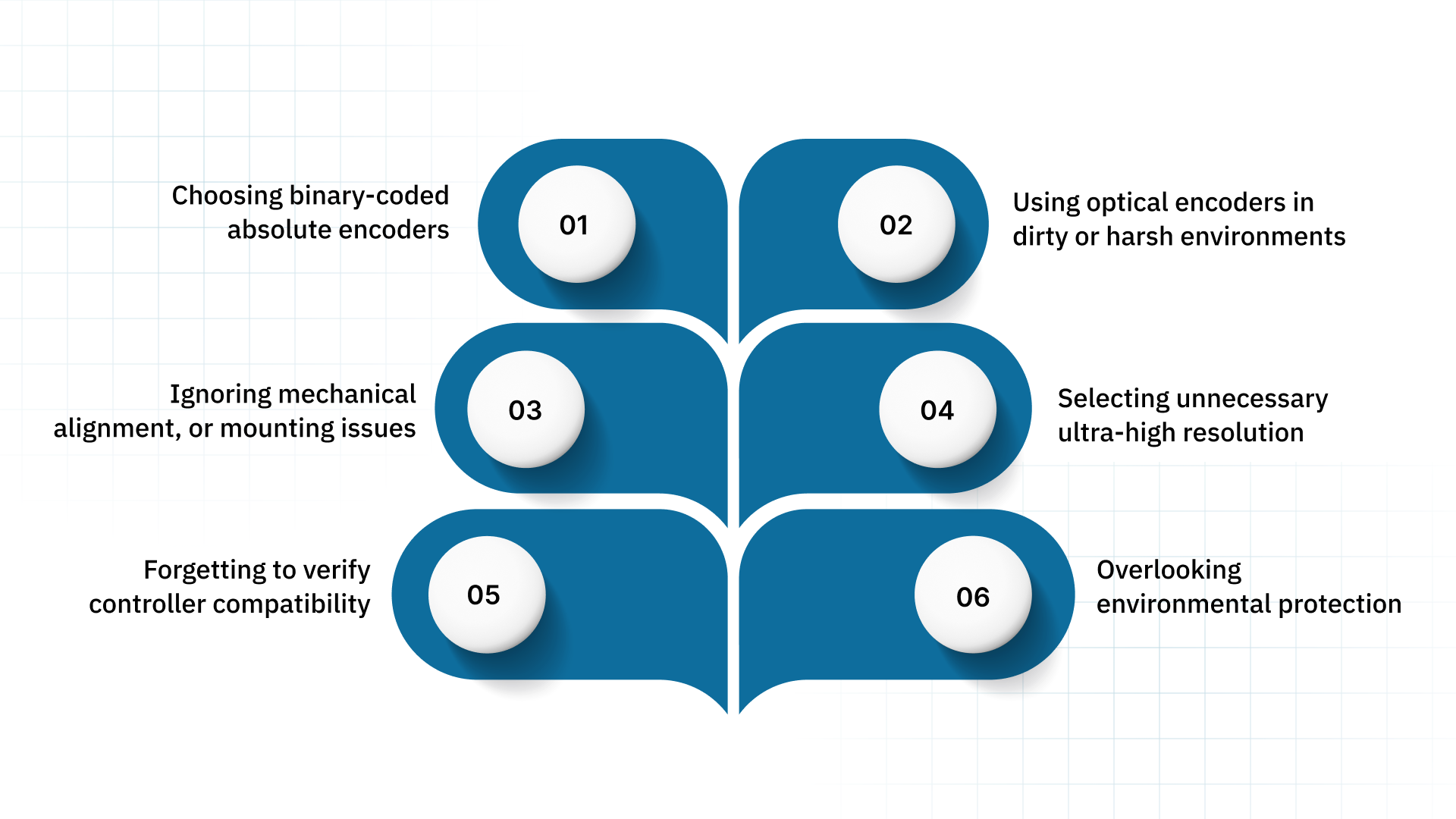
Many encoder failures and performance issues can be traced back to specification mistakes made during selection. Even experienced buyers sometimes overlook critical details such as coding format, environmental conditions, mounting accuracy, or controller compatibility.
Let's look at the pitfalls buyers should stay watchful of:
Choosing binary-coded absolute encoders instead of Gray Code for high-resolution needs
Binary encoding changes multiple bits at once when crossing certain position boundaries, which increases the risk of misreads in high-resolution or high-speed systems.
Gray Code, on the other hand, changes only one bit at a time, offering far greater stability and reliability. Selecting binary for high-accuracy applications can lead to position jumps, false counts, and increased system errors.
Using optical encoders in dirty or harsh environments
Optical encoders deliver excellent precision but are sensitive to dust, oil, moisture, vibration, and shock. When used in harsh environments, contaminants can block or distort the optical path, causing erratic signals or total sensor failure.
Magnetic encoders or sealed rugged models are better suited for outdoor, industrial, or heavy-duty conditions.
Ignoring mechanical alignment, shaft stress, or mounting issues
Incorrect alignment, improper shaft coupling, or mounting stress can shorten encoder lifespan and produce inaccurate readings.
Common issues include:
Bent or misaligned shafts
Excessive radial or axial load
Loose or mismatched couplings.
Ensuring proper mounting, alignment, and shaft compatibility reduces mechanical wear and prevents premature failure.
Selecting unnecessary ultra-high resolution and increasing costs
Higher resolution is not always better. Ultra-high CPR encoders increase cost, processing load, and sometimes noise sensitivity—without providing actual performance benefits in many applications.
Choose resolution based on real mechanical requirements, not on theoretical maximums.
Forgetting to verify controller compatibility
Encoders may use different electrical interfaces, signal types, or communication protocols. If the controller cannot interpret the output, the encoder becomes unusable.
Verify compatibility for:
Voltage levels (TTL/HTL)
Communication standards (SSI, CANopen, BiSS-C, etc.)
Signal format (incremental, absolute, Gray Code)
Connector type and wiring arrangement
5. Overlooking environmental protection and sealing requirements
Failure to check IP ratings, temperature limits, chemical resistance, and moisture protection can lead to fast degradation or data errors.
In demanding environments, choosing insufficient protection reduces reliability and increases maintenance needs.
Always match the encoder’s environmental rating to the actual working conditions.
How Fiama’s Rotary Encoders Deliver Precision and Reliability for Your Applications?
Fiama has over 100 years of engineering and manufacturing experience. We understand the complexities involved in selecting the right rotary encoder for your system. With our extensive range of encoders, we can help you make the best choice based on your application’s specific needs, ensuring precision, reliability, and efficiency.
Let's look at how Fiama can help you:
Gray Code Rotary Encoders: Our absolute encoders with Gray Code technology are designed to minimize transition errors, ensuring smooth and reliable performance, even in high-speed and high-resolution applications.
Wide Range of Encoder Types: Whether you need incremental encoders for simple motion control or absolute encoders for high-precision, power-independent position feedback, FIAMA offers tailored solutions for every application.
Custom Solutions for Harsh Environments: With magnetic and rugged optical encoders, Fiama provides encoders that can withstand harsh conditions like dust, moisture, and vibration, ideal for industrial, outdoor, and mobile environments.
Expert Guidance: Our experts help you evaluate your project’s unique requirements, from sensing technology and resolution to environmental tolerance and electrical compatibility, ensuring the encoder you choose will perform flawlessly for years to come.
Summing Up
Choosing the right rotary encoder for your system is a crucial decision that directly impacts its performance, accuracy, and longevity. With a variety of encoder types, such as incremental and absolute, and different sensing technologies like optical, magnetic, and mechanical, understanding your application’s specific needs is essential for optimal performance.
As highlighted, Gray Code plays a vital role in applications requiring high precision, minimizing errors during transitions, and ensuring reliable position feedback. Whether your system is in robotics, CNC machines, medical devices, or heavy-duty industrial applications, the right encoder will ensure smooth operation, reduce downtime, and enhance safety.
Explore Fiama's range of high-precision industrial-grade encoders today to ensure reliable, accurate, and long-lasting performance in your projects. Contact us today.
FAQ
Do I always need Gray Code?
Gray Code is not always required. It is recommended for absolute encoders needing precise, error-free readings during transitions, high speeds, or high-resolution applications to ensure reliable position feedback.What encoder type is best for dusty or outdoor industrial environments?
Magnetic encoders with robust sealing and an appropriate IP rating are ideal. They resist dust, moisture, vibration, and shock, providing reliable performance in harsh industrial or outdoor conditions.How do I maintain position after powering off with an incremental encoder?
Incremental encoders provide relative movement only. To maintain accurate position after power-off, a homing routine must be performed at startup, referencing a known position for system synchronization.How do I choose a resolution?
Choose the lowest resolution that meets your application requirements. Higher resolution improves precision but may increase cost and processing demands; balance resolution with actual motion, speed, and accuracy needs.What are the trade-offs among optical, magnetic, and mechanical encoders?
Optical: highest precision
Magnetic: strongest environmental durability
Mechanical: lowest cost and simplest construction