Precision and reliability are non-negotiable in modern industrial operations. When equipment falls out of alignment or fails to provide accurate positional feedback, production slows, scrap increases, and maintenance costs rise. For procurement managers, plant heads, and operations leaders, even small inefficiencies in motion control can impact throughput, downtime, and overall operational costs
Encoders play a direct role in supporting those goals by capturing precise rotational data that helps machines maintain alignment, reduce scrap, and operate predictably. In fact, the demand for absolute rotary encoders is growing steadily worldwide, with the global market expected to reach USD 1999 million by 2032, at a CAGR of 4.7%.
In 2025–2026, industries are shifting toward encoders that do more than provide angular feedback. The latest models support advanced sensing, robust signal integrity, and industry-ready communication interfaces. For decision-makers, understanding which encoder type suits your application is essential for improving throughput and minimizing risk.
In this article, we’ll break down the best rotary absolute encoder types, sensing technologies, communication interfaces, and selection factors.
In a nutshell:
Rotary absolute encoders deliver precise position feedback and retain data after power loss, ensuring consistent and reliable machine operation.
Various types, like single-turn, multi-turn, optical, magnetic, and capacitive, provide solutions tailored to different industrial needs and environments.
Sensing technologies like optical, Hall effect, magnetoresistive, and capacitive ensure high accuracy, durability, and stable performance under diverse conditions.
Modern encoders feature smart diagnostics, network-ready interfaces, and energy-efficient designs, enabling predictive maintenance and seamless integration.
What Are Rotary Absolute Encoders?
Rotary absolute encoders are sensors that generate a unique digital code for every angular position of a shaft. Unlike incremental encoders, they retain positional data even after power loss, making them indispensable for precise and reliable motion control in industrial systems.
Here’s why they matter:
Reliable position retention: Holds exact position data during shutdowns or power interruptions. This helps equipment like indexing tables, form-fill-seal machines, and servo-driven axes restart without drift or misalignment.
Supports throughput and repeatability: Accurate, real-time position feedback helps reduce scrap and stabilise cycle times in systems such as robotic pick-and-place units and automated conveyors.
Lower operator dependency: Removes the need for manual recalibration on machines that require precise tool positioning, such as filling stations or multi-axis cutters.
Enables predictive planning: Many modern encoders provide diagnostics, allowing maintenance teams to identify vibration, signal degradation, or wear before they affect uptime.
Absolute encoders are now foundational in robotics, servo drives, CNC machines, and many high-precision manufacturing setups. In the next section, let's examine the different types of rotary absolute encoders and their specific applications.
Major Types of Rotary Absolute Encoders
Rotary absolute encoders vary by measurement range, sensing principle, and mechanical construction. Choosing the correct type helps ensure stable machine performance, reliable data, and reduced rework.
Here are the major types of rotary absolute encoders:
1. Single-Turn Absolute Encoders
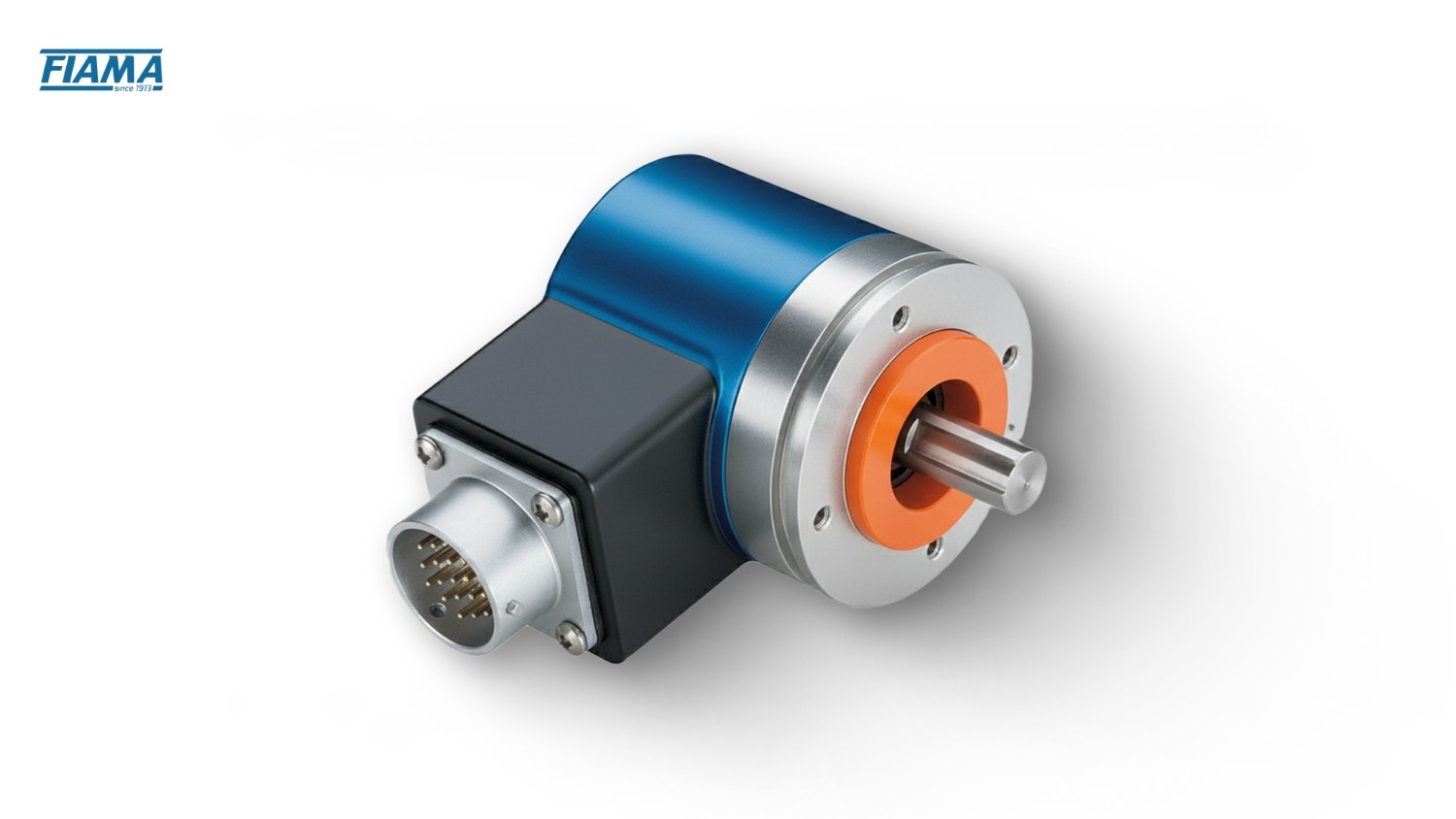
Single-turn absolute encoders measure shaft position within a single 360° revolution. They provide precise positional feedback for applications where continuous multi-revolution tracking is unnecessary, yet high accuracy is critical. These encoders are commonly used in packaging, automation, and indexing systems.
Key Features:
High Positional Accuracy: Delivers exact position within a single revolution, ensuring consistent alignment in servo or actuator-driven systems.
Rapid Response: Responds quickly in high-speed applications, supporting stable cycle times and minimizing operator intervention.
Compact Design: Fits easily into constrained machine assemblies without compromising performance.
Ideal Use-Case Scenario: Perfect for automated packaging lines requiring single-revolution feedback.
Avoid When: Multi-turn tracking is required for long-stroke or multi-axis machinery.
2, Multi-Turn Absolute Encoders
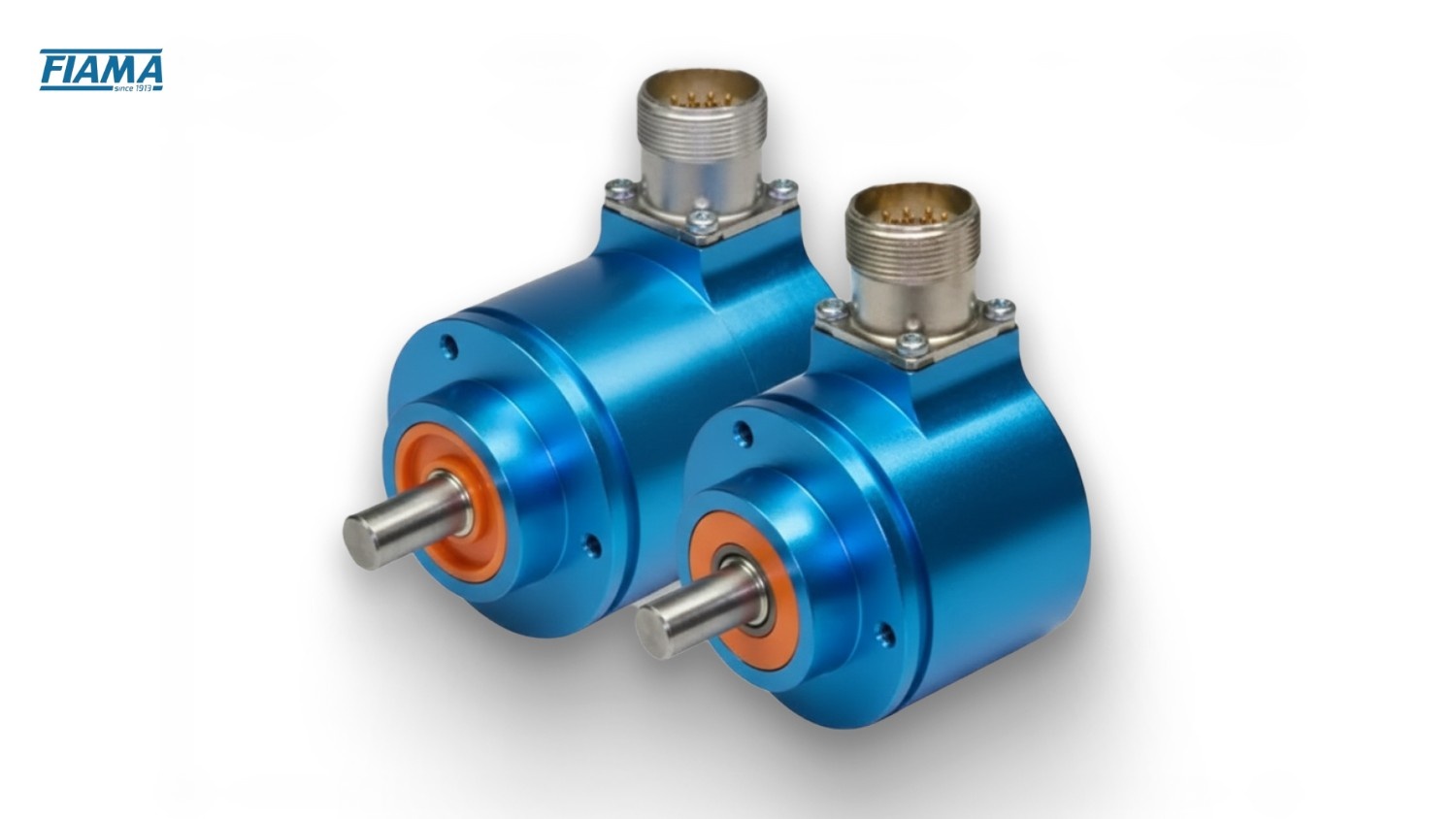
Multi-turn encoders track both the angular position and the number of full revolutions of a shaft. This capability is essential for long-travel or multi-axis machinery where power interruptions must not compromise positional data. Applications include gantries, elevators, and robotics.
Key Features:
Extended Position Tracking: Monitors multiple revolutions to deliver precise absolute positioning for long-stroke applications.
Power-Loss Memory: Retains rotational data during shutdowns, letting machines resume operations without reinitialization delays.
High Integration Flexibility: Integrates smoothly with complex mechanical setups and robotic systems, supporting multi-axis control and high-cycle production lines.
Ideal Use-Case Scenario: Suitable for robotic arms and gantry systems requiring continuous positional tracking.
Avoid When: Only single-turn precision is needed.
3. Optical Absolute Encoders
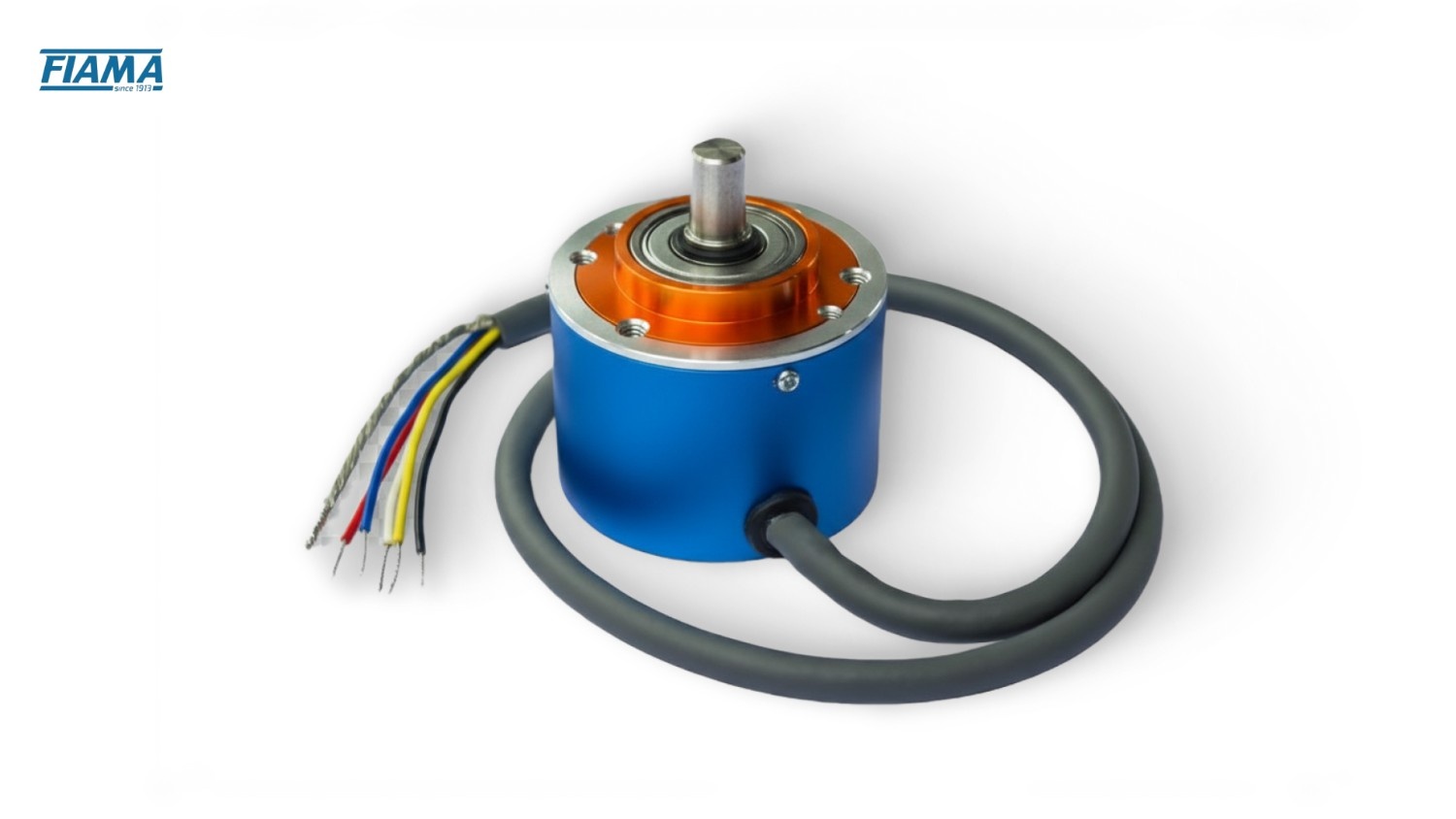
Optical absolute encoders use light patterns on a coded disk to determine shaft position. They deliver high-resolution, precise feedback, making them suitable for precision automation tasks such as semiconductor handling, robotics, and metrology equipment.
Key Features:
High Accuracy: Maintains excellent linearity and minimal signal drift for precision applications.
Stable Signal Quality: Withstands minor mechanical wear to ensure consistent readings over time.
Non-Contact Measurement: Limits wear and extends service life, increasing uptime and reducing maintenance.
Ideal Use-Case Scenario: High-precision metrology or semiconductor manufacturing requiring exact position feedback.
Avoid When: Harsh environments with dust, moisture, or vibration could interfere with optical sensing.
4. Magnetic Absolute Encoders
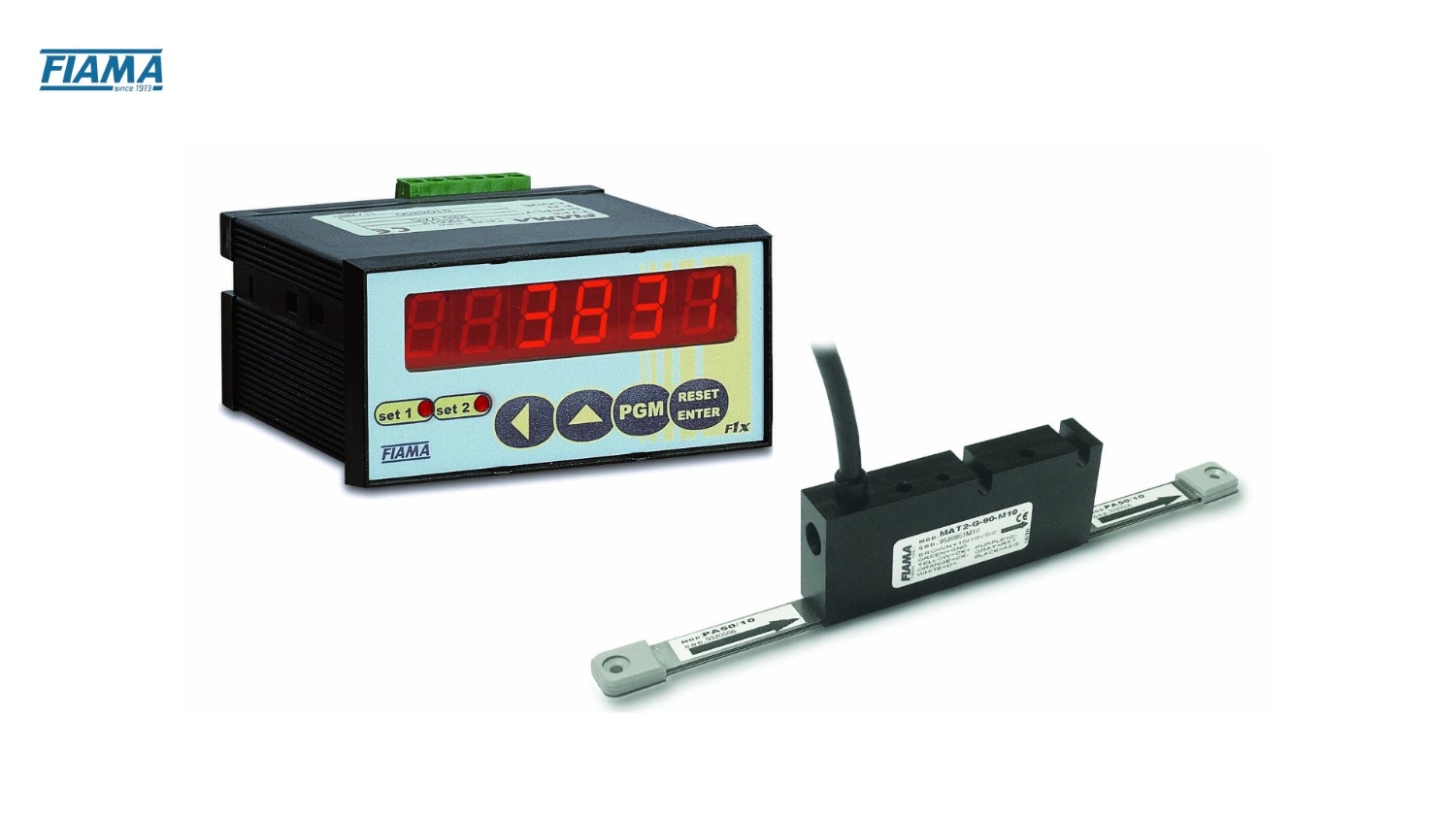
Magnetic absolute encoders rely on magnetic field sensing to determine position. They excel in environments where dust, moisture, vibration, or mechanical shock might compromise other sensing methods.
Key Features:
Environmentally Robust: Operates reliably in dusty, wet, or vibration-prone conditions, reducing unplanned downtime.
Durable Construction: Non-contact sensing reduces mechanical wear, extending service life.
Versatile Applications: Works in packaging, food processing, wood, and outdoor machinery, minimizing downtime from contamination or stress.
Ideal Use-Case Scenario: Food processing or packaging lines exposed to moisture or dust.
Avoid When: Ultra-high precision under controlled conditions is required.
For example, Fiama offers Magnetic Encoders suitable for both rotary and linear applications, providing reliable absolute and incremental measurement for industrial environments.
5. Capacitive Absolute Encoders
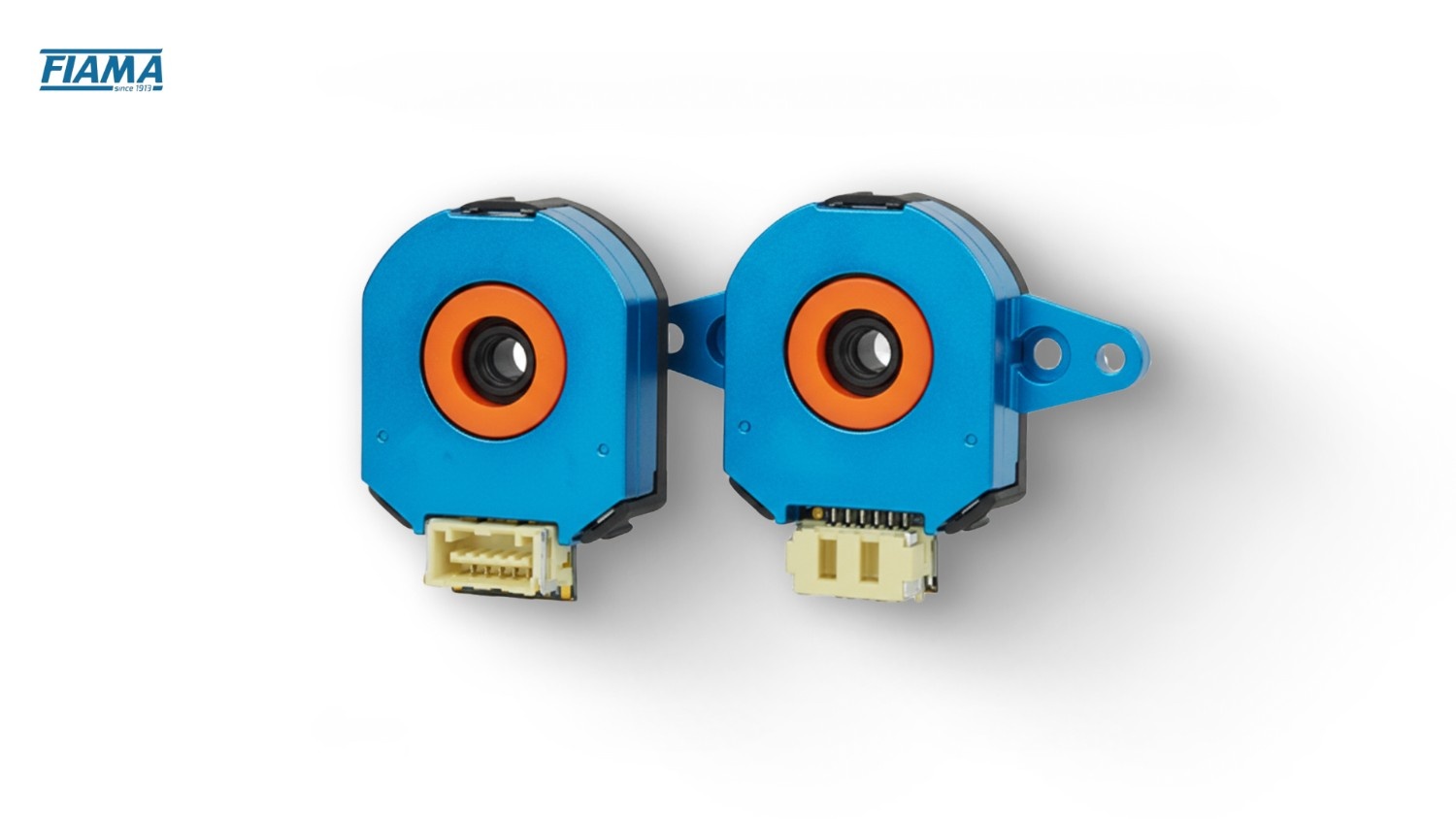
Capacitive encoders detect positional changes through variations in electrical capacitance. They offer stable output under moderate accuracy demands while maintaining resistance to contamination and wear, making them suitable for general-purpose automation.
Key Features:
Contamination Resistance: Works reliably in dusty, oily, or mildly humid environments, reducing maintenance cycles.
Compact and Lightweight: Integrates easily into space-constrained machines.
Long-Term Stability: Non-contact operation reduces wear, supporting consistent throughput and minimizing downtime.
Ideal Use-Case Scenario: General-purpose conveyor or actuator systems where environmental resilience matters.
Avoid When: High-speed, high-resolution applications demand optical or magnetic precision.
Understanding these types helps decision-makers match encoder capabilities with operational KPIs such as uptime, yield, and cycle stability. Next, let’s discuss the sensing technologies that determine their performance and reliability.
Key Technologies Used in Rotary Absolute Encoders
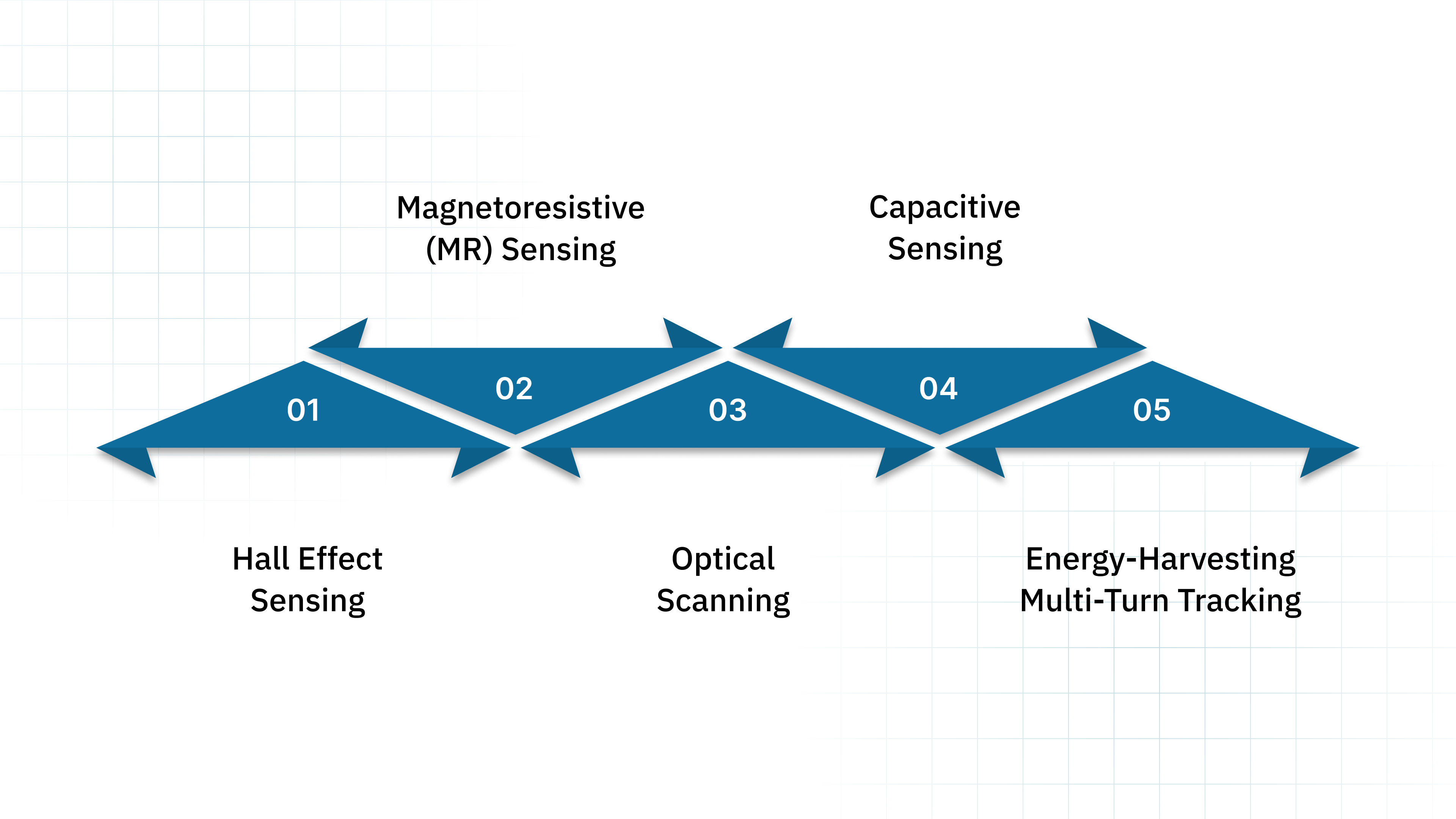
The performance of a rotary absolute encoder depends on the sensing technology behind it. Each method affects resolution, noise immunity, durability, and long-term stability under production stresses.
Below are the core technologies shaping rotary encoder performance.
Hall Effect Sensing
Hall effect encoders detect the presence of magnetic fields to determine shaft position. They are simple, reliable, and perform well in moderately harsh environments, making them a practical choice for industrial automation.
Durable in harsh conditions: Performs reliably in dusty, vibratory, and temperature-variable environments.
Moderate precision: Provides sufficient accuracy for general industrial applications like conveyors or indexing systems.
Low maintenance: Minimal moving parts and simple electronics reduce upkeep requirements and downtime.
Hall effect encoders deliver a practical balance of robustness, accuracy, and affordability, making them the preferred choice for many general-purpose industrial machines.
Magnetoresistive (MR) Sensing
MR encoders detect changes in electrical resistance caused by magnetic fields, offering higher sensitivity and stronger signal stability. They suit environments with vibration and temperature fluctuations.
High Sensitivity: Accurately tracks small rotor movements, supporting applications like tension control and multi-axis robotics.
Enhanced Noise Immunity: Maintains position integrity in electrically noisy environments or when multiple motors operate in proximity.
Environmental Flexibility: Performs reliably in vibration-heavy or dusty settings without requiring extensive protection.
MR technology supports precise motion control in challenging industrial environments, ensuring consistent output quality and reduced rework.
Optical Scanning
Optical encoders rely on light passing through or reflecting off a coded disk to determine position. This technology offers the highest resolution and low interpolation error, making it ideal for precision-dependent applications.
High Resolution: Captures minute positional changes, essential for semiconductor processing, pharma packaging, and precision assembly.
Fast response: Supports high-speed operations without compromising position reliability.
Sensitive to environment: Requires protective housing in dusty or high-vibration areas to maintain performance.
Optical scanning ensures accuracy and speed but requires environmental protection for long-term reliability.
Capacitive Sensing
Capacitive encoders detect changes in the electric field between the rotor and stator. They tolerate contamination, consume low power, and suit compact applications.
Environmentally tolerant: Performs well in oil, dust, or moisture-prone areas without losing positional accuracy.
Compact and energy-efficient: Small size and low power draw make it suitable for lightweight or battery-sensitive systems.
Stable operation: Maintains consistent readings over time, supporting predictable machine cycles.
Capacitive sensing offers versatility for compact and moderately harsh industrial setups, providing reliable position data with minimal maintenance.
Energy-Harvesting Multi-Turn Tracking
Energy-harvesting mechanisms allow multi-turn encoders to track revolutions without batteries, storing position data mechanically or magnetically. This technology reduces maintenance while preserving long-term accuracy.
Battery-free operation: Eliminates the need for regular battery replacement, reducing downtime and operational complexity.
Multi-Turn Counting: Tracks rotations beyond a single turn, ideal for conveyors, draw-wire systems, and long-travel actuators.
Reliable Data Retention: Maintains position information during power loss, supporting seamless restart and minimizing misalignment.
Energy-harvesting multi-turn systems provide a maintenance-friendly, reliable solution for tracking complex rotational motion in industrial automation.
Understanding these core technologies helps engineers match encoders to machine requirements efficiently. In the next section, let’s review how encoders communicate with control systems for seamless integration.
Communication Interfaces and Compatibility
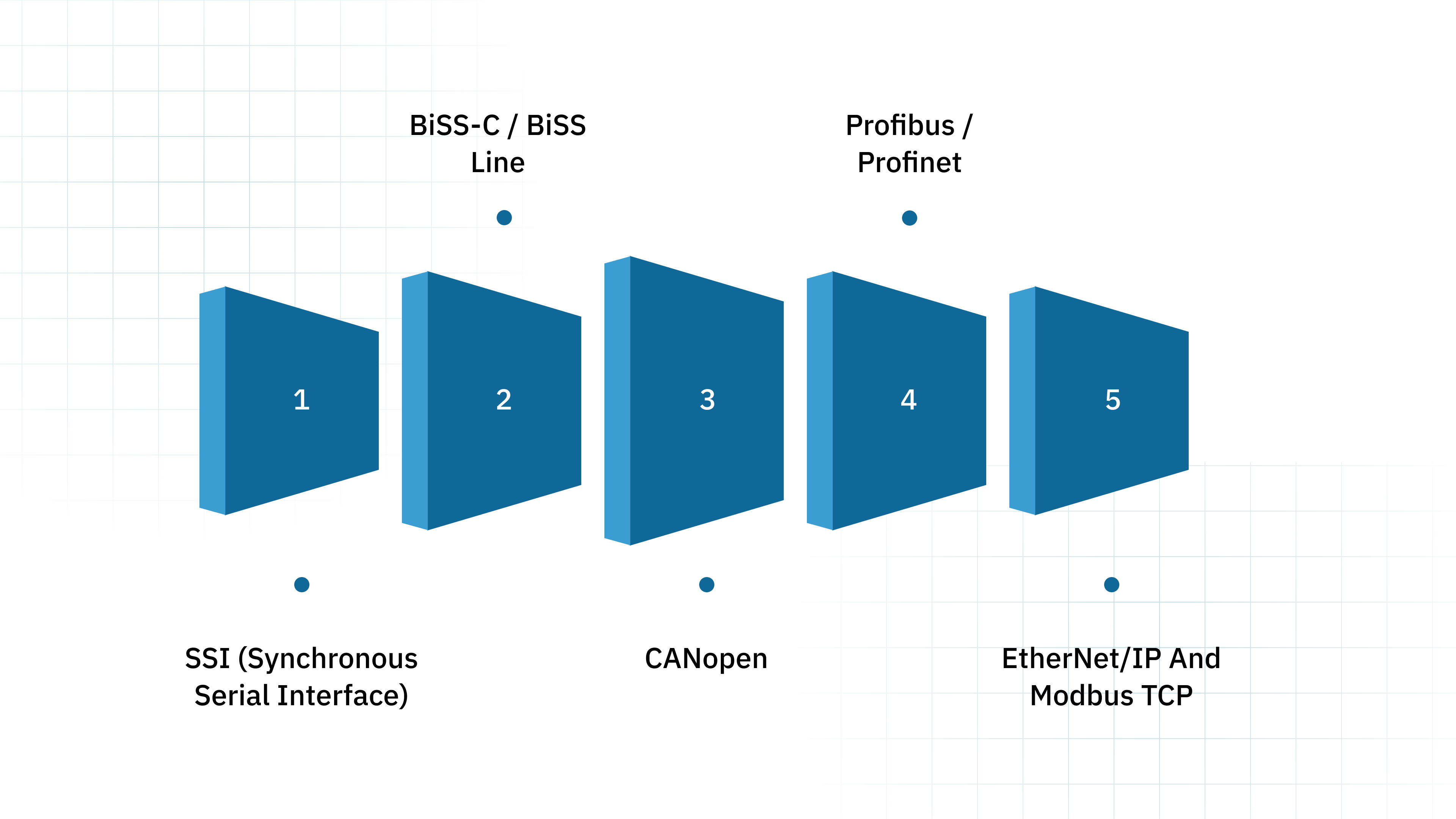
Communication protocols determine how well an encoder integrates with PLCs, drives, and control networks. Compatibility affects data speed, diagnostic capability, and installation flexibility.
Modern factories rely on interfaces that deliver fast and reliable communication between encoders and automation systems.
Communication options differ widely by application:
SSI (Synchronous Serial Interface)
SSI is a point-to-point communication standard widely used in industrial equipment. It transmits absolute position data in a stable, noise-resistant format. This interface is ideal for applications requiring deterministic timing and simple wiring, such as indexing machines, conveyors, and packaging lines. SSI ensures precise data delivery without a complex network setup.
BiSS-C / BiSS Line
BiSS-C is an open-source, high-speed protocol designed for real-time data transfer. It supports error detection, diagnostic feedback, and multi-axis control. Equipment using BiSS-C speeds up updates and simplifies integration in robotics, automated assembly, and high-precision production.
CANopen
CANopen is a distributed network protocol common in modular and mobile industrial systems. It allows multiple devices to communicate reliably over long distances and supports decentralized control architectures. Encoders with CANopen compatibility can integrate seamlessly into factory networks with multiple axes or remote devices, reducing downtime and simplifying system design.
Profibus / Profinet
Profibus and Profinet are standard industrial networking protocols often used in automated production facilities. They provide high reliability and predictable communication between encoders, PLCs, and drives. Choosing encoders with these protocols ensures smooth integration with legacy and modern systems, supporting consistent throughput and reducing wiring errors.
EtherNet/IP and Modbus TCP
EtherNet/IP and Modbus TCP are Ethernet-based protocols that offer fast, flexible, and widely compatible communication. These interfaces allow encoders to transmit real-time data for monitoring, diagnostics, and motion control across connected networks. Plants upgrading to Industry 4.0 setups benefit from these protocols for remote visibility and streamlined integration with existing automation systems.
Selecting the right interface ensures smoother commissioning, reduced wiring complexity, and stable operation. Next, let's consider factors that affect encoder performance in your setup.
Key Factors to Consider When Selecting a Rotary Absolute Encoder
Selecting the right rotary absolute encoder ensures reliable feedback, stable machine operation, and reduced downtime. The following factors help you match the encoder to your equipment, environment, and production KPIs.
Here are the most crucial factors you should consider:
Environmental Conditions: Evaluate temperature extremes, vibrations, dust, moisture, and chemical exposure. Encoders with proper IP-rated housings and sealed components maintain accuracy and minimize downtime in demanding industrial settings.
Accuracy & Resolution: High-precision applications need encoders with fine resolution and low interpolation error. Choosing the right technology, optical, magnetic, or MR, lets you achieve consistent positioning and reduce scrap or misalignment.
Speed & Duty Cycle: If your machines run continuously or at high speeds, you need encoders rated for those conditions. Properly matched encoders maintain stable signals, reduce measurement noise, and prevent errors during peak operation.
Mounting & Fit: Encoder type, shaft design, and flange compatibility affect installation ease and positional stability. Mounting the encoder correctly prevents mechanical wear, supports uptime, and keeps feedback accurate over long-term operation.
Communication Protocol: Interface compatibility with PLCs, drives, or SCADA systems determines integration ease and data reliability. By choosing encoders that support SSI, BiSS, CANopen, or Ethernet-based protocols, you can reduce configuration issues and minimize downtime.
Durability & Maintenance: Bearings, materials, internal components, and sealing determine encoder longevity. Rugged designs reduce unplanned maintenance, protect against environmental stress, and sustain consistent machine performance.
Application Needs: Some machines require multi-turn capability, battery-free operation, or custom shaft designs. Evaluating these requirements early prevents retrofit challenges and ensures continuous, accurate position feedback.
Innovations and Trends in Rotary Absolute Encoders
Rotary absolute encoders are evolving to meet higher performance and industrial automation demands. Here are some of the key trends shaping encoder design in 2025–2026:
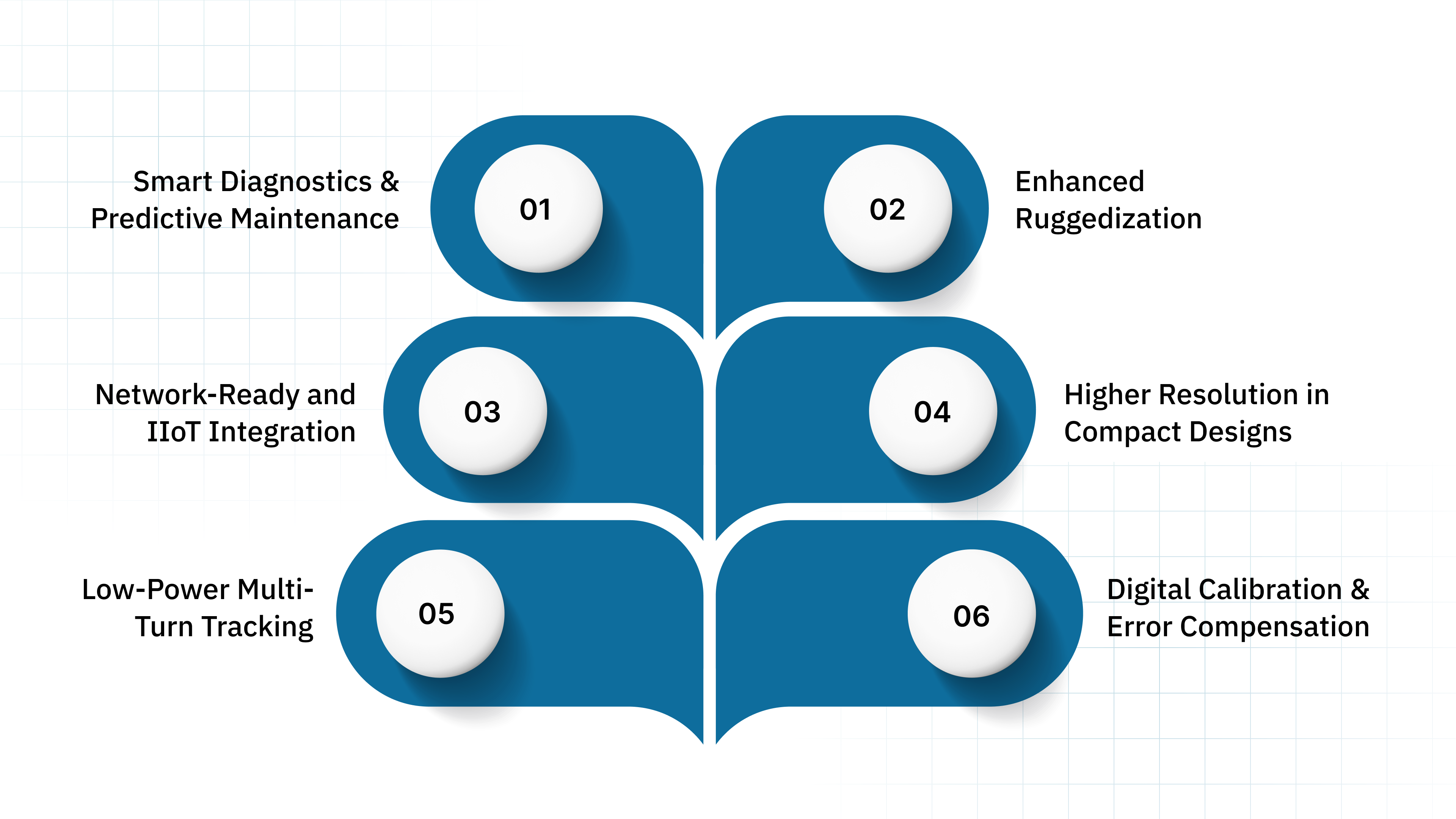
Smart Diagnostics & Predictive Maintenance: Encoders now feature self-monitoring capabilities, including error counters and health reporting, so you can detect potential failures early and reduce unplanned downtime.
Enhanced Ruggedization: High-IP housings, shock-resistant designs, and vibration-tolerant construction enhance reliability in harsh industrial environments.
Network-Ready and IIoT Integration: Built-in EtherCAT, Profinet, and OPC UA compatibility lets you monitor in real time, configure remotely, and integrate seamlessly with Industry 4.0 systems.
Higher Resolution in Compact Designs: Advances in optical and magnetic sensing deliver high-resolution performance in smaller, space-efficient packages.
Low-Power Multi-Turn Tracking: Energy-efficient designs and non-volatile memory retain multi-turn counts without batteries, reducing maintenance and improving reliability.
Digital Calibration & Error Compensation: Software-based compensation in modern encoders corrects systematic errors, enhancing positional accuracy without complex hardware.
In the following section, let's see how Fiama helps streamline encoder selection and integration for reliable operations.
How Fiama Simplifies Rotary Absolute Encoder Selection & Integration
Fiama provides encoder solutions backed by 100 years of engineering experience and ISO 9001:2008 certification. Their depth of knowledge helps plants avoid misalignment, compatibility issues and complexity.
Here’s how we can help you:
Application-specific guidance: Fiama engineers work closely with operations and OEM teams to match encoder types to specific equipment loads, environmental conditions, and process requirements, helping reduce integration challenges.
Custom stroke lengths and configurations: From flexible shafts to draw-wire encoders and linear potentiometers, Fiama offers tailored lengths and configurations to fit unique machinery setups.
Metal housings and rugged designs: Many Fiama products feature stainless steel or aluminum housings, providing durability for washdown, vibration-heavy, or industrial environments.
Practical OEM engineering support: The team provides hands-on assistance for mounting, coupling selection, and communication interface alignment, ensuring smooth integration with existing PLCs, drives, or control systems.
Robust, Italian-manufactured products: Their encoders come from facilities with over 100 years of design and manufacturing experience, ensuring quality and consistency.
Support across multiple industries: Fiama solutions serve food, packaging, wood, automation, and semiconductor applications where uptime and repeatability matter.
This approach helps operations maintain predictable performance without overspecifying or selecting incompatible devices.
Conclusion
Choosing the best rotary absolute encoder depends on understanding the machine environment, required accuracy, mounting constraints, and communication standards. As automation systems become more connected, modern encoders support better data integrity, reduced manual alignment, and improved uptime across production lines.
Recent advancements in sensing technologies and network interfaces have made encoders more dependable, easier to integrate, and better suited for predictive maintenance.
If you’re assessing encoder needs or reviewing upgrade options, you can reach out to Fiama for guidance. Their engineering-driven approach and deep specialization help streamline encoder selection and ensure a reliable match for your application.
FAQs
How do capacitive rotary absolute encoders differ from other types?
Capacitive rotary absolute encoders use changes in capacitance to detect position, offering high immunity to dust, dirt, and vibration. Unlike optical or magnetic encoders, they provide stable readings in harsh conditions, with moderate resolution, and are often more durable and maintenance-free.
What are single-turn vs multi-turn absolute encoders?
Single-turn encoders measure the exact position within one rotation, resetting after each turn. Multi-turn encoders track position over multiple rotations, maintaining absolute positioning across several turns, making them suitable for applications needing precise motion tracking over extended ranges.
Which output protocols do absolute rotary encoders support?
Absolute rotary encoders commonly support protocols like SSI (Synchronous Serial Interface), BiSS, CANopen, Modbus, and incremental analog or digital outputs. Protocol choice depends on system compatibility, data transfer speed, and application requirements, enabling seamless integration with industrial controllers or automation systems.
What environments are best suited for magnetic vs optical encoders?
Magnetic encoders excel in dirty, dusty, or vibration-prone environments due to their robustness. Optical encoders, offering higher resolution and accuracy, perform best in clean, controlled conditions, where environmental interference is minimal, making them ideal for precision tasks.
What trade-offs exist between accuracy, durability, and cost in rotary absolute encoder technologies?
High-accuracy encoders, like optical types, can be sensitive to dust and require careful maintenance, increasing costs. Magnetic and capacitive encoders offer durability and lower maintenance at moderate accuracy. Choosing an encoder involves balancing precision needs, environmental resilience, and budget constraints.