
Introduction
Rotary transducers convert shaft rotation into electrical signals that drive precision across automated assembly lines, robotic systems, pharmaceutical packaging, and semiconductor manufacturing. When they fail or deliver inaccurate feedback, the consequences ripple through entire production systems: quality defects, unplanned downtime, and costly rework.
Selecting the right manufacturer is genuinely complex. The US market hosts a mix of global sensor conglomerates, specialized distributors, and precision engineering firms—each with distinct product portfolios, lead times, and support capabilities.
Engineers and procurement teams must match technical specifications to real-world application requirements while navigating vendor claims and supply chain realities.
This guide evaluates 10 leading rotary transducer manufacturers serving the US market, selected based on product quality, technical support depth, lead times, industry certifications, and demonstrated cross-sector applicability—not simply brand recognition.
Key Takeaways
- Rotary transducers convert shaft rotation into electrical signals for position, speed, or torque measurement
- Sourcing options range from large global sensor conglomerates to focused specialty distributors — each with different lead times, support depth, and pricing
- Selection criteria include resolution, sensing technology, IP rating, certifications, and lead time
- Top 10 covered: FIAMA US, BEI Sensors, Dynapar, EPC, Honeywell, TE Connectivity, Heidenhain, Kübler, FUTEK, and Renishaw
- Prioritize suppliers who offer genuine technical support — not just order processing — to avoid costly application mismatches
What Are Rotary Transducers and Why Do They Matter in US Industry?
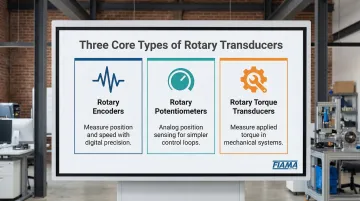
Rotary transducers convert rotational mechanical motion into usable electrical output signals. Three types dominate industrial applications:
- Rotary encoders — measure position and speed with digital precision
- Rotary potentiometers — provide analog position sensing for simpler control loops
- Rotary torque transducers — measure applied torque in mechanical systems
These devices form the foundational feedback layer in closed-loop control systems across US manufacturing, from CNC machine tools to pharmaceutical filling lines.
That demand is reflected in the numbers. The global encoder market is projected to reach $6.50 billion by 2030, growing at 11.6% annually from 2024 to 2030. North America holds a 39.51% market share, driven by industrial automation adoption and rising demand for precision motion control.
This guide focuses on suppliers serving the US market with strong inventory availability, application engineering support, and compatibility with North American industrial standards: companies that bring both product depth and technical knowledge to the table.
Top 10 Rotary Transducer Manufacturers in the US
The following manufacturers were selected based on product quality, industry certifications, application breadth, technical support capability, and US market availability—not simply company size. Each brings distinct strengths to different industrial applications and procurement priorities.
FIAMA US
FIAMA US serves as the North American distributor for Italian manufacturer F.I.A.M.A. S.r.l., operating from Luling, Louisiana. The company offers a focused line of rotary encoders and potentiometers serving food and beverage, pharmaceutical, semiconductor, packaging, and robotics industries.
What distinguishes FIAMA is their engineering-first approach. The team consists of degreed engineers with no sales quotas, providing genuine application-level support focused on finding the right product rather than maximizing order value.
Their product line includes the EN Series hollow shaft encoders (available in 14mm, 20mm, and 25mm bore sizes with resolutions from 10 to 500 PPR) and PR Series rotary potentiometers with multiple output options (potentiometer, 0-10V, 4-20mA).
FIAMA's components carry ISO 9001 certification from Italian manufacturing, extensive in-stock inventory for short lead times, and competitive pricing that often outperforms domestic alternatives in comparative testing. The non-quota sales model prioritizes matching the right product to the application rather than maximizing order value.
| Attribute | Details |
|---|---|
| Product Type | Rotary encoders and potentiometers (incremental and absolute) |
| Key Differentiator | Engineer-staffed, non-commissioned team; ISO 9001 certified Italian manufacturing |
| Industries Served | Food & beverage, pharma, semiconductor, packaging, robotics, automotive, metalworking |
BEI Sensors (Sensata Technologies)
BEI Sensors operates as a legacy US encoder brand under Sensata Technologies, headquartered in Attleboro, Massachusetts. The company built its reputation on industrial-grade rotary encoders designed for harsh environments across automation, agriculture, and defense sectors.
Their product line features both optical and magnetic encoders with robust environmental ratings. The DXM5/DXK5 series offers IP69K protection for high-pressure washdown environments, while industrial models like the LP35 series operate from -40°C to +100°C. Resolution options extend up to 500,000 PPR for incremental models and 16 bits for absolute encoders.
The combination of extreme-temperature ratings and IP69K protection makes BEI a practical choice when encoder failure means production downtime in difficult conditions.
| Attribute | Details |
|---|---|
| Product Type | Incremental and absolute optical rotary encoders |
| Key Differentiator | Proven harsh-environment designs with extensive North American distribution |
| Industries Served | Industrial automation, agriculture, defense, transportation |
Dynapar
Dynapar operates as one of the largest dedicated encoder manufacturers in the US under the Fortive corporate umbrella. The company manufactures heavy-duty incremental encoders at a 166,000 sq. ft. facility in Elizabethtown, North Carolina, with sales and support based in Vernon Hills, Illinois.
Their comprehensive catalog covers motor feedback, conveyor systems, and process control applications. Product offerings include both standard and custom-engineered solutions, from hollow-shaft encoders like the HS35iQ to non-contact shaftless designs that eliminate mechanical wear.
For OEMs and system integrators sourcing at volume, the combination of US manufacturing and custom engineering options reduces both procurement risk and qualification timelines.
| Attribute | Details |
|---|---|
| Product Type | Incremental and absolute rotary encoders, hollow-shaft encoders |
| Key Differentiator | High-volume US manufacturing with custom engineering options |
| Industries Served | Motor control, packaging, printing, food processing, material handling |
Encoder Products Company (EPC)
EPC operates from a 100,000 sq. ft. facility in Sagle, Idaho, where they design, manufacture, and assemble their Accu-Coder and Tru-Trac encoder lines. This vertical integration and "Made in USA" positioning provides supply chain stability increasingly valued in post-2020 procurement strategies.
The company specializes in heavy-duty rotary encoders engineered for demanding industrial environments. Products feature robust construction capable of handling significant radial and axial shaft loads, with environmental protection up to IP65 ratings.
EPC is a practical fit for mining, oil & gas, and heavy manufacturing applications where lead time predictability and shock-rated construction carry equal weight.
| Attribute | Details |
|---|---|
| Product Type | Heavy-duty incremental and absolute encoders |
| Key Differentiator | US-manufactured, engineered for high-shock and high-vibration environments |
| Industries Served | Mining, oil & gas, steel, heavy manufacturing |
Honeywell
Honeywell's Sensing & Safety Technologies division offers rotary position sensors as part of a broader industrial, aerospace, and automotive sensor portfolio. The company's global manufacturing footprint and extensive North American sales network provide enterprise-scale support capabilities.
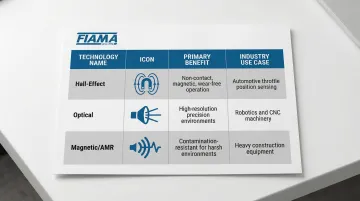
Their rotary position sensor lines focus on non-contact Hall-effect technology. The RTY series features shaft-activated sensors with optional levers, while the RTP series separates the magnet from the sensor body to eliminate bearing wear. Both series offer IP69K-sealed packages and dual-output variants for safety-critical applications.
Products carry CE and UKCA marks, with EMC testing exceeding regulatory requirements. Honeywell is frequently specified in applications where brand reliability, regulatory compliance, and long product lifecycle cannot be compromised.
| Attribute | Details |
|---|---|
| Product Type | Rotary position sensors, Hall-effect sensors, potentiometers |
| Key Differentiator | Extensive compliance portfolio (UL, CE, ATEX); trusted for safety-critical applications |
| Industries Served | Aerospace, HVAC, automotive, industrial process control |
TE Connectivity
TE Connectivity, headquartered in Switzerland with major US manufacturing and R&D operations, expanded its sensor portfolio significantly with the 2014 acquisition of Measurement Specialties. The company offers rotary position sensors targeting automotive, industrial, and transportation markets.
Their product line employs Hall-effect and Anisotropic Magneto Resistive (AMR) technologies designed to remain unaffected by dirt, oil, and dust. Output options include analog (VDC, 4-20mA) and digital (PWM, CAN CiA 443) formats for flexible system integration.
TE's strength lies in high-volume OEM supply capability backed by broad automotive and industrial qualification bases, making them a go-to source for large-scale production programs.
| Attribute | Details |
|---|---|
| Product Type | Rotary position sensors, contactless angular sensors |
| Key Differentiator | High-volume OEM supply capability; broad automotive and industrial qualification base |
| Industries Served | Automotive, transportation, general industrial, consumer appliances |
Heidenhain
HEIDENHAIN CORPORATION operates its US subsidiary from Schaumburg, Illinois, representing the German precision measurement specialist. The company sets the benchmark for high-accuracy rotary encoders in CNC machine tools, metrology equipment, and semiconductor manufacturing.
Heidenhain encoders deliver accuracy down to ±10 arc seconds in the ROC 425 series. Product offerings span absolute encoders (ECN/EQN series with up to 25-bit resolution) and incremental models (ERN, ROD, ROC series) designed for applications where sub-micron accuracy and long-term repeatability are essential.
Heidenhain is the benchmark brand in high-precision US manufacturing, specified where measurement uncertainty directly impacts product quality or process capability.
| Attribute | Details |
|---|---|
| Product Type | High-precision optical and magnetic rotary encoders, angle encoders |
| Key Differentiator | Sub-micron accuracy; industry standard in CNC and precision metrology |
| Industries Served | CNC machining, semiconductor, medical equipment, metrology |
Kübler Group
Kübler operates its US subsidiary, Kübler Inc., from Charlotte, North Carolina, serving the North American automation market with comprehensive rotary encoders, slip rings, and counters manufactured in Germany.
The company's emphasis on functional safety sets them apart. The Sendix 5814FS2/5834FS2 series carries certifications up to SIL2 (EN 61800-5-2) and PLd (EN ISO 13849-1), with documented reliability data including PFHd values of 2.16 x 10^-8 h^-1 and 20-year mission times.
For machinery builders facing evolving safety regulations, Kübler provides certified components that integrate directly into safety control systems, reducing compliance risk and engineering effort.
| Attribute | Details |
|---|---|
| Product Type | Incremental, absolute single- and multi-turn encoders; safety-rated encoders |
| Key Differentiator | Functional safety certified (SIL2/PLe) models; strong US applications support |
| Industries Served | Industrial automation, elevator systems, wind energy, robotics |
FUTEK Advanced Sensor Technology
FUTEK operates from Irvine, California, as a US-based manufacturer specializing in precision rotary torque transducers, load cells, and force sensors. The company serves test & measurement, medical devices, and research applications where metrological traceability is required.
Their rotary torque transducer line includes shaft-to-shaft, square drive, and hex drive configurations, with some models incorporating built-in encoders for angle and speed measurement. FUTEK performs over 50,000 calibrations annually, each traceable to NIST standards, with A2LA accreditation available for critical applications.
For laboratory-grade and high-precision industrial torque measurement, FUTEK offers US manufacturing with verifiable accuracy—critical for applications where measurement uncertainty affects regulatory compliance or research validity.
| Attribute | Details |
|---|---|
| Product Type | Rotary torque transducers, reaction torque sensors |
| Key Differentiator | US-made with NIST-traceable calibration; strong custom engineering capability |
| Industries Served | Test & measurement, medical devices, aerospace, robotics research |
Renishaw
Renishaw, headquartered in Wotton-under-Edge, UK, maintains a strong US presence serving high-accuracy encoder applications in machine tools, additive manufacturing, and coordinate measuring machines (CMMs).
The RESOLUTE series represents true-absolute optical encoding capable of 1 nm resolution at speeds up to 100 m/s. The TONiC series offers compact incremental encoders for highly dynamic precision motion systems. Both product families demonstrate exceptional contamination tolerance—critical in real-world manufacturing environments.
Renishaw is the preferred choice for semiconductor manufacturing and scientific instrumentation where resolution requirements push the boundaries of optical encoder technology.
| Attribute | Details |
|---|---|
| Product Type | Optical and magnetic rotary encoders, ring encoders |
| Key Differentiator | Exceptionally high accuracy and contamination tolerance; preferred for CMM and machine tool applications |
| Industries Served | Machine tools, CMM, additive manufacturing, semiconductor |
How We Selected These Manufacturers
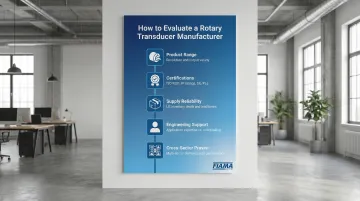
These manufacturers were evaluated on multiple criteria that matter in day-to-day procurement and engineering decisions:
Range of rotary transducer types — encoders, potentiometers, torque sensors — plus resolution options, output formats, and environmental ratings to match diverse application requirements.
Certifications applied to specific products — not just company-level claims — including ISO 9001, UL/CE marks, IP67/IP69K environmental ratings, and SIL/PLe for safety-critical applications.
US inventory depth, distributor networks, and documented lead times. North American robot orders fell 7.9% in H1 2024 — market volatility that makes supply reliability critical.
Engineering expertise for real application guidance — not order-takers reading datasheets — since the wrong advice at spec stage often means costly redesign later.
Demonstrated performance across multiple sectors, indicating robust design and broad technical knowledge rather than narrow niche experience.
A common procurement mistake is selecting suppliers on brand name alone, without checking lead times or the depth of their technical team.
A recognizable brand with 12-week lead times and generic support often delivers less value than a specialized distributor with in-stock inventory and engineers who actually understand your application.
Conclusion
The US rotary transducer market offers a wide range of suppliers—from large conglomerates like Honeywell and TE Connectivity to precision specialists like Heidenhain and FUTEK, and engineer-staffed distributors like FIAMA US. The right choice depends on your specific application requirements, industry environment, and the level of technical support your team needs.
When evaluating suppliers, look beyond product specifications. Total supplier value includes:
- Lead times that align with your project schedule
- Direct access to engineering support when you need application guidance
- Pricing transparency with no upsell pressure
- A supplier motivated to match the right product to your application
FIAMA US carries ISO 9001-certified rotary transducers and is staffed entirely by degreed engineers with no sales quotas. That combination — deep application knowledge and an extensive in-stock inventory — directly addresses the two friction points engineers most often hit in industrial procurement: getting the right technical answer and getting the product fast.
To discuss your rotary transducer application, contact FIAMA US at info@fiama-us.com or call 504-352-0986.
Frequently Asked Questions
What is the difference between a rotary encoder and a rotary transducer?
A rotary encoder is a specific type of rotary transducer that converts angular position or motion into digital or pulse signals. "Rotary transducer" is a broader term encompassing any device that converts rotational input (position, torque, velocity) into usable electrical output—including encoders, potentiometers, and torque sensors.
What industries rely most heavily on rotary transducers in the US?
Industrial automation, automotive manufacturing, semiconductor fabrication, food and beverage processing, pharmaceutical packaging, robotics, and medical equipment depend heavily on rotary transducers. These sectors require precise position or torque feedback for process control, quality assurance, and regulatory compliance.
How do I choose the right rotary transducer for my application?
Match the measurement type (position vs. torque), output format (analog, incremental, absolute), resolution, IP rating, and mounting configuration to your specific conditions. A technically qualified supplier—one without sales quotas—can assess those requirements objectively rather than defaulting to their highest-margin product.
What resolution should I look for in a rotary position transducer?
General industrial automation typically works well with 1,000–2,048 PPR incremental encoders, while precision CNC or metrology applications may require 10,000+ PPR or absolute encoders with multi-turn capability. Higher resolution only adds value if your controller and wiring can reliably handle the signal.
What certifications are important for rotary transducer manufacturers?
Key certifications to look for: ISO 9001 (quality management), CE/UL marks (European and North American market compliance), IP67/IP69K (environmental sealing), and SIL or PLe ratings for safety-critical applications. Verify that certifications apply to the specific product model—not just the manufacturer's broader portfolio.
Are there short-lead-time rotary transducer suppliers in the US?
Lead times vary significantly by supplier and product type. Specialty distributors like FIAMA US maintain extensive in-stock inventory for rapid fulfillment of standard models. Custom or high-precision products from manufacturers like Heidenhain or FUTEK typically carry longer lead times. Verifying stock availability before specifying a part can prevent costly project delays.