
This article provides a curated evaluation of 10 manufacturers and distributors supplying linear position potentiometers to US industrial buyers, with emphasis on what differentiates each supplier and how to match their capabilities to your specific measurement application.
Key Takeaways
- Linear potentiometers convert mechanical displacement to electrical signals — widely used in automation, hydraulics, and process control
- The US market includes global manufacturers with local operations alongside specialized distributors offering engineering support and fast fulfillment
- Key selection factors: stroke range, linearity tolerance (±0.025% to ±5%), IP rating, output type, and lead time
- Engineering-staffed suppliers reduce misapplication risk — unlike commission-driven sales teams, they match specs to your actual requirements
- Top US-serving suppliers include FIAMA US, Bourns, Honeywell, TE Connectivity, Novotechnik, Vishay, BEI Sensors, Penny + Giles, Omega Engineering, and Celesco
What Is a Linear Position Potentiometer?
A linear position potentiometer is a resistive sensing device featuring a sliding wiper that travels along a resistive element, producing a voltage output proportional to the wiper's position along a straight-line path. This makes it a direct, economical solution for linear displacement measurement in industrial automation.
Two Primary Construction Types:
- Wire-wound elements: Higher power handling and rugged construction suited to harsh environments, but with finite resolution limited by wire spacing
- Conductive plastic elements: Smoother infinite resolution, longer cycle life (20 million to 100+ million cycles), preferred in precision automation applications
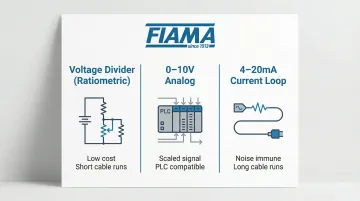
These sensors also vary by output format, each suited to different control architectures and transmission distances:
- Voltage divider (ratiometric): Simple, low-cost output; ideal for short cable runs with stable supply voltage
- 0–10V analog: Common in PLC applications requiring a clean, scaled voltage signal
- 4–20mA current loop: Preferred for long cable runs where noise immunity matters
While newer technologies like magnetostrictive sensors and LVDTs see growing adoption in high-end applications, linear potentiometers remain widely specified in US manufacturing due to their simplicity, low cost, and direct compatibility with standard PLC analog input modules, with no complex signal conditioning required.
Top 10 Linear Position Potentiometer Manufacturers in the US
These ten manufacturers and distributors were selected for product quality, US market presence, technical breadth, industry certifications, and the ability to serve demanding industrial applications with competitive lead times.
FIAMA US
FIAMA US operates as the North American arm of Italian-based F.I.A.M.A. S.r.l., headquartered in Luling, LA, serving food processing, pharmaceutical, semiconductor, automotive, and packaging industries across North America. Unlike typical distributors, FIAMA's team consists entirely of degreed engineers—not commissioned salespeople—ensuring customers receive technical guidance driven by application requirements rather than sales quotas.
FIAMA deliberately limits its product lines to maintain deep expertise in what it carries—a deliberate tradeoff that pays off in faster, more accurate application matching.
| Aspect | Details |
|---|---|
| Key Product Lines | P_ Series Linear Potentiometer Transducers (PAK, PY2, PS, PSX models); stroke ranges 25mm to 900mm; up to 100 million cycle life; aluminum housing; DIN-compliant connectors |
| Industries Served | Food & Beverage, Pharmaceutical, Semiconductor, Packaging, Automotive, Robotics, Medical Equipment, Material Handling |
| Notable Differentiator | ISO 9001 certified Italian manufacturing; engineer-staffed team with no sales quotas; competitive US pricing with short lead times; custom stroke lengths available |
Bourns, Inc.
Bourns, based in Riverside, California, brings decades of experience producing precision potentiometers including linear slide and linear position variants widely used in industrial controls, medical devices, and consumer electronics across the US market.
Its catalog spans thousands of standard configurations, with stocked availability through Mouser, Digi-Key, Newark, and Arrow—useful when lead time matters as much as specification.
| Aspect | Details |
|---|---|
| Key Product Lines | PTA Series (Low Profile Slide Potentiometer, 15-60mm stroke, 15,000 cycles); Model 3048 (500,000 cycles); standard linearity ±5% |
| Industries Served | Industrial controls, medical devices, consumer electronics, test & measurement |
| Notable Differentiator | Extensive standard catalog; tight tolerance options; massive North American distribution presence |
Honeywell Sensing & IoT
Honeywell's Sensing & IoT division is one of the largest US-based sensor producers, offering linear position sensors including potentiometric types for aerospace, HVAC, industrial automation, and defense sectors.
Honeywell's differentiators center on brand-backed reliability, broad industry certification portfolios, global supply chain with US fulfillment capabilities, and a reputation for rugged sensors capable of withstanding harsh environmental conditions including high vibration and extreme temperatures.
| Aspect | Details |
|---|---|
| Key Product Lines | LFII Series (vibration-resistant plunger transducers); AQLT Series (shaftless waterproof transducers); SLF Series (short stroke); linearity ±0.1% to ±1%; tested to 1 billion dither operations |
| Industries Served | Aerospace, HVAC, industrial automation, defense, process control |
| Notable Differentiator | Brand-backed reliability; extensive certification portfolio; NEMA 4 environmental ratings; conductive plastic "MystR" elements |
TE Connectivity (Measurement Specialties)
TE Connectivity's Measurement Specialties division serves as a major US supplier of position sensing solutions including linear potentiometers and displacement transducers, serving automotive, industrial, and aerospace OEMs with high-volume manufacturing capability. The 2014 acquisition of Measurement Specialties integrated the Celesco brand into TE's portfolio.
TE's differentiators include OEM-scale production capability, broad technology portfolio spanning potentiometric and non-contact sensing technologies, and global application engineering resources with North American support infrastructure.
| Aspect | Details |
|---|---|
| Key Product Lines | MLP Series (miniature linear potentiometers); CLP Series (conductive plastic, 1" to 10" stroke, up to 750mm); IP65 housings; operating temperatures to 150°C |
| Industries Served | Automotive OEM, aerospace, industrial machinery, medical device manufacturing |
| Notable Differentiator | OEM-scale production; broad technology portfolio; global application engineering support; integration of legacy Celesco cable-extension expertise |
Novotechnik U.S., Inc.
Novotechnik operates from Southborough, MA, bringing German-engineered high-precision linear position transducers and potentiometers to US manufacturers in machine tool, medical, and semiconductor equipment sectors requiring tight linearity and long mechanical life.
Novotechnik's differentiators include conductive plastic resistive technology offering millions of operating cycles, compact form factors, and IP67/IP68 rated housings suitable for wash-down and harsh industrial environments.
| Aspect | Details |
|---|---|
| Key Product Lines | TLH Series (rodless, side-actuated, up to 3000mm stroke, >100 million cycles, ±0.02% linearity); TEX Series (compact rod-style with return springs, IP67 rated) |
| Industries Served | Machine tools, medical equipment, semiconductor manufacturing, plastics machinery |
| Notable Differentiator | Exceptional cycle life (>100 million movements); precision linearity down to ±0.02%; compact IP67/IP68 rated housings |
Vishay Precision Group
Vishay operates as a major US electronics and sensor manufacturer whose precision potentiometer division (Vishay Spectrol brand) produces linear wirewound and conductive plastic position sensing elements used in mil-spec, industrial, and commercial applications, with manufacturing facilities in the US and globally.
Vishay's differentiators include mil-spec qualified product options, broad resistance value ranges, and a legacy of precision resistive technology trusted in aerospace, defense, and test instrumentation applications.
| Aspect | Details |
|---|---|
| Key Product Lines | REC 115 L series (conductive plastic, 25mm to 1000mm stroke, ±0.025% to ±1% linearity, 40 million cycle life, essentially infinite resolution) |
| Industries Served | Aerospace, defense, test & measurement, industrial controls |
| Notable Differentiator | Mil-spec qualified options; precision resistive technology heritage; linearity down to ±0.025%; broad resistance range |
BEI Sensors (Custom Sensors & Technology)
BEI Sensors, now part of Sensata Technologies following the 2015 acquisition of Custom Sensors & Technologies, maintains its California heritage in position sensing for industrial and military applications, offering linear potentiometric sensors alongside encoders and other position measurement technologies.
BEI's differentiators include deep customization capability, heritage in harsh-environment position sensing, and a proven track record in defense and heavy industry applications.
| Aspect | Details |
|---|---|
| Key Product Lines | 9600 Series linear position sensors; harsh environment position sensors for industrial, aerospace, agricultural, and medical device markets |
| Industries Served | Defense, heavy industry, oil & gas, industrial automation, agriculture |
| Notable Differentiator | Custom configuration capability; harsh-environment heritage; mil-grade options; Sensata Technologies backing |
Penny + Giles (Curtiss-Wright)
Penny + Giles, now a brand under Curtiss-Wright's Industrial division, originated in the UK but maintains strong US market presence offering linear position transducers including potentiometric models used in motorsport, industrial testing, and aerospace environments.
Penny + Giles differentiators center on premium build quality, motorsport-proven precision, and proprietary "Hybrid Track Technology" combining wire-wound stability with conductive plastic resolution—plus a product range extending into high-resolution draw-wire and Hall-effect sensors for demanding measurement applications.
| Aspect | Details |
|---|---|
| Key Product Lines | SLS and MLS Series (Hybrid Track Technology combining wire-wound and conductive plastic, 20-50 million operations, IP66 rated, strokes to 350mm) |
| Industries Served | Motorsport, aerospace testing, industrial R&D, marine, structural monitoring |
| Notable Differentiator | Motorsport-grade precision; Hybrid Track Technology; premium build quality; IP66 sealing; Curtiss-Wright backing for defense/aerospace |
Omega Engineering
Omega Engineering, headquartered in Norwalk, CT, operates as a well-established US instrumentation brand offering a broad catalog of linear position sensors including potentiometric displacement transducers, widely used in test, measurement, and process control applications across research and manufacturing facilities.
Omega's differentiators include a one-stop instrumentation catalog spanning sensors, signal conditioners, and readout displays, strong technical documentation, and fast delivery from US stock—making it a practical choice for engineers who need a complete measurement solution rather than just a sensor.
| Aspect | Details |
|---|---|
| Key Product Lines | LP800 Series including LP801 (long stroke to 1200mm, conductive plastic film for extended life) and LP804 (miniature, ±1.0% linearity); compatible meters and signal conditioners |
| Industries Served | Research & testing, process control, academic laboratories, manufacturing |
| Notable Differentiator | One-stop instrumentation ecosystem; strong technical documentation; fast US stock delivery; integrated signal conditioning options |
Celesco (TE Connectivity / Measurement Specialties)
Celesco represents a historically significant US brand in linear position measurement, originally known for pioneering cable-extension transducers and linear potentiometric sensors. Now integrated into TE Connectivity's Measurement Specialties portfolio following the 2011 acquisition, the Celesco name remains recognized among experienced US engineers.
Celesco's legacy differentiators include pioneering cable-extension potentiometer designs widely adopted in industrial and military applications, with the TE Connectivity integration providing continued product availability, engineering support, and distribution through major channels.
| Aspect | Details |
|---|---|
| Key Product Lines | CLP Series (conductive plastic potentiometers); MLP Series (miniature linear potentiometers); cable-extension transducers; available through TE/Measurement Specialties channels and major distributors |
| Industries Served | Industrial automation, defense, aerospace, material handling, robotics |
| Notable Differentiator | Pioneer in cable-extension potentiometric sensing; continued availability through TE Connectivity distribution; proven compact precision in space-constrained installations |
How We Chose the Best Linear Position Potentiometer Manufacturers
Manufacturers and distributors on this list were assessed across five criteria:
- Product quality and certifications — ISO 9001 compliance, stroke range, and linearity accuracy suited to US industrial applications
- Signal compatibility — Output formats compatible with common US PLCs and control systems
- Lead times and inventory — Stock availability and fulfillment speed for North American buyers
- Application engineering support — Depth of technical guidance offered before and after the sale
- Environmental suitability — IP ratings, temperature range, and cycle life appropriate for target use conditions

These criteria separate suppliers who can simply ship a product from those who can help you select the right one.
Common Selection Mistakes
A frequent mistake buyers make is selecting suppliers based on price alone without verifying linearity tolerance, IP protection rating, or mechanical cycle life for the target environment. This often results in premature sensor failure or signal drift, especially in wet, dusty, or high-vibration settings.
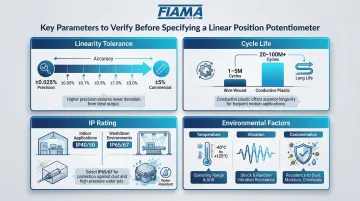
Key parameters to verify:
- Linearity tolerance: Standard commercial grade ranges from ±1.0% to ±5%, while precision industrial grade achieves ±0.1% to ±0.025%
- Cycle life: Wire-wound typically offers 1-5 million cycles; conductive plastic delivers 20-100+ million cycles
- IP ratings: Indoor/lab applications require IP40/IP50; industrial/washdown environments need IP65/IP66/IP67
- Environmental factors: Operating temperature range, vibration resistance, contamination protection
Engineering-led suppliers ask the right questions upfront, catching misapplication risks before they become costly field failures.
Size Isn't Everything
Smaller, specialized distributors often outperform large catalog suppliers in technical sectors. Buyers in specialized sectors like pharmaceutical or semiconductor manufacturing often benefit more from a technically focused distributor with short lead times and direct engineering support than from a large catalog supplier with weeks-long lead times and generic sales support.
Conclusion
The right linear position potentiometer manufacturer for your application depends on more than brand recognition—it depends on whether the supplier can match the right product specification to your environment, control system, and cycle life requirement.
Before choosing a supplier, evaluate them on:
- Application-specific guidance — can they advise on spec selection, not just catalog listings?
- North American stock availability — what are realistic lead times for your region?
- Certifications — ISO 9001 or equivalent quality management credentials
- Total cost of ownership — a sensor priced $50 higher that lasts years rather than months avoids thousands in downtime, replacement labor, and production losses
The cheapest option at purchase is rarely the cheapest option over a production cycle.
FIAMA US supplies Italian-made, ISO 9001-certified linear position potentiometers from a US-based location in Luling, LA. Their team consists of degreed engineers who carry no sales quotas — meaning product recommendations are based on your application requirements, not a commission target. Contact them at info@fiama-us.com or 504-352-0986 to discuss your specification.
Frequently Asked Questions
What is the difference between LPT and LVDT?
An LPT is a contact-based resistive sensor — a wiper slides along a resistive track and outputs a DC voltage signal directly. An LVDT is a non-contact inductive sensor that offers higher resolution and infinite mechanical life, but requires AC excitation and signal conditioning, making it more expensive and complex to implement.
What are the four types of potentiometers?
The four main types are rotary (angular displacement), linear (straight-line displacement), multi-turn (fine rotary adjustment over multiple turns), and digital (electronically adjustable resistance). This article focuses on linear potentiometers used for position sensing in industrial automation.
What is the most commonly used potentiometer?
Rotary potentiometers lead overall due to widespread use in consumer electronics. In industrial position sensing, however, conductive plastic linear potentiometers are most specified — they deliver 20–100+ million cycles, smooth resolution, and direct compatibility with standard analog control inputs.
What is a linear position potentiometer used for?
Common industrial applications include measuring actuator stroke in hydraulic and pneumatic cylinders, feedback for CNC axis positioning, level sensing in tanks, position monitoring in medical equipment, and displacement measurement in automated assembly and packaging machinery.
How do I choose the right linear position potentiometer for my application?
Start by matching stroke length, linearity tolerance (±0.025% to ±5%), output type (resistance, voltage, or current), IP rating, temperature range, and rated cycle life. Consult an application engineer before finalizing a part number — misapplication is a common and costly mistake.
What is the typical mechanical cycle life of a linear position potentiometer?
Wire-wound types typically deliver 1–5 million cycles; conductive plastic types reach 20–100+ million cycles. Actual life varies based on operating speed, stroke length, and environmental contamination, so always verify the manufacturer's rated cycle life in the datasheet before specifying.