Choosing the right gear drive can make or break the efficiency of your production line. Procurement managers, plant heads, and operations leaders face constant pressure to maximize throughput while keeping equipment downtime and maintenance costs low. The wrong drive orientation can create hidden bottlenecks, lead to uneven wear, and reduce the overall lifespan of your machinery, affecting both operational KPIs and cost per unit.
Understanding how inline and right-angle gear drives perform under real-world conditions can help you avoid these challenges. By selecting the correct orientation for torque demands, footprint constraints, and speed requirements, you can improve equipment uptime, reduce scrap rates, and simplify maintenance schedules.
With the global gears market expected to reach USD 261.31 billion by 2032, choosing the right drive is not just a technical decision; it directly impacts the efficiency and reliability of your entire operation.
In this guide, we’ll provide a practical comparison of inline and right-angle gear drives, focusing on what matters to plant managers, engineers, and procurement professionals: torque capabilities, footprint, efficiency, cost, and maintenance considerations.
In a nutshell:
Inline drives align input and output shafts, offering higher efficiency, smoother operation, and easier maintenance, making them ideal for high-speed, continuous applications.
Right-angle drives change shaft direction, providing flexible installation in tight layouts and compact systems, but may have slightly lower efficiency and higher maintenance needs.
Torque handling, speed capabilities, and wear patterns differ between the two; inline drives excel in uniform load conditions, while right-angle drives are suited for angular power transfer and space-constrained setups.
Selection depends on operational priorities like footprint, speed, torque, maintenance accessibility, and lifecycle cost, ensuring optimal performance for specific industrial applications.
Understanding the Basics: What Are Inline and Right-Angle Gear Drives?
Gear drives convert rotational energy from motors to mechanical motion, delivering torque and controlling speed. Both inline and right-angle drives transmit rotational power, but their configurations and applications differ significantly. Understanding gear drive fundamentals is crucial before evaluating performance differences.
Inline Gear Drives
Inline gear drives, also called parallel shaft drives, align the input and output shafts on the same axis. They are typically used when alignment is straightforward, space is not constrained, and high efficiency is a priority.
Key characteristics:
High mechanical efficiency with minimal energy loss
Direct alignment reduces wear and heat generation.
Simpler maintenance due to fewer components
Inline drives are often preferred in conveyor systems, packaging lines, and automated material handling applications where torque and speed must be transmitted reliably over long operational hours.
Right-Angle Gear Drives
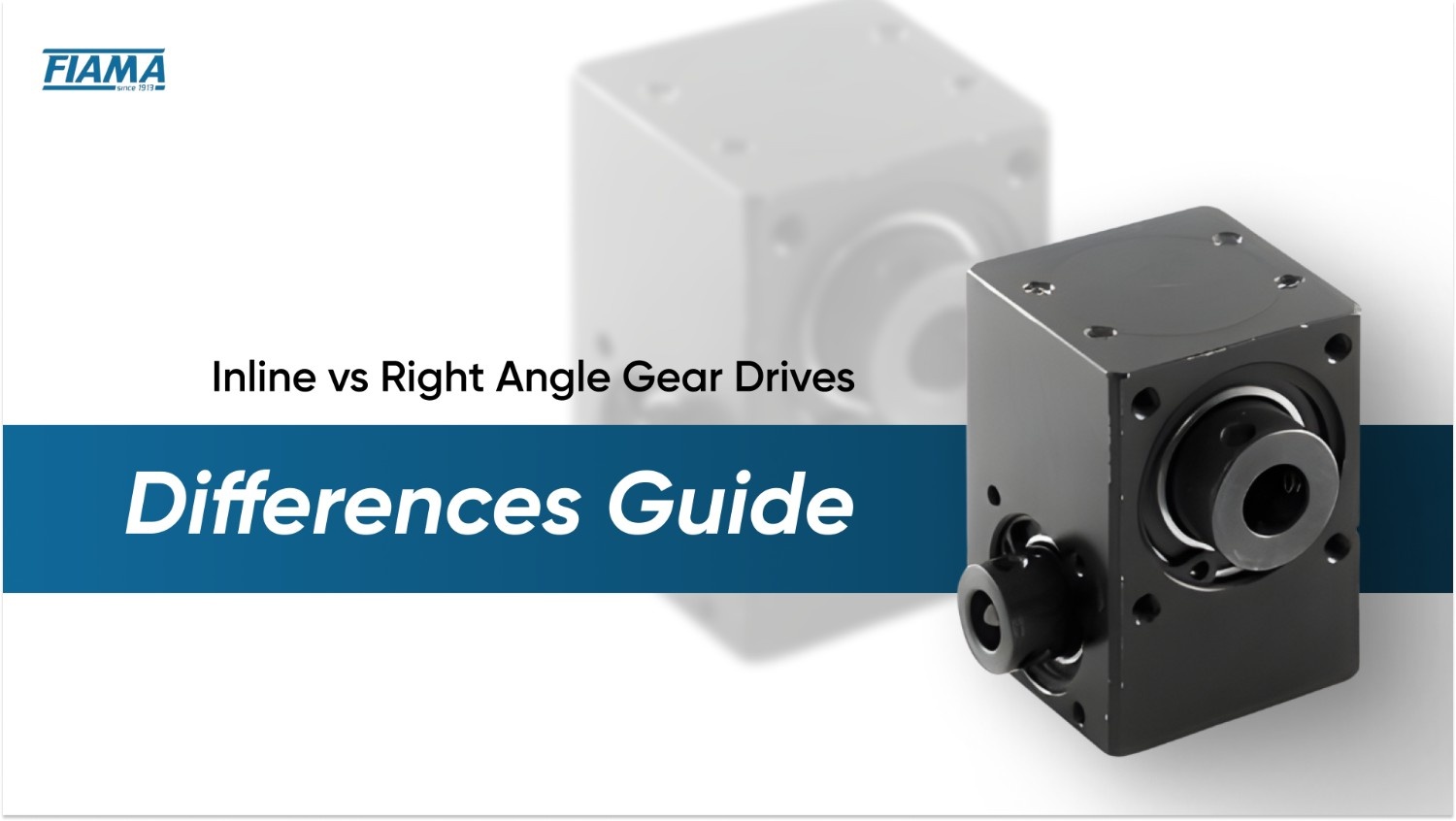
Right-angle gear drives, commonly using bevel, hypoid, or worm gears, transfer power at a 90-degree angle. They are ideal for applications where machinery layout or space constraints require a change in direction of motion.
Key characteristics:
Flexible installation in tight or complex layouts
Can handle torque transfer at angles without additional shafts
Slightly lower efficiency due to additional meshing surfaces and heat generation
Right-angle drives are widely used in robotics, printing machines, packaging equipment, and any scenario where linear alignment is impractical, but torque and speed must still be transmitted effectively.
Next, let’s examine the key differences that impact performance, efficiency, and maintenance.
Key Differences Between Inline and Right-Angle Drives
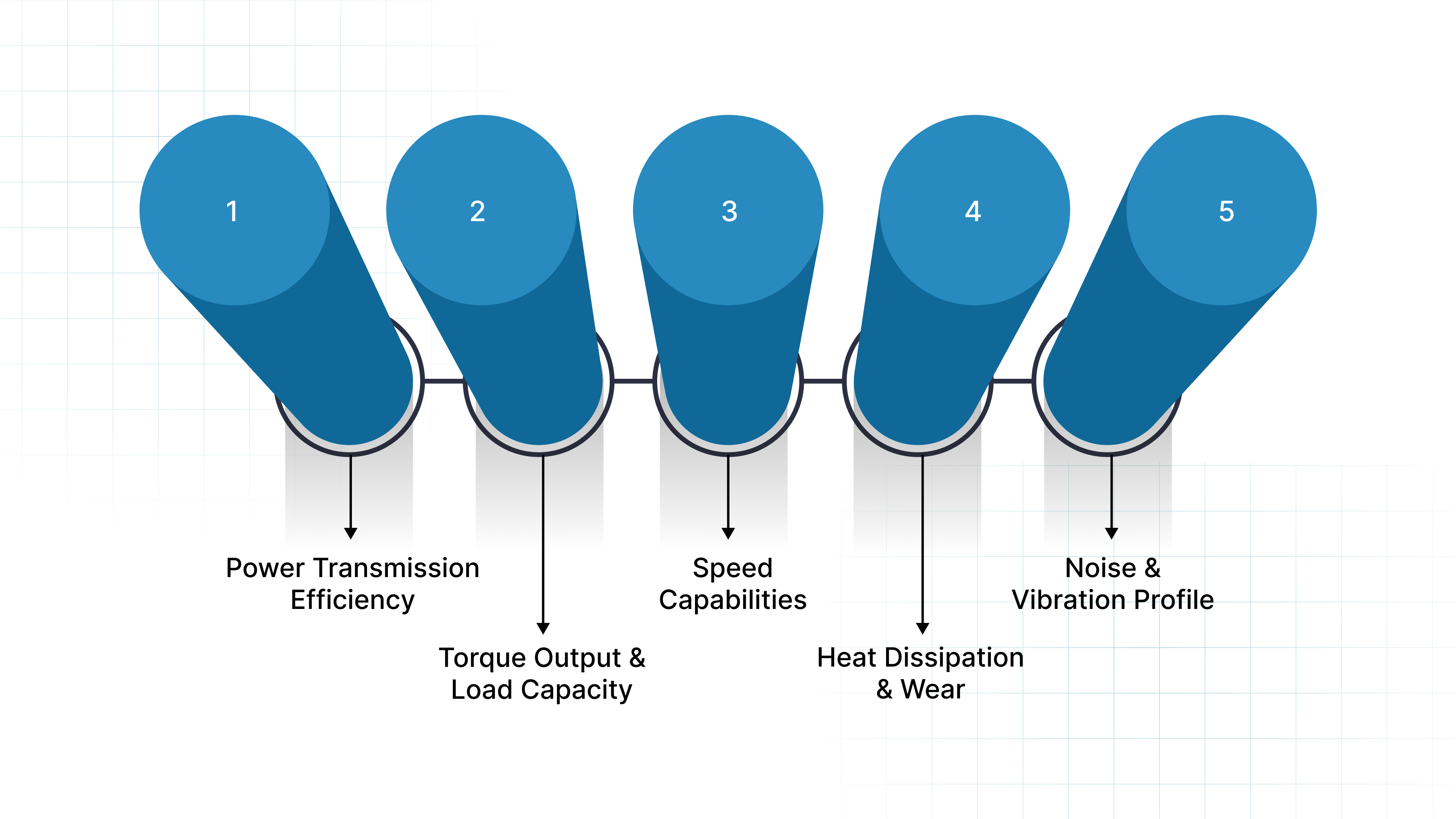
When comparing inline and right-angle gear drives, several technical and operational factors play a major role in determining the most suitable choice for a given application.
Below, we’ll compare inline vs right‑angle drives across crucial factors that often decide which setup is “fit for purpose.”
Power Transmission Efficiency
Inline and right-angle gear drives differ significantly in how efficiently they transmit power, a crucial factor for energy use, heat, and overall throughput.
Inline Gear Drive: Because the input and output shafts remain aligned and typically use spur or helical gears, inline drives offer a relatively simple, direct power path with minimal friction. This design usually delivers higher overall mechanical efficiency.
Right-Angle Gear Drive: Changing shaft direction (usually via bevel or worm-type gearing) introduces more gear meshing and, in some cases, sliding contact. That extra complexity often leads to slightly more loss of power through friction, reducing efficiency compared to inline designs.
If your application demands maximum efficiency and minimal losses, inline drives are more suitable, whereas right-angle options are chosen when directional changes outweigh efficiency trade-offs.
Torque Output & Load Capacity
Different gear drive orientations also influence how effectively torque and load are handled, a key concern for heavy machinery and production equipment.
Inline Gear Drive: The simpler, direct shaft alignment distributes load more evenly, enabling robust handling of radial loads and high torque without complex stress concentrations. This makes inline drives suitable for heavy-duty, high-throughput applications where load stability matters.
Right-Angle Gear Drive: Right-angle configurations, especially those with bevel or worm gears, can still provide good torque and even torque multiplication (useful for slow, high-torque requirements). However, because of more complex geometry and additional meshing, torque capacity may be somewhat limited compared to inline gearboxes of similar size.
Choose inline drives for smooth, consistent torque or right-angle drives when space is tight, and higher output torque is essential.
Speed Capabilities
Speed (input or output RPM) and how smoothly the gearbox handles varying speeds are important for equipment where throughput or precise motion control matters.
Inline Gear Drive: Because of the straightforward gear geometry (spur or helical) and minimized sliding contact, inline drives tend to handle higher input speeds efficiently. This makes them suitable for conveyors, high-speed packaging lines, or other continuous-motion systems.
Right-Angle Gear Drive: Speed capability depends heavily on the gear type. When using bevel (especially spiral or hypoid) gears, moderate to high speeds are possible. However, worm-type right-angle drives typically limit speed due to higher friction and sliding contact, making them a better fit for lower-speed, high-torque applications.
If your system prioritizes speed, inline drives are generally superior, while right-angle drives work best where speed is secondary to torque or space efficiency.
Heat Dissipation & Wear
Gear geometry and shaft orientation also influence heat generation, wear on gears and bearings, and maintenance intervals, all crucial for long-term uptime and reliability.
Inline Gear Drive: The simpler, rolling-contact gear meshing (spur/helical) tends to generate less friction per power transfer, reducing heat generation and wear. This tends to result in longer service life and lower maintenance frequency.
Right-Angle Gear Drive: Especially with worm or complex bevel gearing, sliding contact and directional change introduce more friction, which can generate more heat and accelerate wear on gears and bearings. That may require more frequent maintenance, careful lubrication, and sometimes more robust housings.
For heavy-duty, continuous, or long-run industrial applications where uptime matters, inline drives hold an advantage, whereas right-angle drives require more robust maintenance and thermal control.
Noise & Vibration Profile
In many industrial settings (especially food, pharma, packaging, or automation), noise and vibration aren’t just nuisances; they affect equipment life, precision, and working conditions.
Inline Gear Drive: With helical gears, tooth engagement is gradual and smoother, reducing shock loads, noise, and vibration. That makes inline drives favorable in applications where smooth operation and minimal vibration are priorities.
Right-Angle Gear Drive: Depending on the internal gearing (bevel, worm, hypoid), right-angle drives can introduce more vibration or noise, especially under heavy load or if alignment is not perfect. This trade-off arises from more complex meshing geometry and potential sliding contact in some designs.
If vibration, noise, or mechanical smoothness is critical (for instance, in packaging, clean-room, or precision automation), inline drives often provide a quieter, more stable solution. Right-angle drives may suffice where noise/vibration constraints are less strict, or layout dictates orientation.
In the following section, let's look at the installation and spatial requirements for selecting the correct gear drive.
Installation, Footprint & Space Constraints
Integrating a gear drive into an existing system often depends more on available space and mounting flexibility than on torque or speed ratings. Inline and right-angle drives behave differently in terms of layout, accessibility, and how they interact with surrounding components.
Understanding these spatial considerations helps you reduce redesign time, prevent interference issues, and streamline installation.
Inline Drive Fitment
Inline gear drives mount directly along the same axis as the motor and driven shaft, making them easier to integrate into systems that already follow a linear motion layout. They offer straightforward alignment but may demand more longitudinal space depending on the motor-gearbox combination.
Key Fitment Characteristics
Linear alignment: Inline drives connect directly in line with shafts, which reduces coupling requirements and makes installation predictable and simple—even for high-precision equipment.
Longer axial footprint: Because the gear drive extends in the same direction as the motor, these setups often require additional linear space. This can affect layouts with depth limitations or applications that must fit inside narrow enclosures.
Higher design flexibility for modular setups: Inline drives support modular expansions such as brakes, encoders, and sensors without complicating the installation, making them a common choice in packaging and automation systems.
Inline drives work best when your system supports linear mounting and can accommodate longer axial lengths without compromising access or safety clearances.
Right-Angle Drive Fitment
Right-angle drives change motion direction by 90 degrees, making them perfect for tight machine envelopes or layouts with limited straight-line room. Their compact, corner-friendly architecture allows more efficient use of vertical or horizontal space.
Key Fitment Characteristics
Compact, space-saving geometry: The 90° output shaft significantly reduces total equipment depth, allowing easier integration into cabinets, floorside installations, and low-profile automation frames.
Flexible Mounting Positions: They can be mounted in multiple orientations; horizontal, vertical, or side-mounted, making them suitable for multi-axis systems and applications with dynamic layouts.
Reduced Axial Space Demand: Since they redirect motion sideways instead of extending forward, right-angle drives are much better suited for enclosed cabinets, robotic joints, or equipment with fixed depth limitations.
Right-angle fitment supports compact, flexible designs where conserving space or redirecting power flow is essential. It provides installation versatility while optimizing the overall machine footprint.
In the next section, let's discuss cost, maintenance, and lifecycle performance considerations for gear drives.
Cost, Maintenance & Lifecycle Considerations
Inline and right-angle gear drives differ in how they wear, how often they need servicing, and what users can expect across years of operation. Understanding these distinctions helps engineering teams predict operating expenses more accurately and plan for long-term reliable performance.
Initial Cost Differences
The upfront cost of a gear drive influences project budgets, especially in high-volume machinery or multi-axis systems. Inline and right-angle drives differ in design complexity, which directly affects manufacturing costs and integration expenses.
Inline Gear Drive: Inline drives usually have a simpler axial layout with fewer intersecting components. This often reduces machining complexity and keeps base pricing more economical for many standard industrial models, especially in mid-torque ranges.
Right-Angle Gear Drive: Right-angle drives require bevel gears or worm gearing to redirect motion, adding precision machining steps and higher assembly tolerances. As a result, initial costs tend to be higher, particularly for high-efficiency spiral-bevel or hypoid systems.
While inline drives usually offer a lower entry cost, right-angle variants justify their higher price when space or orientation challenges demand a more engineered solution.
Longevity & Wear Patterns
Durability depends on how well the gear system handles load, alignment, and thermal stress. Each orientation distributes forces differently, shaping long-term wear behavior and component lifespan.
Inline Gear Drive: Inline systems experience more uniform load distribution along the shaft, which helps slow down wear. They typically show predictable aging patterns, especially when running at steady speeds and moderate torque levels.
Right-Angle Gear Drive: Right-angle drives introduce directional changes, which create additional side loads and friction points. Depending on the type of bevel or worm gearing, wear may concentrate in certain areas, potentially shortening lifespan in poorly lubricated or high-shock environments.
Choosing between the two comes down to understanding how your application loads the gears; inline drives excel in uniform conditions, while right-angle drives need closer attention to lubrication and alignment.
Servicing & Replacement Ease
Maintenance frequency and part replacement affect downtime costs. Accessibility, lubrication needs, and internal geometry directly affect serviceability.
Inline Gear Drive: Inline drives are typically easier to service because of their straight-through design. Technicians can quickly access seals, bearings, and shafts, reducing inspection time and maintenance disruption.
Right-Angle Gear Drive: Right-angle drives have more intricate layouts, which can make internal components harder to reach. Bevel and worm gears may need specialized tools or trained technicians, increasing service time and part costs.
Inline drives generally offer simpler maintenance pathways, while right-angle drives require more careful handling but remain manageable with proper preventive service schedules.
In the next section, let's discuss the application-wise comparison of both gear drives.
Application-Specific Comparison: Which to Use When?
Different industrial applications have unique requirements for torque, speed, space, and layout flexibility. Understanding which gear drive orientation fits best can directly impact equipment uptime, throughput, and operational costs.
The following table provides an application-wise comparison of inline and right-angle gear drives:
Industry / Equipment Type | Inline Gear Drives | Right-Angle Gear Drives |
High-Speed Conveyors | Ideal for continuous, high-speed operation where shafts can remain aligned. Supports consistent throughput with minimal energy loss. | Suitable only if layout constraints require angular shaft positioning; may need speed adjustments for durability. |
Packaging Lines | Works well in linear layouts with sufficient space. High torque stability helps maintain smooth production flow. | Excellent for compact packaging machinery or vertical configurations where space is tight. Enables flexible machine arrangements. |
Material Handling | Preferred for heavy-load conveyors and automated systems requiring continuous torque and minimal downtime. | Useful when machinery layout demands angular power transmission or when multiple levels of equipment are involved. |
Robotics & Automation | Provides precise, high-speed motion control for linear or planar tasks. Reduces vibration and improves operational accuracy. | Allows complex motion paths and angular actuation where machinery requires direction changes. Supports flexible automation layouts. |
Food & Pharma Processing | Supports long production lines with linear arrangement, maintaining consistent torque and minimizing downtime. | Optimal for modular or compact process lines where machinery must fit in tight spaces or follow angular paths. |
Each gear drive orientation excels in a specific context. Inline drives are typically favored when efficiency, speed, and continuous torque delivery matter most. Right-angle drives become essential in compact machinery, multi-axis layouts, or systems where equipment depth, floor space, or access limitations restrict design choices.
In the next section, let's weigh the pros and cons of each drive type to guide your final selection.
Pros and Cons of Inline vs Right Angle Gear Drives
When deciding between inline and right-angle gear drives, it's helpful to see the key advantages and trade-offs side by side. The table below summarizes the main points you should know:
Gear Type | Pros | Cons |
Inline Gear Drives | High efficiency due to a straight power path and minimal friction. Supports high torque and heavy loads consistently. Easier maintenance and simpler installation. | Requires more axial space, limiting use in compact layouts. Less flexible in changing the shaft direction. |
Right-Angle Gear Drives | Compact footprint allows flexible installation in tight spaces. Can redirect power efficiently in complex machine layouts. Suitable for directional changes in conveyors or automation lines. | Slightly lower efficiency due to additional gear meshing and sliding friction. May require more maintenance and careful alignment. |
This comparison helps operations leaders quickly assess which gear drive fits their requirements without needing to delve into detailed technical manuals.
Once you understand the pros and cons, the next step is applying these insights to select the right drive for your equipment.
How to Choose the Right Gear Drive for Your Application?
When selecting between inline and right‑angle gear drives, treat it like specifying any industrial component: match the drive to system requirements, not the other way around. Use a checklist like this before design or procurement:
Gear Drive Selection Checklist
Does the machine layout allow a linear shaft (inline), or is space/layout constrained (favor right‑angle)?
What are the torque, load, and radial load requirements?
What is the required operating speed (RPM)?
Are there requirements for direction changes, tight clearances or compact footprint?
How important is efficiency, thermal management, and long-term reliability for the line?
What is the maintenance budget, and how easy must servicing be?
What is the cost‑per‑unit (initial + lifecycle) budget constraint?
Is noise, vibration, or smooth operation a crucial factor (e.g., for food, pharma, packaging)?
Answering these questions helps align mechanical requirements with operational and business KPIs, throughput, uptime, maintenance cost, layout flexibility, and total cost of ownership.
How Fiama Helps You Select the Ideal Gear Drive System?
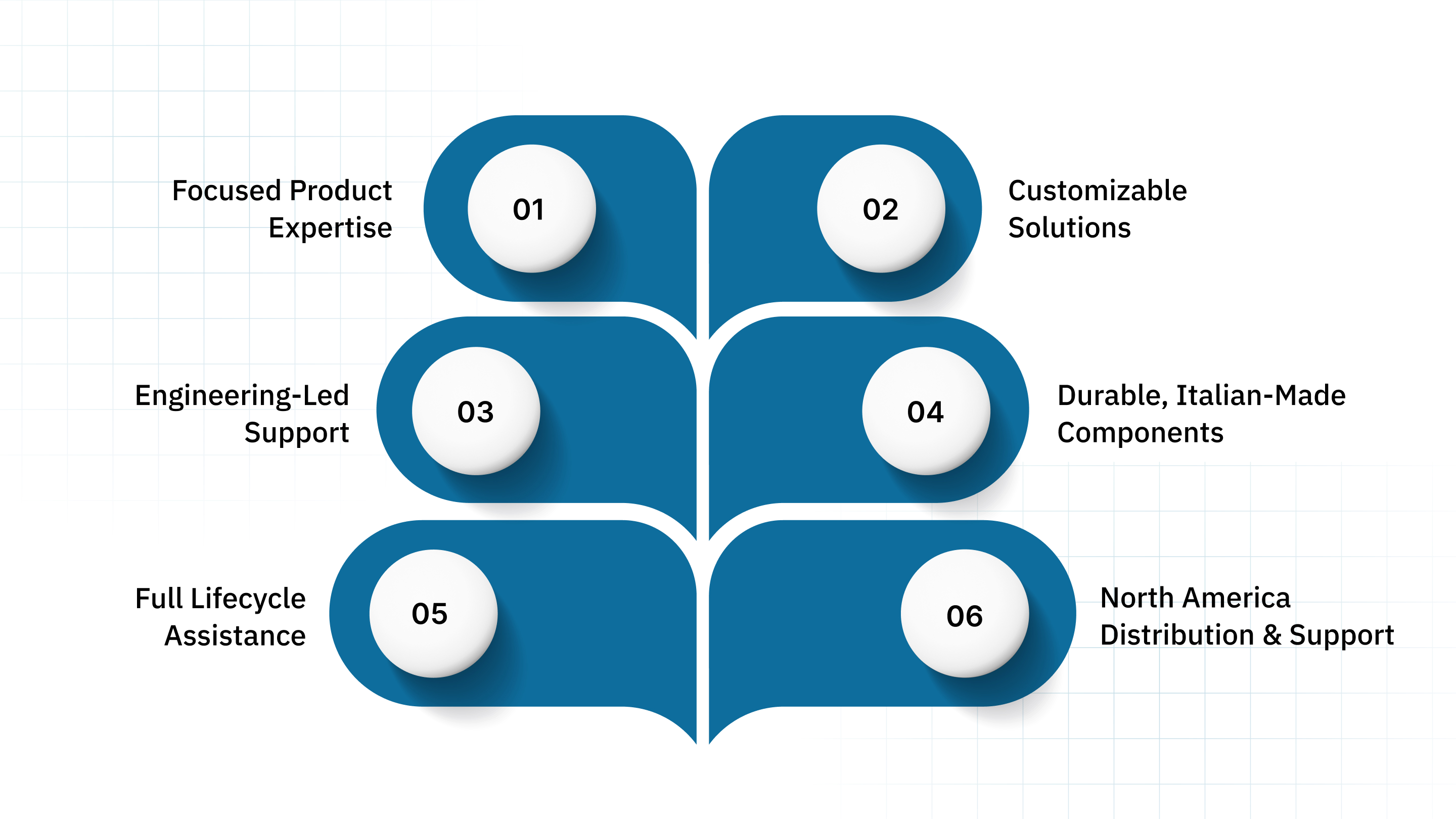
Fiama supports plant managers, engineers, and operations leaders in choosing the right gear drive by combining over 100 years of hands-on engineering expertise with practical product solutions.
Here’s how we can support you:
Focused Product Expertise: Fiama carries a curated range of industrial components, allowing their engineers to provide deep, application-specific guidance on gear drives, encoders, and servo systems, ensuring each recommendation matches your system requirements.
Customizable Solutions: From metal housings to custom stroke lengths, Fiama offers tailored variants that fit unique OEM applications, helping optimize space, torque, and efficiency without compromising operational goals.
Engineering-Led Support: Fiama’s degreed engineers work directly with your team to evaluate system torque, footprint, and speed needs. Their guidance ensures solutions align with real-world operational constraints, not theoretical specs.
Durable, Italian-Made Components: Fiama products feature robust metal housings and high-quality materials, giving your machinery longer operational life while reducing maintenance interventions and downtime.
Full Lifecycle Assistance: Fiama’s team guides you through initial selection, installation, and ongoing maintenance, ensuring drives perform consistently over their lifecycle while supporting throughput and minimizing scrap rates.
North America Distribution & Support: Through Edmar Metric LLC, Fiama ensures fast access to components, local technical support, and application assistance across the Americas, making it easier for plants to implement and scale solutions effectively.
By utilizing Fiama’s expertise, you can reduce downtime, extend machine life, and make informed procurement decisions that positively impact your operational KPIs.
Conclusion
Choosing between inline and right-angle gear drives is not just a matter of layout preference; it affects torque handling, efficiency, speed, wear, and long-term operational performance. Inline drives deliver high efficiency, simpler maintenance, and reliable performance in straight-line applications. Right-angle drives provide flexible installation in space-constrained environments, supporting complex layouts without compromising torque delivery.
Balancing factors such as equipment uptime, footprint, torque, speed, and lifecycle cost ensures the best choice for your operation. Fiama’s engineering-focused approach and customizable solutions help decision-makers select gear drives that meet both performance and operational goals.
For expert guidance on selecting the right gear drive system, contact us today to discuss your application requirements and explore tailored solutions.
FAQs
What is the primary difference between inline and right-angle gear drives?
Inline gear drives transmit power along the same axis, offering compact, straight-through power flow. Right-angle gear drives change the direction of power by 90°, allowing flexible equipment layouts but slightly increasing complexity and space requirements.
What types of gears are commonly used in inline gear drives compared to right-angle gear drives?
Inline gear drives typically use spur or helical gears for smooth, direct power transfer. Right-angle gear drives often employ bevel, hypoid, or worm gears to transmit torque efficiently while changing the shaft orientation.
Which gear drive type can handle higher radial loads on the shafts?
Inline gear drives with helical or spur gears generally handle higher radial loads better due to direct shaft alignment. Right-angle drives, especially worm gears, often have lower radial load capacity because of sliding contact and angular stress.
Are right-angle gear drives generally more expensive than inline gear drives?
Yes, right-angle gear drives are usually more expensive because they require more complex gear types, precision alignment, and additional housing considerations to efficiently transfer power at 90°, increasing manufacturing and installation costs.
What maintenance considerations differ between inline and right-angle gear drives?
Inline drives are easier to maintain due to simpler gear alignment and lubrication. Right-angle drives often need more frequent inspection, precise lubrication, and monitoring for wear on bevel or worm gears to prevent efficiency loss and overheating.