Introduction
A single mismatched encoder can cascade into calibration failures, unplanned downtime, and costly rework — which is why encoder vendor selection carries more weight than most procurement decisions. Across automation, robotics, medical equipment, and semiconductor manufacturing, rotary encoders are the feedback devices that determine whether a system holds tolerance or drifts. The global encoder market was valued at USD 3.01 billion in 2023 and is projected to reach USD 6.50 billion by 2030, growing at a CAGR of 11.6%. Rotary encoders alone account for 64.57% of that global revenue.
The US market tells the same story: currently valued at USD 1.1 billion, it's expected to reach USD 1.8 billion by 2036. Robot orders climbed 6.6% in early 2025 as manufacturers accelerated Industry 4.0 adoption — pulling encoder demand with them.
This article examines 10 of the most recognized rotary encoder manufacturers and distributors serving the US market, evaluated on product range, reliability, certifications, and support capability — so you can shortlist vendors matched to your application requirements and lead time constraints.
Key Takeaways
- Rotary encoders convert shaft rotation into electrical signals for precise motion control across industries
- US manufacturers range from heavy-duty specialists to compact OEM-focused suppliers
- Key selection factors include resolution, IP rating, signal output type, and available technical support
- Growing automation demand means more encoder options — but also more variation in quality and lead times
- FIAMA US stands out with engineer-led application support, stocked inventory, and competitive lead times for North American buyers
Overview of Rotary Encoders in US Industrial Applications
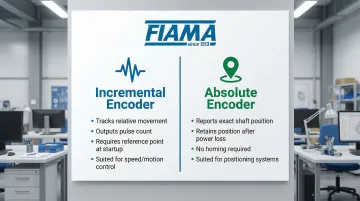
A rotary encoder is an electromechanical device that converts shaft position or motion into analog or digital output signals. Two primary types dominate industrial applications:
- Incremental encoders track relative movement by generating pulses proportional to shaft rotation, requiring a reference point at startup.
- Absolute encoders report the exact shaft position at all times, retaining position data even after power loss — ideal when losing a position reference is unacceptable.
In the US industrial context, rotary encoders are essential components in CNC machines, conveyors, robotics, elevators, packaging lines, and agricultural equipment. As manufacturers invest in automation and Industry 4.0 technologies, demand for accurate feedback devices is accelerating.
The numbers reflect that shift: robot orders increased 6.6% in early 2025, signaling strong demand for precise position feedback across factory floors.
With that context in mind, the following list covers 10 leading manufacturers and distributors serving the US market, evaluated on product portfolio breadth, reliability, certifications, and support capability.
Top 10 Rotary Encoder Manufacturers in the US
Each company below was selected based on product portfolio breadth, US market presence, technical certifications, and ability to serve diverse industrial applications.
Encoder Products Company (EPC)
Idaho-based EPC manufactures the Accu-Coder® product line, specializing in incremental and absolute rotary encoders with in-house engineering, machining, and assembly capabilities. Their vertically integrated 100,000-square-foot facility enables complete US-based production.
Differentiators: Made-in-USA positioning, flexible mounting options including shafted, hollow-shaft, and kit encoders, strong OEM customization capability, and fast lead times for automation, packaging, and material handling applications. ISO 9001:2015 certified.
| Attribute | Details |
|---|---|
| Key Product Lines | Accu-Coder® incremental and absolute encoders, hollow-shaft and kit encoders |
| Encoder Types Supported | Incremental, Absolute |
| Best Suited For | OEMs, automation, packaging, material handling |
Dynapar (Fortive)
One of the most recognized US encoder brands under Fortive, Dynapar's portfolio includes sub-brands NorthStar and Harowe, covering incremental encoders, absolute encoders, and resolvers for industrial and heavy-duty environments.
Differentiators: Broad product portfolio with proven durability in shock, vibration, and harsh environments. Widely deployed in factory automation, elevators, cranes, and energy systems. Offers ATEX-certified models for hazardous locations, backed by global engineering resources.
| Attribute | Details |
|---|---|
| Key Product Lines | Incremental & absolute encoders, brushless resolvers, industrial feedback devices |
| Encoder Types Supported | Incremental, Absolute, Resolver |
| Best Suited For | Factory automation, elevators, cranes, energy systems |
US Digital
Washington State-based manufacturer offering optical incremental and absolute encoders, compact motor encoders, and kit encoders—popular among OEMs and robotics developers for quick delivery and competitive pricing.
Differentiators: Strong focus on miniaturized, high-resolution designs with over one million off-the-shelf configurations. Broad product catalog with customization options. US manufacturing since 1980 ensures supply chain reliability. Valued in robotics, medical equipment, and CNC systems.
| Attribute | Details |
|---|---|
| Key Product Lines | Optical incremental & absolute encoders, motor/kit encoders, miniature encoders |
| Encoder Types Supported | Incremental, Absolute |
| Best Suited For | Robotics, medical devices, CNC machinery |
Sensata Technologies
US-headquartered industrial technology company offering rotary encoders under its Sensing Solutions segment, alongside a broader portfolio of sensors and embedded systems for aerospace, industrial, and medical verticals.
Differentiators: Diverse product portfolio spanning rotary encoders, linear encoders, draw wire sensors, and inclinometers, supported by multiple established sub-brands. Serves high-stakes sectors including aerospace & defense, material handling, and professional food equipment.
| Attribute | Details |
|---|---|
| Key Product Lines | Rotary encoders, linear encoders, draw wire sensors, inclinometers |
| Encoder Types Supported | Incremental, Absolute |
| Best Suited For | Aerospace, defense, industrial automation, material handling |
Honeywell
Global technology leader with extensive US operations, focusing on contactless magnetic and Hall-effect rotary position sensors rather than traditional optical encoders—delivering long service life and high reliability.
Differentiators: Engineered for harsh environments including dust, moisture, and temperature extremes. Non-contact technology eliminates wear. Trusted in industrial automation, aerospace, HVAC, and transportation. Strong R&D capabilities and comprehensive industry certifications.
| Attribute | Details |
|---|---|
| Key Product Lines | Contactless Hall-effect rotary sensors, magnetic position sensors |
| Encoder Types Supported | Absolute (contactless/magnetic) |
| Best Suited For | Harsh environments, aerospace, HVAC, transportation |
Avtron (Nidec / Avtron Automation)
Part of Nidec, Avtron is a specialized US-market manufacturer with a strong reputation in heavy-duty incremental encoders built for extreme shock, vibration, and temperature conditions.
Differentiators: Rugged housings designed for the most demanding environments. ATEX and IECEx options for hazardous locations including explosive atmospheres. Widely deployed in mining, steel mills, conveyors, elevators, and wind energy—focused on minimizing downtime in extreme conditions.
| Attribute | Details |
|---|---|
| Key Product Lines | Rugged incremental encoders, hollow-shaft encoders, heavy-duty industrial encoders |
| Encoder Types Supported | Incremental (heavy-duty) |
| Best Suited For | Mining, steel mills, conveyors, wind energy |
BEI Sensors
Well-established US market encoder supplier (operating under Sensata Technologies) offering optical and magnetic incremental and absolute encoders, known for high accuracy, rugged configurations, and compliance with strict aerospace and defense standards.
Differentiators: Custom encoder configurations for demanding applications. Strong track record in aerospace, defense, and medical sectors. High environmental resistance including wash-down and hazardous area ratings. Precision specifications are validated against stringent aerospace and defense qualification standards.
| Attribute | Details |
|---|---|
| Key Product Lines | High-performance optical & magnetic encoders (incremental & absolute) |
| Encoder Types Supported | Incremental, Absolute |
| Best Suited For | Aerospace, defense, medical, specialized industrial |
Grayhill
US-based manufacturer combining encoder technology with human-machine interface (HMI) solutions, producing optical and mechanical rotary encoders for panel mounting, industrial controls, and aerospace-grade applications.
Differentiators: Long life cycles with consistent signal output and precise tactile feedback. In-house molding and tooling capabilities. Trusted in avionics, defense, industrial automation, and professional equipment interfaces. US manufacturing heritage with finely tuned haptics for control applications.
| Attribute | Details |
|---|---|
| Key Product Lines | Panel-mount optical & mechanical encoders, haptic/volume encoders |
| Encoder Types Supported | Incremental (optical & mechanical) |
| Best Suited For | Avionics, defense, industrial controls, HMI panels |
Bourns, Inc.
Globally recognized electronics manufacturer with strong US engineering roots, offering contacting, optical, and potentiometric rotary encoders for industrial, automotive, and consumer electronics applications.
Differentiators: Compact designs with stable electrical performance and cost-effective pricing suited for high-volume production. Widely used in control panels, HVAC, automotive electronics, and instrumentation. Strong distribution network ensures availability.
| Attribute | Details |
|---|---|
| Key Product Lines | Contacting & optical rotary encoders, potentiometric encoders, control knobs |
| Encoder Types Supported | Incremental, Potentiometric |
| Best Suited For | Automotive electronics, HVAC, control panels, consumer electronics |
FIAMA US
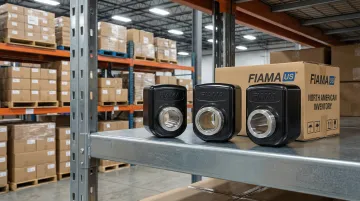
Headquartered in Luling, Louisiana, FIAMA US is a North American distributor of Italian-made FIAMA industrial components—including rotary encoders and position sensors—selected through comparative testing for superior quality at competitive price points and short lead times.
Differentiators: Staff comprised entirely of degreed engineers—not commissioned salespeople—providing application-matched technical support that generalist distributors rarely offer. ISO 9001 certified with extensive inventory across food, pharma, semiconductor, packaging, robotics, and metalworking applications. Stainless steel and hollow-shaft encoder configurations available for harsh and washdown environments.
| Attribute | Details |
|---|---|
| Key Product Lines | Rotary encoders (EN Series hollow-shaft, 14–25mm bore), position sensors, industrial measurement components |
| Encoder Types Supported | Incremental, Absolute |
| Best Suited For | Food & pharma, semiconductor, packaging, robotic systems, metalworking |
How We Chose the Best Rotary Encoder Manufacturers
These manufacturers were assessed based on product portfolio breadth, US market presence and availability, certifications (ISO, CE, ATEX), technical support quality, delivery lead times, and ability to serve diverse industrial applications.
The most common mistake buyers make is prioritizing brand name over application fit, which leads to over-specified or incompatible encoder selections. Resolution and signal output type (incremental vs. absolute, SSI vs. CAN) must match your control system before anything else.
Environmental ratings deserve equal attention. IP65 handles dust and water jets, IP67 covers temporary immersion, and IP69K is required for high-pressure washdown environments — each one is a different specification, not just a higher number.
Critical selection criteria include:
- Resolution (PPR/CPR) matched to your actual precision requirements — not the highest available
- Output interface compatibility with your control system (HTL, TTL, SSI, CANopen, analog)
- Shaft configuration suited to your mounting setup (solid, hollow, blind hollow, or kit/modular)
- Environmental protection covering IP rating, operating temperature range, and chemical resistance
- Certifications required for your environment — ATEX for hazardous areas, UL for certain US applications, CE for European markets
- Customization options if you have OEM-specific requirements
- Total cost of ownership, accounting for lead time and support responsiveness — not just unit price
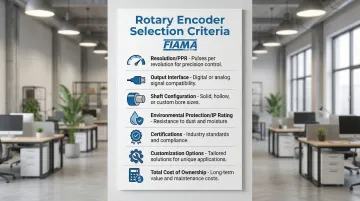
These criteria together determine fit — not just on paper, but in the field. ISO 9001 confirms a baseline of process discipline, but application-specific testing and genuine engineering consultation distinguish reliable long-term partners from one-time vendors.
Conclusion
The right rotary encoder manufacturer should align with your specific operational requirements—resolution, environment, communication protocol, and support model—not just brand recognition or lowest price.
Before finalizing a supplier, evaluate:
- Engineering depth and application expertise
- Lead time reliability and US inventory availability
- Customization capability for OEM or high-throughput requirements
- Post-sale technical support model
For industrial applications where downtime is costly, a supplier's logistics and support structure matter as much as the encoder's specifications.
FIAMA US is worth evaluating if you need Italian-manufactured components, short lead times from extensive US inventory, and application support from degreed engineers who operate without sales quotas or commission pressure. Contact the team at fiama-us.com or call 504-352-0986 for application-specific guidance.
Frequently Asked Questions
What is a rotary encoder and how does it work?
A rotary encoder is an electromechanical sensor that converts shaft rotation into electrical output signals (digital or analog). Incremental types track relative movement via pulse counts, while absolute types report exact shaft position at all times—even after power loss.
What is the difference between incremental and absolute rotary encoders?
Incremental encoders output pulses proportional to movement and require a reference point at startup. Absolute encoders provide a unique position value at all times, making them preferable for applications where power loss or loss of position reference is a concern.
What industries use rotary encoders the most in the US?
Key sectors include factory automation, robotics, packaging, CNC machining, food and beverage processing, pharmaceutical equipment, semiconductor manufacturing, and aerospace.
What should I look for when choosing a rotary encoder manufacturer?
Evaluate resolution (PPR/CPR), output signal type (HTL, TTL, SSI, CANopen), IP rating for environmental protection, shaft configuration (solid vs. hollow), customization options, lead time, and whether the supplier offers engineering support—not just a parts list.
What certifications matter for rotary encoder manufacturers?
ISO 9001 indicates quality management systems. CE marks are required for European markets. ATEX certification is critical for hazardous/explosive environments. UL listing may be required for specific US industrial or safety applications.
What is a typical lead time for rotary encoders from US-based manufacturers?
Standard stocked items from US-based manufacturers or distributors typically ship within 1–5 business days. Custom-configured or made-to-order encoders may range from 2–8 weeks depending on the manufacturer's production capacity and supply chain.