 in the US](https://file-host.link/website/fiama-us-lyvx17/assets/blog-images/d9bbb8de-3e5f-425d-b296-36b573e86343/1771929250248084_cb06b8e759814a0ca62305704d5ee7e6/360.webp)
Introduction
Flexible shaft couplings do one job—and when they fail, production stops. In food processing lines, semiconductor fabs, pharmaceutical packaging systems, and metalworking equipment, these components absorb misalignment and shock loads that would otherwise damage motors, bearings, and driven equipment. When a coupling is wrong for the application, the consequences show up fast: vibration, premature bearing wear, and unplanned downtime.
Selecting the right supplier is rarely straightforward. Dozens of manufacturers and distributors serve the US market, each offering different torque capacities, misalignment tolerances, material options, and levels of engineering support. Choosing on price or brand name alone often leads to the wrong coupling for the job — and failure at the worst possible time.
This guide profiles the top 10 flexible shaft coupling manufacturers and distributors serving US industrial buyers. For each, we break down engineering depth, product range, certifications, and lead times — so you can match the supplier to your actual application, not just a catalog number.
Key Takeaways
- Flexible shaft couplings transmit torque while compensating for misalignment and absorbing shock—essential in every industrial drive system
- US suppliers range from domestic manufacturers to internationally-backed distributors—with significant differences in engineering depth and product breadth
- Choosing the right coupling means matching type, torque/speed ratings, and environmental conditions to your specific application
- This list covers 10 leading suppliers serving North American buyers across food processing, pharma, semiconductor, packaging, and heavy industry
- FIAMA US (Luling, LA) stands out for engineer-staffed (not sales-driven) support, ISO 9001-certified Italian manufacturing, and stocked inventory for fast turnaround
Overview of Flexible Shaft Couplings in US Manufacturing
A flexible shaft coupling is a mechanical device designed to connect two rotating shafts while compensating for angular, parallel, or axial misalignment—and protecting drivetrain components from shock and vibration without rigid mechanical constraint.
The global industrial couplings market was valued at $400.5 million in 2024 and is projected to reach $600.4 million by 2033, growing at a CAGR of 4.6%. Flexible couplings currently hold the largest market share at 35.4%, driven by demand for high-speed automation and precision motion control.
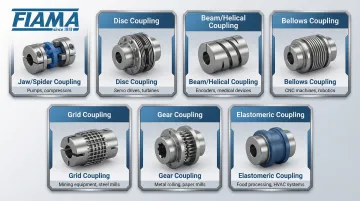
Primary coupling types serving US industrial buyers include:
- Jaw/spider couplings – Vibration damping with fail-safe operation; common in pumps and compressors
- Disc couplings – Zero-backlash and high torsional stiffness, preferred for servo drives and turbines
- Beam/helical couplings handle multi-axis misalignment in a single piece — well suited for encoders and medical devices
- Bellows couplings – High torsional rigidity for CNC machines and robotics
- Grid couplings deliver high torque density with built-in shock absorption, making them a standard choice for mining and steel mills
- Gear couplings – Highest torque capacity available; used in metal rolling mills and paper processing
- Elastomeric couplings offer maintenance-free damping, widely specified in food processing and HVAC
Selecting the right coupling type comes down to torque range, misalignment tolerance, and whether your application demands zero-backlash precision or shock absorption. The manufacturers below cover each of these requirements across the industries where US buyers are most active.
Top 10 Flexible Shaft Coupling Manufacturers in the US
Choosing the right coupling manufacturer affects system reliability, lead times, and total cost. These ten companies were evaluated on product range, engineering capability, US market presence, certifications, lead time reputation, and industry breadth.
FIAMA US
FIAMA US, headquartered in Luling, Louisiana, is the North American distributor of FIAMA's Italian-manufactured precision industrial couplings, serving sectors from food and pharma to semiconductor, robotics, automotive, and packaging.
The team is staffed entirely by degreed engineers (not commissioned salespeople), operates under ISO 9001 certification, and carries an extensive, fast-shipping inventory at competitive price points. FIAMA US also builds custom configurations beyond catalog offerings, including flexible shafts, semi-rigid couplings, universal joints, and telescopic shaft systems with stainless steel AISI 303 terminals suited for food-grade and pharmaceutical environments.
| Headquarters | Luling, Louisiana, USA (manufacturing in Italy) |
|---|---|
| Key Coupling Types | Flexible shafts (AF-M, TR, FAP-M), semi-rigid couplings (GR, ASR), universal joints (GC, GCC), telescopic shafts, rigid shafts |
| Certifications / Strengths | ISO 9001; engineer-staffed team; short lead times; no commissioned sales staff; custom configurations available |
Lovejoy (Dodge / ABB)
Lovejoy, now fully integrated into the Dodge brand under ABB, is one of the most recognized flexible coupling names in the US, with a history spanning over a century. The product range covers jaw, disc, grid, and gear couplings for heavy industrial use.
Key strengths include an extensive North American distribution network, a torque range from fractional horsepower to 7 million lb-in (Grid-Lign series), and OEM relationships in mining, oil & gas, and material handling.
| Headquarters | Simpsonville, South Carolina, USA |
|---|---|
| Key Coupling Types | Elastomeric (Raptor, Para-Flex, D-Flex, StarFlex jaw), metallic (Grid-Lign, gear, disc, chain) |
| Certifications / Strengths | Broad industrial distribution; OEM presence; high torque range up to 7 million lb-in |
Rexnord (Regal Rexnord)
Rexnord is a Milwaukee-based industrial manufacturer with a coupling portfolio that includes Thomas disc couplings, gear couplings, and elastomeric designs. Following the 2021 merger with Regal Beloit, the Rexnord brand serves process industries, power generation, and heavy equipment.
The company is known for engineered-to-order capability and high-temperature, high-torque variants. Thomas disc couplings are specified for infinite-life designs in turbine-driven applications where coupling failure carries significant downstream costs. Key facilities are in Milwaukee, WI and Florence, KY.
| Headquarters | Milwaukee, Wisconsin, USA |
|---|---|
| Key Coupling Types | Disc (Thomas brand), gear, elastomeric, and grid couplings |
| Certifications / Strengths | Engineered-to-order options; strong in process industries; high-torque capability; turbine-grade designs |
Ruland Manufacturing
Ruland, based in Marlborough, Massachusetts, specializes in precision shaft couplings — beam, bellows, oldham, disc, and rigid types — primarily for motion control, robotics, medical equipment, and semiconductor applications.
All couplings are manufactured in-house in the US, with same-day shipping on stocked items placed before 4:30 PM EST. Designs feature zero-backlash construction and full RoHS3 compliance, making them a reliable choice for servo and encoder applications where positioning accuracy matters.
| Headquarters | Marlborough, Massachusetts, USA |
|---|---|
| Key Coupling Types | Beam, bellows, oldham, disc, jaw couplings |
| Certifications / Strengths | US-manufactured; same-day shipping; zero-backlash; RoHS3 compliant |
R+W America
Zero-Max, headquartered in Plymouth, Minnesota, manufactures flexible shaft couplings — including their well-known Composite Disc (CD) couplings — for servo, motion control, and general industrial applications across the US and internationally.
Their proprietary composite disc design offers zero backlash, high misalignment tolerance, and maintenance-free operation using a patented composite material rather than metal. The result is high vibration damping, and the couplings are widely specified in packaging, printing, food processing equipment, and dynamometer test rigs.
| Headquarters | Plymouth, Minnesota, USA |
|---|---|
| Key Coupling Types | Composite disc, servo, and industrial flexible couplings |
| Certifications / Strengths | Zero backlash; maintenance-free; patented composite material; strong presence in packaging and printing |
Helical Products (Helical Flex)
Helical Products, a brand of MW Components based in Santa Maria, California, is a specialist manufacturer of helical beam couplings, servo couplings, and flexible shafts, primarily serving precision motion control, medical, aerospace, and semiconductor industries.
Their proprietary "HELI-CAL" helical cut designs are machined from aluminum, stainless steel, and titanium, delivering flexibility and zero backlash in a compact, one-piece form factor. By eliminating mechanical joints, the flexure design provides constant velocity — a configuration preferred by OEM engineers where space and precision are both non-negotiable.
| Headquarters | Santa Maria, California, USA |
|---|---|
| Key Coupling Types | Helical beam, servo, and flexible shaft couplings |
| Certifications / Strengths | Proprietary helical design; one-piece construction; compact form; OEM-preferred for medical and aerospace |
Boston Gear (Regal Rexnord)
Boston Gear became part of the Regal Rexnord group following the March 2023 acquisition of Altra Industrial Motion. The brand offers flexible couplings — including jaw, grid, and disc types — for general industrial and power transmission applications.
The primary buying case here is breadth: Boston Gear's catalog covers speed reducers, gearing, and couplings, enabling buyers to consolidate suppliers. Its distribution network spans North America, with particular depth in packaging and material handling through the combined Regal Rexnord portfolio.
| Headquarters | Charlotte, North Carolina, USA (brand operations in Radford, VA and other sites) |
|---|---|
| Key Coupling Types | Jaw, grid, and disc couplings |
| Certifications / Strengths | Wide distributor network; OEM relationships; full power transmission product suite |
Renold Ajax
Renold Ajax, the US arm of UK-based Renold plc, manufactures and distributes flexible couplings — gear, pin & bush, spiderjaw, and tyreflex types — for mining, aggregate, cement, primary metals, and material handling from their Westfield, New York facility.
Renold Ajax is the name to know in heavy-duty, high-shock environments. The Westfield facility designs and manufactures custom gear spindles for steel mill applications and fluid traction couplings for subway rail cars. Renold Clutches & Couplings holds BS EN ISO 9001:2000 certification.
| Headquarters | Westfield, New York, USA (parent: UK) |
|---|---|
| Key Coupling Types | Gear couplings, pin & bush, spiderjaw, tyreflex, and fluid couplings |
| Certifications / Strengths | BS EN ISO 9001:2000; heavy-duty and high-shock applications; US manufacturing; mining, steel, and rail focus |
Regal Rexnord (Falk Brand)
The Falk brand, now operating under Regal Rexnord, covers gear-type flexible couplings and grid couplings for large-scale industrial drives — steel, paper, mining, and power generation among them.
Steelflex Grid couplings are the most specified grid coupling in North America, handling loads up to 8,250,000 lb-in with bore capacity up to 20 inches. Lifelign Gear Couplings use a triple-crowned teeth design for high torque and misalignment capacity. Both come backed by a 5-year heavy-duty warranty when used with Falk Long Term Grease (LTG).
| Headquarters | Milwaukee, Wisconsin, USA (Regal Rexnord parent) |
|---|---|
| Key Coupling Types | Steelflex grid couplings, Lifelign gear couplings, high-torque industrial couplings |
| Certifications / Strengths | Legacy industrial brand; high-torque specialization up to 8.25 million lb-in; 5-year warranty; steel, paper, and mining applications |
How We Chose the Best Flexible Shaft Coupling Manufacturers
We assessed manufacturers and distributors on product range breadth (covering multiple coupling types and torque classes), US market presence, documented engineering support capability, certifications (especially ISO 9001 or equivalent), and industry feedback on lead times and reliability.
Choosing purely on catalog price often leads to misapplication and premature coupling failure — making these criteria essential for long-term equipment reliability.
The criteria most critical to end-users include:
- Misalignment accommodation capacity (angular, parallel, axial)
- Backlash specification for precision vs. general-purpose use
- Environmental suitability (food-grade materials, corrosion resistance, high-temperature capability)
- Whether the supplier offers genuine application engineering vs. pure order-taking
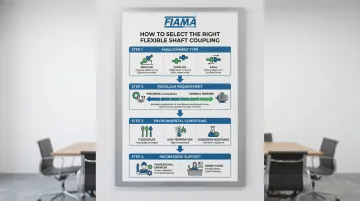
Even when those criteria are met, buyers frequently select a coupling by bore size and torque rating alone — overlooking torsional stiffness, damping characteristics, or shaft material compatibility. That shortcut can result in resonance, accelerated bearing wear, or drivetrain damage even when the coupling appears correctly sized on paper. ANSI/AGMA 9009-E20 (R2025) provides the standard nomenclature and classification to guide these decisions and prevent costly failures.
Conclusion
Choosing a flexible shaft coupling supplier is an engineering decision, not just a procurement one. The right choice directly impacts equipment uptime, maintenance intervals, and drivetrain longevity across industries from food and pharma to robotics and metalworking.
Look beyond brand name and catalog availability. Evaluate whether the supplier's team can actually help size and specify the right coupling for your application, and whether their inventory and lead times support operational continuity.
For buyers in North America looking for an engineer-backed source of precision flexible couplings—with ISO 9001 quality, Italian-made components, and genuinely short lead times—FIAMA US (Luling, Louisiana) offers a direct line to application specialists who are degreed engineers with no sales quotas. Contact FIAMA US at info@fiama-us.com or 504-352-0986.
Frequently Asked Questions
What is a flexible shaft coupling used for?
Flexible shaft couplings connect two rotating shafts to transmit torque while accommodating angular, parallel, or axial misalignment. They also dampen vibration and protect sensitive drivetrain components from shock loads, making them essential in virtually every industrial drive system.
What are the main types of flexible shaft couplings?
The primary categories include jaw/spider, disc, beam/helical, bellows, gear, oldham, grid, and elastomeric couplings. Each type offers different trade-offs in backlash, torsional stiffness, misalignment capacity, torque density, and environmental suitability. Proper selection is critical to application success.
What is the difference between a flexible coupling and a rigid coupling?
Rigid couplings allow zero relative movement between shafts and are used only where shafts are precisely aligned. Flexible couplings intentionally accommodate misalignment, absorb vibration, and protect connected equipment. They are far more common in real-world applications where perfect shaft alignment cannot be guaranteed.
How do I select the right flexible shaft coupling for my application?
Start by evaluating torque, speed, shaft sizes, misalignment type, backlash tolerance, operating environment, and torsional damping needs. Consult a supplier with degreed application engineers — catalog selection alone risks resonance, premature wear, and equipment damage.
Do flexible shaft couplings require maintenance?
Maintenance requirements vary by coupling type. Gear couplings need periodic lubrication and wear inspection. Elastomeric jaw and disc couplings are largely maintenance-free but require periodic checks for wear or fatigue cracking. Beam, bellows, and composite disc couplings typically need no maintenance at all.
What industries commonly use flexible shaft couplings?
Flexible couplings are used across food and beverage processing, pharmaceutical manufacturing, semiconductor equipment, packaging machinery, robotics, automotive assembly, metalworking, printing, medical devices, mining, power generation, and HVAC systems — any industry relying on motor-driven rotating equipment where misalignment compensation and vibration damping are required.