
Introduction
When a pharmaceutical filling machine drifts by just 0.5mm during a production run, the result isn't just cosmetic—it's thousands of units rejected, regulatory audits triggered, and production lines halted. Across modern industrial operations, from food processing conveyors to semiconductor wafer handlers, precise position control is the critical layer separating smooth operations from costly downtime, product waste, and safety incidents.
Position indicators sit at the center of this precision. Whether mechanical, digital, or electronic, these devices provide real-time feedback on the exact location of valve stems, lead screws, actuators, and handwheels. Choosing the right manufacturer, however, means more than comparing spec sheets.
The right fit depends on:
- Measurement accuracy and resolution
- Environmental and IP ratings for your facility
- Application compatibility (valve, screw, actuator)
- Lead times and inventory availability
- Engineering support and application expertise
The profiles below cover 10 manufacturers and suppliers worth knowing—what each does best, where they fall short, and which applications they're built for.
Key Takeaways
- Position indicators measure and display the exact position of machine components in real time—critical for maintaining process accuracy
- Top manufacturers specialize in different technologies: mechanical analog dials, digital electronic displays, and encoder-based systems
- Choose based on measurement accuracy, IP rating, certifications, connectivity, and supplier lead times
- Ten suppliers dominate the global market, each with distinct strengths in technology, accuracy, and industry focus
- Verify that your supplier's team can match specs to your application—not just move inventory
What Are Position Indicators and Why Do They Matter in Industrial Settings
Position indicators are devices—mechanical, digital, or electronic—that measure and display the linear or rotational position of machine elements such as valve stems, lead screws, handwheels, or actuators. The two main categories differ significantly in how they operate:
- Mechanical dial-type indicators use gear-driven digit drums to show position without requiring power
- Electronic and encoder-based models provide digital readouts with remote monitoring and PLC integration
Positional accuracy is mission-critical across industries. Unplanned downtime costs the world's 500 largest companies $1.4 trillion annually, with automotive manufacturing facing up to $2.3 million per hour in idle line costs.
The downstream costs extend further. In food and beverage packaging, positional inaccuracy and overfilling costs individual production lines $280,000 to $440,000 annually. In pharmaceuticals, positioning drift can trigger batch rejections and compliance violations — both far more expensive than the indicator itself.

Choosing the right supplier determines whether you get a component that fits your application — or one that creates problems months later. The manufacturers below represent the strongest options across product range, certifications, and real-world industrial performance.
Top 10 Position Indicator Manufacturers and Suppliers
These manufacturers were evaluated across five criteria:
- Product quality and manufacturing standards
- Application range and industry coverage
- Certifications and compliance ratings
- Lead time reliability and inventory depth
- Technical support capability
FIAMA US
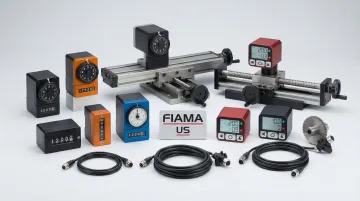
FIAMA is an ISO 9001-certified distributor and supplier of Italian-made position indicators serving North American industrial markets. Their product range covers mechanical digital position indicators, electronic displays with RS485 MODBUS RTU connectivity, hollow shaft models, and measurement components for industries from food and pharma to semiconductor and packaging.
FIAMA's team is comprised entirely of degreed engineers — no commissioned salespeople, no sales quotas. Recommendations are driven by application fit. They maintain extensive inventory for short lead times, offer competitive pricing, and focus on a limited product line to ensure deep expertise in every component they carry.
| Category | Details |
|---|---|
| Key Product Types | Mechanical digital position indicators, electronic position indicators with LCD displays, hollow shaft models (OP2, OP3, OP7, EP7 series), battery-powered programmable indicators, position indicator right-angle gearbox accessories |
| Certifications & Standards | ISO 9001 Quality Management System; Italian-manufactured components |
| Industries Served | Food & beverage, pharmaceutical, semiconductor, packaging, metalworking, robotics, medical equipment, automotive manufacturing |
SIKO GmbH
SIKO is a German manufacturer specializing in position indicators, encoders, and measurement systems, with decades of experience supplying precise position feedback components for machine tools, packaging equipment, and automation systems. Headquartered in Buchenbach, Germany, SIKO focuses heavily on format adjustment applications in packaging and woodworking machinery.
Their portfolio spans from mechanical digital indicators to fieldbus-connected electronic models. The AP05 supports bus-controlled operation with RS485, CANopen, and IO-Link. The SG31NEO draw-wire encoder handles measuring lengths up to 3000mm, and the AG03/1 positioning drive enables automated format changes.
| Category | Details |
|---|---|
| Key Product Types | AP05/AP20 electronic position indicators, DA04 mechanical indicators, SG31NEO draw-wire encoders, AG03/1 positioning drives |
| Connectivity Options | IO-Link, CANopen, RS485 |
| Notable Certifications | ISO 9001:2015 |
Elesa+Ganter
Elesa+Ganter is an Italian-German joint venture (Elesa S.p.A. in Monza, Italy, and Otto Ganter GmbH & Co. KG in Furtwangen, Germany) that manufactures standard machine elements, including a well-established line of mechanical position indicators widely used in packaging, woodworking, and food machinery.
Their global manufacturing presence, broad catalog of standard and metric-configurable components, and compatibility with a wide range of shaft configurations make them a go-to for OEMs and integrators. The DD51/DD52R series bridges Italian design with German engineering precision.
| Category | Details |
|---|---|
| Key Product Types | DD51 mechanical indicators (14mm shaft), DD52R mechanical indicators (20mm shaft), DD52R-E electronic variant with LCD display |
| Customization Options | Shaft diameters 14mm and 20mm, color coding (RAL 2004 orange, RAL 7035 grey, RAL 7021 grey-black), IP65/IP67 protection on electronic models |
| Target Industries | Packaging, medical equipment, food processing, woodworking |
Heidenhain
Heidenhain is a German precision measurement specialist known for high-accuracy linear and rotary encoders that serve as position feedback components in CNC machine tools, semiconductor manufacturing, and medical equipment. Based in Traunreut, Germany, Heidenhain's reputation centers on sub-micron accuracy and robust build quality.
Their LC 115/116 absolute linear encoders achieve ±3 µm accuracy up to 3040mm measuring length with ±20 nm interpolation error. The ROC 425 absolute rotary encoder delivers ±10 arc second system accuracy. OEMs in high-precision manufacturing typically specify Heidenhain for their EnDat 2.2, DRIVE-CLiQ, and Fanuc interface compatibility.
| Category | Details |
|---|---|
| Key Product Types | LC/LS series absolute linear encoders, ROC series absolute rotary encoders, digital readout systems |
| Accuracy Range | ±3 µm (linear), ±10 arc seconds (rotary), ±20 nm interpolation error |
| Primary Applications | CNC machining centers, semiconductor manufacturing, medical technology, high-precision automation |
Kübler Group
Kübler is a German manufacturer of encoders, counters, and position measurement systems serving automation, logistics, and process industries, with strong presence in both European and North American markets. Located in Villingen-Schwenningen, Germany, Kübler operates as a full-system supplier covering integrated measurement chain solutions end to end.
The Sendix F5868/F5888 optical absolute multiturn encoders offer up to 24-bit multiturn and 19-bit singleturn resolution with support for PROFINET IO (IRT up to 250 µs) and EtherNet/IP with Device Level Ring redundancy. Kübler holds ISO 9001 certification and provides functional safety encoders rated up to SIL3/PLe.
| Category | Details |
|---|---|
| Key Product Types | Sendix family optical/magnetic encoders, absolute multiturn encoders, signal conditioners, display units |
| Interface/Output Options | PROFINET IO, EtherNet/IP, IO-Link, CANopen, SSI, analog outputs |
| Certifications | ISO 9001, SIL3/PLe functional safety ratings |
TR Electronic
TR Electronic is a German manufacturer focused on rotary and linear position measurement technology, offering encoders and position sensors widely used in heavy industrial, wind energy, and automation applications. Based in Trossingen, Germany, TR Electronic specializes in absolute and incremental measurement systems with ruggedized variants for harsh environments.
Their C_V115 heavy-duty absolute rotary encoders feature thick-walled aluminum housings designed for extreme mechanical influences in crane installations, steelworks, and wind power plants. TR Electronic provides explosion-proof variants certified for ATEX Zones 2/22 and functional safety encoders rated to SIL3/PLe.
| Category | Details |
|---|---|
| Key Product Types | C_V115 heavy-duty rotary encoders, LMC 55 magnetostrictive linear systems, LMRS41H linear encoders |
| Environmental Ratings | ATEX Zone 2/22 explosion protection, IP ratings for industrial environments, wide operating temperature ranges |
| Key Industry Applications | Wind energy, cranes, steelworks, heavy industrial automation |
Pepperl+Fuchs
Pepperl+Fuchs is a German sensor and industrial automation manufacturer with a broad portfolio of non-contact position sensors, including inductive, magnetic, and ultrasonic technologies used across process automation and factory automation sectors. Based in Mannheim, Germany, Pepperl+Fuchs excels in intrinsically safe and explosion-proof position sensing solutions.
Their inductive sensors hold global explosion protection certifications (ATEX II 1G Ex ia IIC T6...T1 Ga and IECEx). The ENA58IL magnetic rotary encoders and F31/F31K dual sensors are specifically designed for valve position feedback in oil & gas and chemical processing sectors.
| Category | Details |
|---|---|
| Key Product Types | Inductive proximity sensors, magnetic rotary encoders (ENA58IL), dual valve position sensors (F31/F31K), ultrasonic sensors |
| Safety Ratings | ATEX II 1G Ex ia IIC T6...T1 Ga, IECEx Ex ia IIC T6...T1 Ga, SIL 2/3 functional safety |
| Key Markets | Oil & gas, chemical processing, hazardous area applications, factory automation |
Balluff
Balluff is a German manufacturer of industrial sensors and position measurement systems, known for magnetostrictive linear position sensors and IO-Link-capable sensing solutions used in hydraulic cylinders, machine tools, and material handling. Headquartered in Neuhausen a.d.F., Germany, Balluff focuses on smart sensor connectivity and Industry 4.0 integration.
The BTL series magnetostrictive linear position sensors are designed for integration into the pressure area of hydraulic cylinders, offering measuring lengths up to 7620mm and resolutions up to 1 µm. The BTL C1 profile variant with IO-Link provides repeat accuracy of ≤±10 µm and linearity deviation of ±50 µm, operating from -25 to 85°C with IP67 rating.
| Category | Details |
|---|---|
| Key Product Types | BTL series magnetostrictive linear position sensors, IO-Link-enabled sensors, inductive and capacitive proximity sensors |
| Smart/IO-Link Features | Condition monitoring (temperature, vibration, operating hours), alarm thresholds, PLC integration for predictive maintenance |
| Typical Applications | Hydraulic cylinders, machine tools, material handling, mobile equipment |
Renishaw
Renishaw is a UK-based metrology and precision measurement specialist offering high-accuracy linear and rotary encoders used predominantly in CNC machining, additive manufacturing, and high-precision automation. Based in Wotton-under-Edge, UK, Renishaw's optical and magnetic encoder technology delivers micron-level and nanometer-level resolution.
The RESOLUTE absolute optical encoder system achieves 1 nm linear resolution with maximum speed of 100 m/s, featuring sub-divisional error (SDE) of ±40 nm and jitter below 10 nm RMS. The EVOLUTE series offers 50 nm resolution with generous 500 µm ride-height tolerance, while the VIONiC incremental system achieves 2.5 nm resolution directly from the readhead.
| Category | Details |
|---|---|
| Key Product Types | RESOLUTE absolute optical encoders, EVOLUTE optical encoders, VIONiC incremental encoders, RLS magnetic encoders (LM10, LM13) |
| Measurement Resolution | 1 nm (RESOLUTE linear), 50 nm (EVOLUTE), 2.5 nm (VIONiC), 32-bit rotary |
| Primary Industries | CNC machining, aerospace, additive manufacturing, surgical robotics, medical devices |
Novotechnik
Novotechnik is a German-American manufacturer of contact and non-contact linear and rotary position sensors used in medical, automotive, and industrial automation applications. Global headquarters are in Ostfildern, Germany; U.S. operations run out of Southborough, Massachusetts — a practical advantage for North American buyers on lead times and support.
The LWH series potentiometric transducers offer ±0.04% independent linearity, lifespan exceeding 100 million movements, and IP55 protection. The TF1 inductive linear sensor runs a 10 kHz update rate for highly dynamic applications. Supported interfaces include analog, SSI, CANopen, and IO-Link, with ISO 9001:2015 and IATF 16949:2016 certifications covering automotive supply chain requirements.
| Category | Details |
|---|---|
| Key Product Types | LWH series potentiometric transducers, TF1 inductive linear sensors, TP1 series non-contact sensors |
| Output/Interface Options | Analog (voltage/current), SSI, CANopen, IO-Link |
| Key Certifications or Standards | ISO 9001:2015, IATF 16949:2016 (automotive) |
How to Choose the Right Position Indicator Manufacturer
The most common mistake buyers make is selecting a position indicator based solely on price or catalog availability, without matching the product's accuracy class, IP rating, and shaft compatibility to their specific machine environment.
Examples of costly mismatches:
- Installing a standard IP65 encoder in a food processing washdown area where IP69K is required, leading to water ingress and sensor failure within weeks
- Specifying a mechanical dial indicator for an application requiring PLC integration and remote monitoring, forcing manual data collection and missing predictive maintenance opportunities
- Choosing an encoder with insufficient resolution for a pharmaceutical dosing application, resulting in fill weight variance that triggers regulatory violations and costly product giveaway
Primary evaluation criteria:
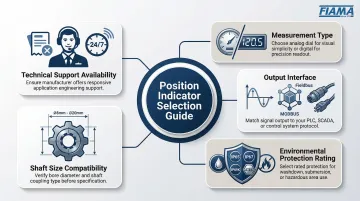
- Measurement type: Mechanical (no power required, simple display) vs. electronic (digital readout, remote monitoring, data logging)
- Output interface: Analog (4-20mA, 0-10V), digital (SSI, BiSS), fieldbus (IO-Link, PROFINET, EtherNet/IP, CANopen)
- Environmental protection rating: IP65 for general industrial, IP67 for temporary immersion, IP69K for high-pressure washdown, ATEX/IECEx for explosive atmospheres
- Shaft size compatibility: Ensure bore diameter, keyway dimensions, and mounting interface match your machine configuration
- Technical support availability: Degreed engineers with application experience will identify specification mismatches that a catalog search or commissioned salesperson will miss
Short lead times and local inventory availability are underrated decision factors. In MRO (maintenance, repair, operations) scenarios, unplanned downtime averages $125,000 per hour — a wrong specification that delays the line compounds fast. FIAMA US operates without quotas or commissions, so their engineering team's only priority is matching the right product to your application the first time.
Conclusion
The position indicator market spans broad-line sensor companies and focused specialists. The right choice depends on your application environment, required accuracy, integration needs, and environmental conditions—not brand name alone.
High-precision CNC applications demand nanometer-level optical encoders from Renishaw or Heidenhain. Hazardous area installations require ATEX/IECEx-certified sensors from Pepperl+Fuchs or TR Electronic. Hydraulic cylinder feedback benefits from Balluff's magnetostrictive technology, and packaging format adjustment systems integrate cleanly with SIKO's bus-connected electronic indicators.
Evaluate suppliers on more than product specs. Key factors include:
- Technical depth and application expertise
- Inventory availability and lead times
- Relevant certifications (ISO 9001, ATEX, IECEx)
- After-sale support quality
Engineering-staffed distributors consistently deliver better application matches and faster problem resolution than transactional parts suppliers.
For North American buyers seeking Italian-made, ISO 9001-certified position indicators, FIAMA US offers mechanical and electronic position indicators with short lead times—backed by a team of degreed engineers who aren't commissioned or quota-driven. Contact FIAMA US at 504-352-0986 or info@fiama-us.com to discuss your application needs.
Frequently Asked Questions
What is a position indicator used for in industrial applications?
Position indicators display the real-time position of machine components such as valve stems, lead screws, handwheels, or actuators. They enable operators to make precise adjustments and verify positioning without disassembly or external measurement tools, ensuring process accuracy and repeatability.
What is the difference between a mechanical and electronic position indicator?
Mechanical position indicators use gear-driven digit drums to display position without requiring power, making them well-suited for simple applications or areas without electrical access. Electronic models use encoders or sensors for digital readouts and support remote monitoring, data logging, and PLC or SCADA integration.
What certifications should I look for when selecting a position indicator manufacturer?
Prioritize ISO 9001 for quality management, IP65/IP67 or IP69K for environmental protection, CE marking for European compliance, and ATEX/IECEx for hazardous locations. Food processing environments may also require FDA-compliant materials.
How do I select the right position indicator for my machine?
Start with these criteria:
- Shaft interface: bore size, keyway, and mounting flange compatibility
- Measurement range: linear travel or rotary degrees required
- Resolution and accuracy needs for your process
- Environmental conditions: temperature, moisture, dust, and vibration
- Output type: passive mechanical display or digital with PLC connectivity
Which industries use position indicators most commonly?
Food & beverage, pharmaceutical, packaging, semiconductor, metalworking, automotive manufacturing, and robotics rely heavily on position indicators. Any industry using adjustable machinery, valve-controlled processes, or automated positioning systems typically depends on position indicators to maintain process accuracy and prevent costly errors.
Can position indicators be customized for specific machine configurations?
Yes. Common options include shaft adapter kits for non-standard bores, custom display ranges and units (mm, inches, degrees), IP-rated enclosures, and color-coded markings. Work with suppliers who offer engineering support to validate application-specific configurations.