

Introduction
Picking the wrong inclinometer doesn't just create a spec mismatch — it leads to costly downtime, failed recalibration cycles, or equipment failure at the worst possible moment. A misaligned sensor in a geotechnical monitoring system can miss critical slope movement until it's too late. An under-spec'd tilt sensor in a pharmaceutical filling line can trigger batch rejection and regulatory scrutiny.
The stakes are just as high on the performance end. Construction equipment needs stable angle feedback on uneven terrain. Robotic arms in semiconductor assembly demand sub-arc-minute positioning accuracy. Getting the sensor right matters across the board.
That challenge is compounded by a fragmented US market. Geotechnical specialists, broad-line industrial distributors, and MEMS sensor OEMs all compete for the same buyers — and procurement teams routinely struggle to distinguish between a $50 consumer-grade digital level and a $5,000 servo inclinometer, let alone identify which supplier actually understands their application versus one pushing generic catalog items.
The global tilt sensor market was valued at $262.7 million in 2024 and is projected to reach $489.7 million by 2030, growing at a CAGR of 11.1%. North America alone is forecast to expand from $96.47 million in 2024 to $236.55 million by 2033—driven by infrastructure renewal, automation adoption, and the integration of tilt feedback into autonomous vehicles and industrial robotics.
Key Takeaways
- Inclinometers measure angular tilt relative to gravity, serving construction, automation, aerospace, and geotechnical monitoring
- Suppliers span geotechnical specialists, MEMS OEMs, and industrial distributors across multiple sectors
- Key selection criteria: measurement range, output interface, IP/NEMA rating, certifications, and lead times
- All 10 companies were evaluated on product quality, certifications, technical support, and US availability
- FIAMA US (Luling, LA) offers Italian-made inclinometers with engineer-led support, short lead times, and competitive pricing
What Is an Inclinometer and Why It Matters for US Industry
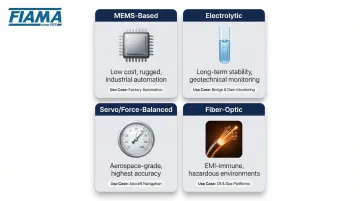
An inclinometer is an instrument that measures the angle of inclination or tilt relative to gravity. The four main types used across US industry are:
- MEMS-based sensors — low cost and rugged, widely used in industrial automation
- Electrolytic units — preferred for long-term geotechnical stability monitoring
- Servo (force-balanced) devices — aerospace-grade precision for demanding applications
- Fiber-optic systems — immune to electromagnetic interference in hazardous environments
For US industrial operations, inclinometers provide real-time tilt feedback across a wide range of applications: machine alignment, platform leveling, slope monitoring, vehicle stability control, and robotic arm positioning.
The stakes are concrete. A construction crane lacking accurate boom-angle feedback risks load imbalance. A geotechnical monitoring system that misses micro-movement in a dam abutment invites structural failure. In pharmaceutical manufacturing, platform leveling directly affects fill accuracy and regulatory compliance — and in semiconductor fab equipment, sub-arc-second tilt control determines yield.
Dozens of manufacturers operate in or serve the US market. The top 10 below are evaluated on five criteria: product precision, US market availability, application versatility, certifications, and customer support quality.
Top 10 Inclinometer Manufacturers in the US
These companies were selected based on product precision, US market availability, application versatility, industry certifications, and customer support reputation.
FIAMA US
FIAMA US is a Luling, Louisiana-based distributor of Italian-made precision industrial components serving food, pharmaceutical, semiconductor, automotive, and packaging sectors. The company's staff are degreed engineers, not commissioned salespeople, ensuring unbiased technical guidance.
ISO 9001-certified products, competitive pricing, short lead times, and focused product lines enable deep application expertise. The engineering team assists with output signal selection, mounting configuration, and PLC integration — with no sales quotas attached.
FIAMA's IM inclinometer series features solid-state sensors without moving parts, offering single-axis (±60° or 0-360°) and dual-axis (±60° on two perpendicular axes) configurations with 4-20mA or 0-10VDC analog outputs.
| Attribute | Details |
|---|---|
| Key Offerings | Tilt sensors and inclinometers for industrial automation, construction equipment, and robotic systems; IM series with single/dual-axis options |
| Certifications | ISO 9001 Quality Management System |
| Why It Stands Out | Engineer-staffed support, Italian-made quality, short lead times, competitive pricing, and customizable cable lengths for demanding US industrial applications |
Geokon Inc.
Geokon, headquartered in Lebanon, New Hampshire, is a long-established geotechnical instrumentation manufacturer known for high-precision sensors used in dam safety, slope monitoring, and underground construction.
The Model 6000 series borehole inclinometers and Model 6150 in-place inclinometer (IPI) systems offer ranges from ±30° to ±90° with high shock survival (up to 2000 g). Advanced data acquisition software, wireless-capable systems, a global service network, and decades of civil engineering field experience round out the offering. Geokon maintains ISO 9001:2015 certification and is widely specified in US Army Corps of Engineers projects.
| Attribute | Details |
|---|---|
| Primary Applications | Slope stability, dam safety assessment, underground excavation monitoring |
| Notable Feature | Real-time data acquisition with wireless communication options and vibrating wire technology |
| Market Presence | Long-standing US manufacturer with global distributor network and USACE project adoption |
Jewell Instruments
Jewell Instruments, based in Manchester, New Hampshire, manufactures high-precision inclinometers and tilt sensors for defense, aerospace, industrial, and OEM markets. The company's force-balanced (servo) inclinometers—including the LSO series—achieve resolution down to 1 microradian (0.1 arc second) with hysteresis below 0.0005% of full range.
Servo-based and MEMS inclinometers with sub-arc-second accuracy, rugged housings, and strong military/aerospace qualification credentials set Jewell apart. Products are designed to MIL-STD-810 and DO-160 standards, ensuring reliability under extreme temperature, shock, and vibration.
| Attribute | Details |
|---|---|
| Measurement Technology | Servo-accelerometer (force-balanced) and MEMS-based tilt sensing |
| Key Industries | Defense, aerospace, precision industrial, OEM |
| Notable Feature | Sub-arc-second resolution options for high-accuracy applications; MIL-STD-810 and DO-160 qualified |
The Fredericks Company
The Fredericks Company, located in Huntingdon Valley, Pennsylvania, specializes in electrolytic tilt sensors and inclinometers. Their proprietary TrueTilt™ sensor line includes the 0717 series (wide-range ±50° to ±60° with ±0.05° repeatability) and the 0703 series (high-precision ±3° with resolution ≤0.0003° or 1 arc second).
Electrolytic sensing technology delivers high stability and exceptionally low drift over time — a meaningful advantage in long-duration deployments. All-metal hermetically sealed construction handles extreme environments, and the company holds ISO 9001:2015 certification with ITAR registration for regulated industries.
| Attribute | Details |
|---|---|
| Sensing Technology | Electrolytic tilt sensing for high-stability, low-drift measurement |
| Key Markets | Scientific instruments, medical equipment, precision industrial machinery |
| Notable Feature | Long operational lifespan, minimal temperature drift, and hermetically sealed metal construction |
Applied Geomechanics Inc. (AGI)
Applied Geomechanics Inc., based in Santa Cruz, California (now part of Jewell Instruments but maintained as a distinct product line), specializes in ultra-high-precision electrolytic tiltmeters for geotechnical and geophysical applications. The 700 Series platform and surface mount tiltmeters resolve angles smaller than 0.1 microradian (0.02 arc second), with long-term stability measured in microradians.
What sets AGI apart is its full-service monitoring model — sensors come paired with data collection, geotechnical analysis, and on-site engineering consultation. These sensors are deployed in dams, volcanoes, particle accelerators, and other applications that demand geodetic-level precision over extended periods.
| Attribute | Details |
|---|---|
| Primary Applications | Slope failure detection, retaining wall performance, foundation settlement, volcanic monitoring |
| Notable Feature | Long-term micro-movement detection with resolution below 0.1 microradian; geotechnical reporting services |
| Support Model | Full-service monitoring with on-site engineering consultation and custom deployment |
TE Connectivity (Measurement Specialties)
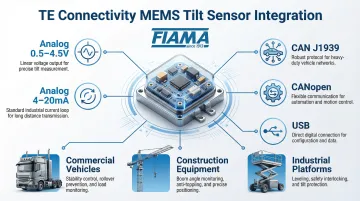
TE Connectivity, through its Measurement Specialties division with US operations in Berwyn, Pennsylvania, offers a broad range of MEMS-based tilt sensors for industrial, automotive, and OEM markets. The AXISENSE series features next-generation tilt sensors with gyroscope compensation for dynamic stability, while the DOG2 series provides dual-axis MEMS inclinometers for platform leveling.
Large-volume OEM supply capability and wide operating temperature ranges make TE a natural fit for high-production environments. Supported interfaces — analog (0.5-4.5V, 4-20mA), CAN J1939, CANopen, and USB — give integrators flexible connection options. The sensors are widely deployed in heavy-duty vehicles, construction equipment, and crane safety systems.
| Attribute | Details |
|---|---|
| Sensing Technology | MEMS-based inertial tilt sensing with optional gyroscope compensation |
| Key Markets | Automotive, industrial OEM, heavy-duty vehicles, construction equipment |
| Output Options | Analog (0.5-4.5V, 4-20mA), CAN J1939, CANopen, USB |
MTS Systems Corporation
MTS Systems, headquartered in Eden Prairie, Minnesota, is a US manufacturer of precision sensors and testing systems. While primarily focused on materials testing and structural monitoring, MTS integrates inclinometers into larger data acquisition and test system ecosystems. The company offers auxiliary tilt sensors such as the MTS Tilt Switch for bulk material level detection.
MTS's strength lies in system-level integration — tilt sensing paired directly with full test and measurement platforms rather than standalone sensor deployments. ISO 9001 certification and ISO 17025 accredited calibration services provide full traceability for both laboratory and field use.
| Attribute | Details |
|---|---|
| Primary Use Cases | Structural testing, materials analysis, industrial automation, bulk material monitoring |
| Notable Feature | Integration with full test and measurement system ecosystems |
| Certifications | ISO 9001, ISO 17025 accredited calibration services |
Parker LORD (Sensing Systems)
Parker LORD, operating through its MicroStrain division in Williston, Vermont, provides MEMS-based inertial sensing solutions for industrial robotics, unmanned vehicles, and antenna pointing systems.
The FAS-A inclinometer offers static/quasi-dynamic measurement with ±70° dual-axis range. The 3DM-GX5 and CV5 series industrial IMUs add dedicated tilt and vertical reference outputs for more demanding dynamic applications. Robust construction for high-vibration environments and output interfaces spanning RS-232, USB, and analog (0-5V) give integrators broad flexibility.
| Attribute | Details |
|---|---|
| Sensing Technology | MEMS inertial sensors with tilt and orientation output; IMU integration |
| Key Markets | Industrial robotics, autonomous vehicles, unmanned systems, antenna stabilization |
| Notable Feature | Designed for high-vibration, dynamic operating environments with robust shock tolerance |
Slope Indicator / Durham Geo
Slope Indicator, now consolidated under Durham Geo Slope Indicator (DGSI), has long set the standard for borehole and in-place inclinometers for geotechnical and structural monitoring. The Digitilt AT System provides portable borehole inclinometer capability with Bluetooth cable reels, while the Serial HD In-Place Inclinometers (IPI) offer MEMS-based sensors for real-time monitoring with ±10° range and 9 arc-second resolution.
DGSI systems are widely adopted across US civil engineering projects — in-place inclinometer arrays enable continuous automated monitoring for landslide, embankment, and deep excavation applications. They are frequently specified for infrastructure projects requiring long-term structural health monitoring.
| Attribute | Details |
|---|---|
| Product Type | Borehole and in-place inclinometer systems (MEMS and servo-accelerometer) |
| Primary Applications | Landslide monitoring, embankment safety, civil infrastructure, deep excavation |
| Notable Feature | Industry-standard borehole inclinometer systems widely used in US geotechnical practice |
Crossbow Technology / Moog Inertial (US)
Now part of Moog Inc.'s inertial division in East Aurora, New York (acquired in 2011), Crossbow Technology develops MEMS-based tilt and inertial sensors for defense, unmanned systems, and precision navigation. The IMU400 series provides high-performance MEMS IMU capability with compensated angular rate and acceleration outputs suited for harsh environments.
High-performance MEMS IMUs with tilt output, radiation-hardened variants, and proven integration in unmanned platforms distinguish Crossbow/Moog from commercial-grade alternatives. Select models meet military vibration and shock standards, covering aerospace, marine dynamics, and defense applications where failure isn't an option.
| Attribute | Details |
|---|---|
| Sensing Technology | MEMS IMU with tilt and orientation output; compensated angular rate measurement |
| Key Markets | Defense, unmanned systems, precision navigation, aerospace |
| Notable Feature | Military-grade and ruggedized options for extreme operating conditions; radiation-hardened variants available |
How We Chose the Best Inclinometer Manufacturers in the US
Companies were assessed on five core criteria: product precision and measurement range (from ±3° high-resolution units to full 0-360° rotation sensors), US market availability and lead times (domestic manufacturing vs. import distribution), industry certifications (ISO 9001, MIL-STD-810, DO-160, NIST traceability), application breadth (geotechnical vs. industrial automation vs. aerospace), and quality of technical support (engineer-led guidance vs. generic catalog sales).
A common procurement mistake is selecting based on brand recognition alone without verifying whether a supplier has deep experience in your specific application. A geotechnical inclinometer optimized for long-term zero-drift stability in static monitoring will perform poorly in a high-vibration robotic environment. Electrolytic sensors excel in dam monitoring but are inappropriate for dynamic vehicle stability control; MEMS sensors dominate mobile equipment but lack the resolution for geodetic micro-movement detection.
Beyond sensor technology, buyers should weigh several practical factors before selecting a supplier:
- Output interface compatibility with existing PLC or SCADA systems (CAN J1939 vs. CANopen vs. analog 4-20mA)
- IP/NEMA protection rating matched to the operating environment (IP54 for indoor vs. IP67 for outdoor/washdown)
- Calibration and recalibration support (on-site vs. return-to-factory)
- Engineer-led application guidance rather than transactional catalog support
For industrial applications across manufacturing, food processing, robotics, and packaging, practical factors often matter as much as raw sensor specifications. Short lead times, competitive pricing, and non-commissioned engineering support — the kind FIAMA US provides — can determine whether a project stays on schedule. A technically superior sensor that ships in 16 weeks with no integration support can stall a project just as effectively as the wrong device for the job.

Conclusion
Choosing the right inclinometer supplier comes down to more than spec sheets. You need a partner who understands your application environment, offers reliable lead times, and provides engineering support when integration challenges arise. A MEMS sensor with ±0.01° accuracy means nothing if the vendor can't help you select the correct mounting orientation or troubleshoot a noisy 4-20mA signal in a high-EMI environment.
Before committing, evaluate each supplier against the questions that matter most:
- Can they support volume growth if your pilot project scales?
- What does ongoing calibration look like—return-to-factory or on-site service?
- What's the true total cost of ownership when you factor in lead times, support hours, and integration downtime?
For US buyers seeking precision inclinometers backed by ISO 9001-certified Italian manufacturing, support from degreed engineers with no sales quotas, and competitive pricing with short lead times, FIAMA US is worth contacting directly at their Luling, LA office: 504-352-0986 or info@fiama-us.com.
Frequently Asked Questions
Are clinometer and inclinometer the same?
While the terms are sometimes used interchangeably, a clinometer typically refers to a manual surveying tool used to measure elevation angles in field work, whereas an inclinometer (or tilt sensor) is more broadly used in industrial and engineering contexts for continuous or electronic tilt measurement with calibrated outputs suitable for data logging and control systems.
What is the inclinometer GIM120?
The GIM 120 is a **Bosch Professional digital inclinometer** designed for construction layout and carpentry. It offers 0-360° measurement range with ±0.05° accuracy at 0°/90° and ±0.2° accuracy at 1-89°, IP54 protection rating, and is intended for trade-grade alignment tasks—not high-precision industrial monitoring.
What is an inclinometer used for?
Inclinometers measure tilt or angular inclination across a wide range of applications:
- Construction machinery boom angle monitoring and crane safety
- Geotechnical slope monitoring for landslide detection
- Vehicle stability systems and rollover prevention
- Robotic arm positioning and industrial platform leveling
- Aerospace attitude sensing for flight control systems
What is the difference between a tilt sensor and an inclinometer?
Tilt sensor and inclinometer are largely synonymous terms. "Tilt sensor" is more common in electronics and OEM contexts, while "inclinometer" is more common in civil, geotechnical, and heavy industrial applications. Both measure angular deviation from a gravitational reference plane.
How do I choose the right inclinometer for my application?
Start with these key decision factors:
- Measurement range and accuracy: ±3° high-precision vs. ±90° wide-range
- Single-axis vs. dual-axis capability
- Output interface: analog (4-20mA/0-10V), RS-232/485, CAN, or I²C
- Environmental rating: IP67/IP68 for outdoor or washdown use
- Supplier's application engineering support for proper integration
What industries in the US use inclinometers the most?
The heaviest users span several sectors:
- Construction and civil engineering: crane safety, excavation monitoring
- Oil and gas: drilling angle control
- Geotechnical monitoring: dam and slope stability
- Industrial automation and robotics: platform leveling, arm positioning
- Aerospace and defense: navigation and weapon stabilization
- Automotive and food/pharma manufacturing: vehicle stability control and fill-line leveling