
Introduction
Precision motion control is the backbone of modern industrial automation. Across robotics, CNC machining, packaging lines, and food processing systems, the ability to deliver high torque in compact spaces while maintaining positional accuracy determines production uptime and output quality. Planetary gear reducers are built for exactly these conditions — high torque density, consistent efficiency, and tight backlash control in servo-driven systems.
With dozens of manufacturers competing on specifications, certifications, and application expertise, choosing the right supplier directly impacts total cost of ownership and long-term reliability.
A misapplied unit doesn't just underperform — it fails. Premature bearing wear, servo hunting, and gear tooth fracture are common consequences of poor specification, not defective hardware.
This guide evaluates five planetary gear reducer manufacturers on engineering capability, product range, certifications, and real-world application fit — so you can identify a supplier who understands your system, not just the spec sheet.
Key Takeaways
- Planetary gear reducers combine high torque density, precision, and compact form—making them a practical fit for robotics, automation, food processing, and packaging
- Key selection criteria: gear ratio range, backlash rating (arcminutes), efficiency percentage, and torque capacity
- Verify ISO certifications and regional availability before committing to a supplier
- Manufacturers vary widely in application focus, pricing models, and the quality of technical support they actually provide
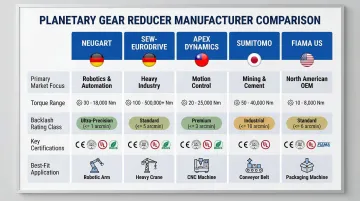
- This guide profiles Neugart, SEW-Eurodrive, Apex Dynamics, Sumitomo Drive Technologies, and FIAMA US
- Evaluate engineering support capabilities alongside product specifications to avoid costly misapplication
What Is a Planetary Gear Reducer and Why Does It Matter?
A planetary gear reducer consists of a central sun gear, multiple planet gears mounted on a carrier, and an outer ring gear. This coaxial configuration distributes load across multiple contact points simultaneously, achieving far higher torque output in a smaller footprint compared to parallel-shaft or worm gear alternatives.
Key performance advantages include:
- Single-stage units run at 95-98% efficiency — worm gear drives top out at 40-90%
- Precision models achieve sub-1 arcminute backlash, critical for servo-driven CNC and robotic positioning
- Coaxial load sharing delivers more torque per cubic inch than parallel-shaft or worm designs
- Low inertia mismatch and high torsional rigidity handle demanding acceleration profiles without degrading response
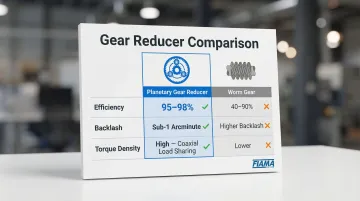
That combination of efficiency, precision, and compact torque density is why robotics, pharmaceutical manufacturing, semiconductor handling, and food & beverage packaging lines lean on planetary designs instead of helical or worm alternatives.
The global precision gearbox market was valued at $2.97 billion in 2023 and is projected to reach $5.72 billion by 2030, growing at a 9.9% CAGR. As automation adoption accelerates, choosing a manufacturer with real application engineering — not just a catalog — determines whether your integration goes smoothly or stalls at commissioning.
Top Planetary Gear Reducer Manufacturers
These five manufacturers were selected based on engineering capability, product diversity, certifications, application range, and market reputation—not brand size or marketing spend.
Each entry covers key differentiators, product lines, torque ranges, and certifications to help you compare options for your application.
Neugart GmbH
Neugart, headquartered in Kippenheim, Germany, specializes in precision gearboxes for servo and stepper motor applications across automation and robotics. The company's focus on ultra-low backlash and application-specific designs (such as the HLAE series with IP69K hygienic certification for food/pharma) sets it apart in high-precision markets.
- Precision lines (PLN, PSN) offer standard backlash of 1–5 arcminutes, with reduced options below 1 arcminute
- Application-specific models like the NGV series optimize AGV wheel drive performance
- Gear ratio coverage spans 3:1 to 512:1 across economy and precision lines
| Category | Details |
|---|---|
| Key Product Lines | Precision Line (PSN, PLN, PSFN, PLFN, WGN); Economy Line (PLE, PLQE, PLPE, PLHE, PLFE); Application-Specific (HLAE for food/pharma, NGV for AGV drives) |
| Torque & Gear Ratio Range | PLE series: 5–800 Nm, ratios 3:1 to 512:1; PLN precision series: 27–1800 Nm |
| Certifications & Standards | ISO 9001:2015, ISO 14001:2015 |
SEW-Eurodrive
SEW-Eurodrive, based in Bruchsal, Germany, operates a large global infrastructure with 18 production plants and 92 assembly facilities across 57 countries. Its modular MOVI-C automation platform integrates planetary servo gear units (PS.F series) with frequency inverters and decentralized drive controllers, making it a widely deployed solution in heavy industry and materials handling.
- PS.F series offers ATEX compliance for explosive atmospheres, covering hazardous environment applications
- Torque range extends from compact 25 Nm servo units to industrial P series handling up to 631 kNm
- An extensive global service network supports local availability and faster response times
| Category | Details |
|---|---|
| Key Product Lines | PS.F (low-backlash planetary servo), PS.C (compact planetary servo), P series (industrial planetary), P-X.e (planetary with bevel-helical primary) |
| Torque & Gear Ratio Range | PS.F: 25–3000 Nm, ratios 3–100; P series: 25–631 kNm, ratios 100–4000 |
| Certifications & Standards | ISO 9001:2015, ATEX compliance (PS.F series) |
Apex Dynamics
Taiwan-based Apex Dynamics has built a reputation for cost-competitive, high-precision planetary gearboxes widely adopted in CNC, robotics, and automation markets across North America and Asia. The company positions itself as a credible alternative to European manufacturers, offering comparable precision at lower price points.
- AP series achieves ≤1 arcminute backlash across 1-, 2-, and 3-stage configurations, on par with European precision standards
- 5-year warranty on select models reflects confidence in product durability
- AE/AER stainless steel series covers washdown environments in food and pharmaceutical applications
| Category | Details |
|---|---|
| Key Product Lines | AP/APK/APC/APCK (high torque/precision), AE/AER (stainless steel), New Generation P-Series (PE, PG, PA, PS, PN, PD, PL) |
| Torque & Gear Ratio Range | AP series: up to 13,875 Nm, ratios 5.5–220; AE series: 14–2000 Nm, ratios 3–100 |
| Certifications & Standards | ISO 9001, ISO 14001, ISO 45001 |
Sumitomo Drive Technologies
Sumitomo Drive Technologies, rooted in Sumitomo Heavy Industries' Japanese engineering heritage, serves heavy manufacturing, mining, and material handling markets with both planetary and cycloidal drive solutions. The company's North American manufacturing presence in Chesapeake, VA, supports localized service and shorter lead times.
- IB Series planetary units (P1, P2, PK1 types) offer precision backlash below 3 arcminutes for servo applications
- Cyclo drives use a cycloidal cam design suited for extreme shock-load environments
- Strong track record in harsh-environment applications including mining and heavy industry
| Category | Details |
|---|---|
| Key Product Lines | IB Series (P1, P2, PK1 types for planetary servo applications); Cyclo drives (cycloidal design for shock loads) |
| Torque & Gear Ratio Range | IB Series P1: 22.5–153 Nm, ratios 3.7–81; IB Series P2: 500–1500 Nm, ratios 4–100 |
| Certifications & Standards | ISO 9001:2015 |
FIAMA US
FIAMA US, the North American distributor of Italian-made industrial components from F.I.A.M.A. S.r.l. (Parma, Italy), serves food & beverage, pharmaceutical, packaging, semiconductor, and robotics applications. The team is staffed by degreed engineers operating without sales quotas or commissions, carrying a focused product line to maintain technical accuracy in specifications.
- Italian manufacturing quality with competitive North American pricing and short lead times
- RDE40 coaxial planetary series handles up to 20 Nm with reduction ratios up to 250:1
- Engineers handle specifications directly, prioritizing application fit over order volume
| Category | Details |
|---|---|
| Key Product Lines | RDE40 (coaxial planetary), RDE405 (right-angle planetary), RDE40-FLOP (displayed planetary with integrated position indicators) |
| Torque & Gear Ratio Range | RDE40 series: up to 20 Nm output torque, reduction ratios up to 250:1 |
| Certifications & Standards | UNI EN ISO 9001:2015 |
How We Chose the Best Planetary Gear Reducer Manufacturers
Manufacturers were evaluated on engineering capability, product range (gear ratios, torque ratings, backlash classes), ISO or industry certifications, application versatility, regional availability, and quality of technical support—not marketing spend or brand recognition.
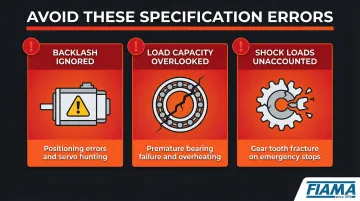
Common buyer mistake: Selecting a planetary gear reducer purely on price or brand name without verifying application fit. For example:
- Ignoring backlash tolerance in servo-driven precision tasks leads to positioning errors and servo "hunting" during direction changes
- Overlooking radial/axial load capacity results in premature bearing failure and overheating
- Failing to account for intermittent shock loads (emergency stops, rapid acceleration) causes gear tooth fracture
Excessive backlash causes servo systems to hunt for correct positions, degrading CNC and robotic arm accuracy. A properly specified unit with sub-3 arcminute backlash prevents these failures in interpolating axes, while standard 10-15 arcminute units suffice for simple conveyors.
Getting the specification right from the start is what separates a reliable supplier from a catalog vendor. Look for suppliers who ask about your load profile, duty cycle, and environmental conditions before quoting, not after a failure occurs. That kind of application-first approach is what this evaluation prioritizes.
Conclusion
The right planetary gear reducer manufacturer aligns with your application's technical requirements—torque, precision, gear ratio, environmental conditions—AND provides engineering-level support throughout selection and integration. Getting the specs right upfront saves costly rework downstream.
Go beyond datasheets when evaluating suppliers. Look at lead times, certifications, inventory depth, and whether the technical team can engage at the application level—not just quote catalog numbers. Ask about sizing software, documented application case studies, and post-sale support depth.
FIAMA US supplies Italian-made planetary gear reducers with ISO 9001-certified quality, short lead times, and an extensive in-stock inventory. The team is staffed by degreed engineers who are non-commissioned—their job is to get your specification right, not to close a sale.
To discuss your planetary gear reducer requirements, contact FIAMA US directly:
- Email: info@fiama-us.com
- Phone: 504-352-0986
Frequently Asked Questions
What is a planetary gear reducer used for?
Planetary gear reducers reduce input speed while multiplying torque in compact, high-efficiency packages. Common applications include servo motor systems, robotics, conveyor drives, packaging machinery, and CNC equipment — anywhere torque density and compact footprint both matter.
How does a planetary gear reducer differ from a worm gear reducer?
Planetary gear reducers offer higher efficiency (95-98% vs. 40-90%), better torque density, and lower backlash compared to worm gear reducers. Worm gears provide self-locking capability and simpler construction but suffer from sliding friction losses, making planetaries preferable for servo and precision automation applications.
What gear ratio range is typical for planetary gear reducers?
Standard planetary gear reducers typically offer ratios from 3:1 to 100:1 in single-stage configurations. Multi-stage designs (stacking two or more gear sets) extend the range to 512:1 or higher.
What does backlash mean in a planetary gear reducer, and why does it matter?
Backlash is the angular play (measured in arcminutes) between meshing gears when direction reverses. Lower backlash is critical in precision servo and CNC applications where positioning accuracy matters — units under 1 arcminute prevent servo hunting and positioning errors on direction changes.
What efficiency can I expect from a planetary gear reducer?
High-quality single-stage planetary gearboxes typically achieve efficiency ratings of 95-98%, making them among the most energy-efficient reducer types available. Multi-stage units remain in the 90-95% range, significantly outperforming worm gear alternatives.
How do I select the right planetary gear reducer for my application?
Start by defining output torque (continuous and peak), input speed, gear ratio, backlash tolerance, mounting configuration, and environmental conditions. From there, an application engineer can validate service factors and confirm radial/axial load ratings for your specific setup.