Introduction
Across robotics, packaging automation, food processing, and semiconductor fabrication, one component keeps showing up at the center of motion control decisions: the planetary gear reducer. These gearboxes deliver high torque density, compact footprint, and efficiency that conventional inline designs can't match at the same size and weight. Demand across North American manufacturing has grown steadily as automation systems push harder against the limits of older drivetrain technology.
With dozens of suppliers in the US market, the catalog specs often look similar. What separates them is harder to quantify: engineering support depth, domestic lead times, relevant certifications, and genuine application fit.
A supplier who ships a catalog part and one who walks through your application requirements are not interchangeable. That distinction frequently determines whether an automation project runs on schedule or gets stuck at the drivetrain selection stage.
Key Takeaways
- Planetary gear reducers deliver 94–98% efficiency and superior torque density, making them the top choice for precision industrial automation
- Both global OEM brands with US operations and specialized distributors serve this market — the latter typically offer shorter lead times and stronger engineering support
- Key selection criteria: torque capacity, gear ratios, backlash specs, ISO 9001 certification, and confirmed domestic availability
- This list covers 10 active US suppliers serving robotics, pharmaceutical, packaging, and industrial sectors
What Is a Planetary Gear Reducer and Why It Matters for US Industries
A planetary gear reducer uses an epicyclic arrangement: a central sun gear drives multiple planet gears (typically 3–5) that orbit around it while meshing with a stationary outer ring gear. Unlike parallel shaft designs that concentrate load on a single mesh, this configuration distributes torque across multiple contact points simultaneously.
That load-sharing geometry is what gives planetary reducers their power density advantage—more output torque from a smaller, lighter package.
Key performance advantages include:
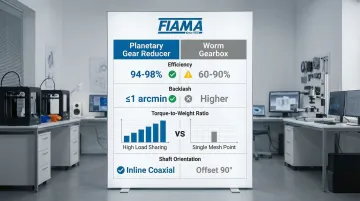
- 94–98% efficiency per stage, compared to 60–90% for worm gearboxes
- Higher torque-to-weight ratios through load sharing across all planet gears
- Precision units reach ≤1 arcmin backlash for CNC and robotic applications
- Inline (coaxial) input/output shafts simplify machine integration
US manufacturers in automation-intensive sectors favor planetary configurations for two practical reasons: lower energy costs in 24/7 operations and a compact footprint that preserves floor space in high-density production environments.
The North American industrial gearbox market is projected to grow from $48.9 billion in 2025 to $60.2 billion by 2030, expanding at 4.25% CAGR. Within the precision gearbox segment specifically, planetary designs commanded 66.5% market share in 2023, driven by robotics adoption and factory automation investments.
Top 10 Planetary Gear Reducer Manufacturers in the US
These companies were selected based on verified US operations, product range breadth, ISO 9001 or equivalent certifications, engineering support capabilities, and documented performance across multiple industrial sectors.
SEW-EURODRIVE
SEW-EURODRIVE operates extensive US manufacturing from its Lyman, South Carolina campus, bringing decades of North American market presence. Their planetary gear reducer lines include the PS.F and PS.C servo planetary series plus the industrial P Series, recently expanded with local assembly of P2.e planetary units in Wellford, SC—cutting lead times to as little as six weeks.
- Modular integration with SEW's electronic controls supports smart factory applications
- Extensive US service network with strong presence in automotive, food & beverage, and intralogistics
- PS.F series includes ATEX-compliant options for hazardous environments
- Integer ratio options (3:1, 4:1, 5:1, 10:1) eliminate rounding errors in digital servo control
Sumitomo Drive Technologies
Headquartered in Chesapeake, Virginia, Sumitomo's US division offers the Cyclo and Paramax series alongside their Compower planetary gearmotors. The brand has built a reputation for high-torque, long-life precision reducers in heavy industrial applications.
- Exceptional torsional rigidity suits mining, material handling, and food processing where shock loads are common
- US-based application engineering support available for complex specifications
- Customization extends to large-torque configurations beyond standard catalog offerings
NORD Drivesystems
NORD's Waunakee, Wisconsin operations focus on compact, hygienic-design gear units. Their NORDBLOC.1 helical inline and UNICASE planetary housing designs serve food & beverage, warehousing, and conveyor applications throughout North America.
- Single-piece UNICASE housings ensure precise bearing alignment and leak protection in washdown environments
- Corrosion-resistant surface treatments standard across hygienic-design units
- Seamless VFD integration and a strong US distribution network support fast MRO availability
Bonfiglioli
Bonfiglioli maintains strong US market presence through their sales network and Kentucky distribution center, offering precision planetary series including the 300P and 600P lines. These units serve agriculture, construction, industrial automation, and renewable energy sectors.
- Global manufacturing scale backed by Kentucky distribution for responsive US delivery
- 300 Series rated up to 1,100,000 Nm for severe-duty mobile machinery
- Modular planetary stages support broad customization across application types
Nidec-Shimpo
Founded in Japan in 1952, Nidec-Shimpo maintains established US distribution and service presence. Their precision planetary gearboxes—VRB, VRL, and VRSF series—are engineered specifically for servo motor integration.
- High precision and low-backlash performance target robotics, machine tools, and semiconductor equipment
- VRSF series offers value-engineered options for servo and stepper applications
- Cross-industry experience spanning ceramics to aerospace, with North American distribution for reasonable lead times
Bosch Rexroth
Bosch Rexroth's US operations support their planetary gearbox lineup, including GTE and GTM series units designed for integration with Rexroth servo drive and motion control ecosystems widely deployed in American manufacturing.
- Seamless IndraDrive servo system integration enables complete motion solutions from a single supplier
- Condition monitoring compatibility supports predictive maintenance strategies
- Robust engineering documentation and proven performance in high-dynamic positioning applications reduce integration engineering time
Flender (Siemens)
As a Siemens subsidiary, Flender brings significant US industrial presence with planetary gear units engineered for wind energy, mining, cement, and heavy process industries across North America.
- Proprietary surface coatings extend service life in extreme-duty environments
- Compatible with Siemens MindSphere IIoT for digital twin and predictive maintenance capabilities
- Global aftermarket parts infrastructure backed by US service centers
Wittenstein Alpha
Positioned as a premium German-engineered brand with US distribution from Bartlett, Illinois, Wittenstein Alpha planetary gearboxes deliver ultra-low backlash as low as 1 arcmin and exceptional torsional stiffness for demanding servo applications.
- TP+, SP+, and LP+ series cover robotics, laser cutting, and CNC machining where positioning accuracy is critical
- Long-life synthetic lubrication reduces maintenance intervals
- US technical sales team provides engineering-level specification support
Regal Rexnord
Headquartered in Milwaukee, Wisconsin, Regal Rexnord stands as one of the largest domestically-rooted power transmission manufacturers. Their Thomas and Dodge planetary reducer lines serve industrial automation and material handling sectors.
- Deep US manufacturing roots support rapid domestic delivery and wide aftermarket parts availability
- Design focus on operational uptime in demanding North American plant environments
- Acquisition of Altra Industrial Motion expanded the consolidated portfolio across power transmission categories
FIAMA US
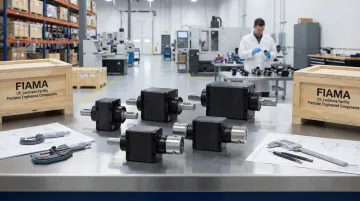
FIAMA US operates from Luling, Louisiana as the North American distributor of Italian-made precision industrial components, including planetary gear reducers. ISO 9001 certified since 2001, the company serves food & pharma, packaging, semiconductor, and robotics industries.
- Entire staff are degreed engineers—no commissioned salespeople—keeping guidance focused on application fit
- Focused product lines mean deep expertise on every component carried
- Italian-made quality at competitive price points suits cost-sensitive procurement
- Extensive North American inventory delivers short lead times for buyers who need both engineering depth and fast fulfillment
How We Chose the Best Manufacturers
Our evaluation framework prioritized US market accessibility through domestic inventory, distribution networks, or manufacturing operations. We verified that each supplier maintains product ranges covering standard torque and gear ratio requirements for industrial automation applications. Relevant certifications—particularly ISO 9001 quality management systems—confirmed consistent manufacturing processes. Finally, we required documented performance across at least two major US industrial sectors to ensure breadth of application experience.
Even with a solid shortlist, certain buying habits consistently lead to poor outcomes:
- Prioritizing brand recognition over engineering support quality
- Ignoring lead time realities when components ship from overseas
- Selecting suppliers with overly broad product lines where component-level expertise is diluted
Avoiding those mistakes is half the equation. The other half is knowing what to evaluate beyond the datasheet:
- Backlash specifications — critical for precision positioning applications
- Mounting compatibility — determines how complex integration will be
- Thermal ratings — sets the ceiling on your duty cycle
- Application engineering support — the quality of technical assistance, not just catalog depth, should drive your final decision for custom or high-cycle applications
Conclusion
The US planetary gear reducer market offers options at every tier—from global OEM brands with domestic infrastructure to specialist distributors providing deeper technical engagement and faster availability. North American robot orders grew 6.6% in 2025 to over 36,000 units, directly fueling demand for precision gear reduction components. As reshoring initiatives accelerate and automation adoption spreads beyond automotive into food processing and general manufacturing, supplier selection has become a real competitive variable.
That context makes the supplier evaluation more consequential than it used to be. Look beyond the datasheet: assess actual engineering capability, stock availability, and fit with your application environment. Those factors often matter more than list price.
For buyers who value engineer-to-engineer consultation, competitive pricing on Italian-made precision components, and short North American lead times, FIAMA US is worth a direct conversation. Contact their team at info@fiama-us.com or 504-352-0986.
Frequently Asked Questions
What is a planetary gear reducer used for?
Planetary gear reducers provide torque multiplication and speed reduction across servo-driven automation, robotics, packaging lines, conveyors, and machine tools. They're the go-to choice when compact size, high efficiency, and low backlash are non-negotiable.
What is the difference between a planetary gear reducer and a worm gearbox?
Planetary reducers offer higher efficiency (94-98% vs. often below 90%), lower backlash, and superior torque density compared to worm gearboxes. While worm gearboxes cost less and provide self-locking capability, planetary designs are preferred for precision and high-duty-cycle applications.
What gear reduction ratios are typically available in planetary reducers?
Single-stage planetary reducers commonly offer ratios from 3:1 to 10:1, while multi-stage configurations can achieve 100:1 or higher. The number of stages affects both ratio range and cumulative backlash.
How do I select the right planetary gear reducer for my application?
Specify required output torque, input speed, gear ratio, backlash tolerance, mounting interface, and duty cycle. Make sure your supplier offers engineering support to validate the selection and avoid expensive errors.
What industries use planetary gear reducers most in the US?
Robotics and automation, food & beverage processing, pharmaceutical manufacturing, packaging equipment, semiconductor systems, material handling, and metalworking drive the majority of US planetary gear reducer demand.
What certifications should I look for in a planetary gear reducer supplier?
ISO 9001 is the baseline, confirming consistent manufacturing quality and process control. Depending on your application, you may also need food-grade material compliance or ATEX certification for hazardous environments.