Introduction
Actuators convert electrical, hydraulic, or pneumatic energy into controlled mechanical motion — and nearly every automated system depends on them. They appear across food processing, pharmaceutical production, semiconductor fabrication, and automotive assembly lines, where precision and reliability directly affect output quality and uptime.
Demand is growing fast. The global actuators market is projected to climb from $71.22 billion in 2025 to $100.41 billion by 2030 — a 7.1% CAGR. In the US alone, the market was valued at $6 billion in 2025 and is forecast to grow at 4.9% CAGR through 2035.
With dozens of suppliers competing on specs, lead times, and support quality, choosing the right manufacturer isn't straightforward. The wrong choice can mean mismatched performance, long procurement delays, or inadequate technical backup when it matters most.
This guide profiles the top actuator manufacturers and companies operating in the USA, examines what sets each apart, and outlines what to look for before committing to a supplier.
Key Takeaways
- Actuators convert energy into controlled mechanical motion—essential in virtually every automated industrial system
- The US market spans legacy conglomerates and specialized engineering firms, each strong in different application areas
- Key selection criteria: actuator type, load/speed specs, certifications, industry fit, and engineering support depth
- Brand reputation is a starting point; operational fit, lead time, and post-sale technical support often determine the better choice
Overview of Actuators in the US Industrial Market
An actuator is a device that converts energy into mechanical motion to enable precision positioning, flow control, and safety shutoffs across automated systems. Across US manufacturing and process industries, actuators are foundational to everything from valve control in chemical plants to robotic assembly in electronics manufacturing.
Three Primary Actuator Technologies Dominate the US Market:
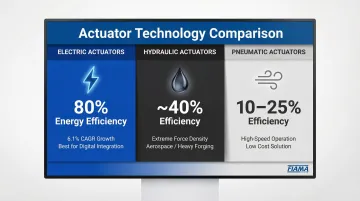
- Electric actuators: The fastest-growing segment (6.1% CAGR through 2030), driven by 80% energy efficiency, superior digital integration, and precise motion profiling capabilities
- Hydraulic actuators: Dominant in high-force applications like aerospace and heavy forging, offering extreme force density despite lower efficiency (around 40%)
- Pneumatic actuators: Widely used for cost-effective, high-speed tasks, though their 10-25% efficiency creates higher total cost of ownership over time
The industry is trending toward electrification and IIoT-enabled "smart actuators" that function as edge-computing nodes, using protocols like IO-Link (growing at 19.2% CAGR) and HART (40+ million installed devices) to enable predictive maintenance.
Top Actuator Manufacturers and Companies in the USA
These companies were evaluated on actuator portfolio breadth, US manufacturing or distribution footprint, industry certifications, and demonstrated performance in demanding applications.
Parker Hannifin Corporation
With fiscal 2025 net sales of $19.85 billion and a #215 Fortune 500 ranking, Parker Hannifin — based in Cleveland, Ohio — runs one of the broadest actuator portfolios in the industry, spanning electric, hydraulic, and pneumatic technologies.
Key Differentiators:
- Components used on virtually every major commercial and military aircraft, making Parker a default supplier across defense and aerospace programs
- ETH High Force Electro Thrust Cylinders and HLR rodless actuators deliver industrial-grade electromechanical performance for heavy-duty applications
- Asset Administration Shell (AAS) generates machine-readable digital twins for over 100 million serial numbers, enabling predictive maintenance and IIoT integration at scale
| Attribute | Details |
|---|---|
| Key Actuator Types | Electric (ETH series), Hydraulic, Pneumatic |
| Key Industries Served | Aerospace, Defense, Semiconductor, Industrial Automation, Energy |
| Notable Certifications | ISO 9001:2015, MIL-SPEC compliance |
Emerson Electric Co.
Emerson's process automation portfolio runs through two key brands: Fisher for valve actuators and Aventics for pneumatic and electric actuators. Based in St. Louis, Missouri, the company holds deep roots in oil & gas, chemical processing, and water/wastewater industries.
Key Differentiators:
- Fisher FIELDVUE DVC6200 digital valve controllers use linkage-less, non-contact feedback with 4-20 mA HART 5/7 and WirelessHART connectivity via the 775 THUM adapter
- The DVC6200 SIS Digital Valve Controller carries exida certification for IEC 61508 SIL 3, covering systematic integrity requirements for safety-critical process environments
- Plantweb digital ecosystem converts valve controllers into IIoT edge devices, generating real-time health indexes and predictive repair urgencies from live operational data
| Attribute | Details |
|---|---|
| Key Actuator Types | Smart valve actuators (Fisher), pneumatic & electric rodless (Aventics) |
| Key Industries Served | Oil & Gas, Chemical Processing, Water/Wastewater, Power Generation |
| Notable Certifications | IEC 61508 (SIL 3), API 607/6FA fire-safe, ISO 9001 |
Rockwell Automation
Rockwell Automation's $8.34 billion in 2025 revenue reflects a global footprint spanning 100+ countries. The Milwaukee, Wisconsin-based company delivers linear actuators and electric cylinders through its Intelligent Devices segment — all tightly integrated with the Allen-Bradley control platform.
Key Differentiators:
- Kinetix VPAR and MPAR Electric Cylinders drop in as direct replacements for pneumatic systems, integrating natively with Allen-Bradley Logix 5000 controllers (ControlLogix, CompactLogix) and Kinetix servo drives via EtherNet/IP and Sercos
- Actuators connect natively with Rockwell's PLCs, drives, and MES software — reducing integration complexity across the automation stack
- Particularly strong in automotive and electronics assembly, where synchronized multi-axis motion and rapid format changes demand tight platform cohesion
| Attribute | Details |
|---|---|
| Key Actuator Types | Linear actuators, electric cylinders (Kinetix VPAR/MPAR), motion control systems |
| Key Industries Served | Automotive Manufacturing, Electronics Assembly, Food & Beverage, Packaging |
| Notable Certifications | CE Mark, cUL Listed, UL Listed |
Thomson Industries (a Regal Rexnord Company)
Founded in 1936, Thomson Industries brings over 90 years of linear motion engineering to its current role within Regal Rexnord following the 2023 merger. Headquartered in Downers Grove, Illinois, the company specializes in electric linear actuators, rodless systems, and ball screw assemblies.
Key Differentiators:
- Electrak HD series includes the onboard EMCS controller with CANopen and SAE J1939 CAN bus options, rated IP69K (static), IP67 (static), and IP66 (dynamic) for extreme washdown environments
- PC-Series rodless actuators achieve ±0.01 mm repeatability — a spec that suits medical equipment and semiconductor applications where positional accuracy is non-negotiable
- Regal Rexnord's quality standards back tight tolerances and lifecycle reliability, with products validated through 500-hour salt spray testing
| Attribute | Details |
|---|---|
| Key Actuator Types | Electric linear actuators (Electrak HD), rodless actuators (PC-Series), ball screw systems |
| Key Industries Served | Medical Equipment, Renewable Energy, Defense, AGVs |
| Notable Certifications | CE, RoHS, REACH compliant; 500-hour salt spray tested |
Tolomatic, Inc.
Since 1954, Tolomatic has built its reputation around high-force electric actuation designed for environments where hydraulics create contamination risks and pneumatics lack precision. Employee-owned and headquartered in Hamel, Minnesota, the company remains one of the few US specialists focused exclusively on demanding electric actuation.
Key Differentiators:
- RSX extreme force series reaches up to 66,000 lbf (294 kN), eliminating hydraulic fluid leak risks while enabling programmable motion profiling for metal stamping and tire manufacturing
- ERD series delivers up to 7,900 lbf (35 kN) with IP67 and IP69K hygienic stainless-steel construction for washdown-intensive environments
- B3W belt-driven actuators extend to stroke lengths up to 14.5 meters (574 inches), handling large-scale gantry and transfer automation
- IMA (Integrated Motor Actuator) embeds the servo motor directly into the actuator body — IP65-rated, compact, and free of coupling alignment issues
| Attribute | Details |
|---|---|
| Key Actuator Types | High-force electric cylinders (ERD/RSX series), belt-driven rodless (B3W), IMA systems |
| Key Industries Served | Metal Stamping, Tire Manufacturing, Aerospace Assembly, Packaging |
| Notable Certifications | ISO 9001, UL Recognized components, CE, ATEX/IECEx, IP67/IP69K |
FIAMA US
Actuators only perform as well as the feedback systems measuring their position. FIAMA US — headquartered in Luling, Louisiana and backed by Italian manufacturing expertise (ISO 9001 certified) — fills that gap as a specialized distributor of precision encoders, transducers, and position sensors that make actuator-driven automation accurate and repeatable. The company serves applications spanning food and pharma to semiconductor and packaging.
Key Differentiators:
- Staff comprised of degreed engineers working without commissions or quotas — buyers get the right component for their application, not the highest-margin option
- Italian-made products selected through comparative testing for quality and price competitiveness, with US-accessible inventory built for short lead times
- Specializes in position indicators, draw wire encoders, and MODBUS RTU linear displacement transducers — the measurement layer that pairs directly with actuator-driven automation systems
| Attribute | Details |
|---|---|
| Key Product Focus | Position sensors, encoders, measurement transducers for motion/actuator systems |
| Key Industries Served | Food & Beverage, Pharmaceutical, Semiconductor, Packaging, Robotics, Metalworking |
| Notable Differentiators | ISO 9001 certified, engineer-staffed support, Italian manufacturing, no sales quotas |
How We Chose the Best Actuator Manufacturers
Selecting a manufacturer by brand name alone is one of the most common mistakes buyers make. Large brand recognition does not always translate to the right technology fit, competitive pricing, or responsive support for your specific application.
Core Selection Factors Used:
Actuator Type and Technology Portfolio
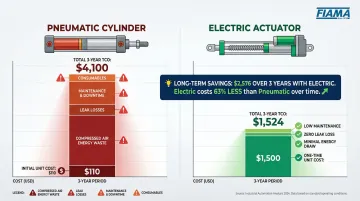
Electric actuators operate at approximately 80% efficiency compared to 10-25% for pneumatic systems. The upfront price difference can be misleading — the real cost shows up over time:
| Pneumatic Cylinder | Electric Actuator | |
|---|---|---|
| Initial Purchase Price | ~$110 | ~$1,500 |
| 3-Year Total Cost of Ownership | ~$4,100 | ~$1,524 |
Compressed air inefficiencies and leak losses drive pneumatic TCO well beyond the sticker price. Evaluating actuators on purchase price alone produces systematically bad procurement decisions.
Depth of US Operations and Lead Time Reliability
Supply chain disruptions have made domestic inventory and responsive fulfillment critical. Manufacturers with US-based distribution centers and on-call engineering support can typically quote confirmed lead times — not estimates — which matters when an unplanned downtime event is costing you by the hour.
Industry-Specific Certifications
Using under-certified equipment in hazardous or sanitary environments risks equipment failure, liability, or rejected audits. Key certifications include:
- ISO 9001: Quality management baseline for tier-1 industrial procurement
- IP67/IP69K: For washdown and wet environments (food & beverage, heavy mobile equipment)
- ATEX/IECEx: For equipment in potentially explosive atmospheres (oil & gas, chemical processing, mining)
- IEC 61508 (SIL 2/SIL 3): For safety-critical applications like emergency shutdown systems
- 3-A Sanitary Standards: For hygienic equipment in dairy, food processing, and pharmaceuticals
Quality of Engineering and Technical Support
For specialized applications — precision positioning, feedback integration, hygienic environments — a focused, engineering-driven supplier consistently outperforms a general-purpose catalog vendor. The difference is specificity: a degreed engineer who has configured that actuator type for your industry will ask different questions than an order-taker working from a datasheet.
Conclusion
The US actuator market includes both industrial giants with global footprints and specialized engineering firms that excel in specific niches. The right choice depends entirely on application demands, not just company size or brand familiarity.
When evaluating suppliers, match them against your actual operational criteria:
- Duty cycle and load requirements
- Environmental rating (IP67, IP69K, ATEX)
- Control interface compatibility (CANopen, EtherNet/IP, MODBUS RTU)
- Lead time and inventory availability
- Access to genuine technical support
If your application requires position feedback devices or measurement systems alongside actuator-driven motion, FIAMA US supplies ISO 9001-certified, Italian-made components with short lead times across North America. Their team consists of degreed engineers — not commissioned salespeople — so the guidance you get is application-specific. Reach them at 504-352-0986 or info@fiama-us.com.
Frequently Asked Questions
Who makes the best actuators?
"Best" depends on application requirements. Parker Hannifin and Emerson lead in heavy industrial and process automation, Thomson and Tolomatic excel in precision electric actuation, while specialized firms like FIAMA US serve niche feedback and positioning needs. Buyers should match manufacturer strengths to their specific load, environment, and control requirements.
What are the three most common actuators?
Electric, hydraulic, and pneumatic actuators are the three most prevalent types. Electric actuators deliver precision with roughly 80% energy efficiency. Hydraulic actuators generate extreme force density for heavy-duty applications. Pneumatic actuators trade some efficiency for fast, low-cost motion in high-cycle environments.
What is the difference between a linear and rotary actuator?
Linear actuators convert energy into straight-line thrust across a defined stroke — used in valve positioning, clamping, and material handling. Rotary actuators convert energy into angular or continuous shaft rotation, making them common in indexing tables, valve automation, and conveyor drives.
What certifications should I look for when selecting an actuator manufacturer?
Match certifications to your operating environment:
- ISO 9001 — quality management baseline
- IP67/IP69K — washdown and wet environments
- ATEX/IECEx — explosive or hazardous atmospheres
- IEC 61508 (SIL 2/3) — safety-critical applications
- FDA/3A — food and pharmaceutical contact
Skipping this step is one of the most common causes of premature failures and compliance issues.
Are electric actuators replacing hydraulic actuators in US industry?
Yes, electrification is accelerating, driven by lower maintenance costs, better digital integration, and higher energy efficiency (80% vs. roughly 40% for hydraulics). Electric actuators now exceed 66,000 lbf, removing the need for hydraulic fluid in many applications. That said, hydraulics remain the preferred choice where extreme force density is non-negotiable — aerospace and heavy forging being the clearest examples.
How do I choose the right actuator for my application?
Work through these selection criteria in order:
- Force/torque and stroke length — your non-negotiable starting point
- Duty cycle — continuous vs. intermittent operation affects sizing
- Operating environment — IP rating, temperature range, chemical exposure
- Control interface — EtherNet/IP, CANopen, MODBUS, or analog
- Positioning accuracy — determines whether feedback devices are required
Confirm final specifications with an engineer before ordering; a mismatched actuator rarely fails quietly.